Yesterday, Vanta made a move worth paying attention to. The company announced it has been named to the 2026 CNBC Disruptor 50 list — and buried in the same press release was something more consequential for enterprise security teams: Vanta donated the Autonomous Action Runtime Management (AARM) specification to the Cloud Security Alliance (CSA).
Vanta describes AARM as "the first open specification defining how autonomous AI agents should be governed at runtime, establishing a shared industry standard for monitoring, controlling and auditing agent behavior as agentic AI moves into production environments."
This is a significant moment for the AI governance market. When a company with more than 16,000 customers publishes an open standard and hands it to a major industry body, the message is clear: runtime AI agent governance is a real enterprise problem, and the industry needs a common framework to talk about it.
But a specification is not enforcement. And that distinction matters more than most enterprise buyers realize.
What AARM Is — and What It Isn't
ARM specifications tell you what governed AI agents should look like. They give security teams a vocabulary. They give procurement a checklist. They give auditors a framework for evaluating vendor claims.
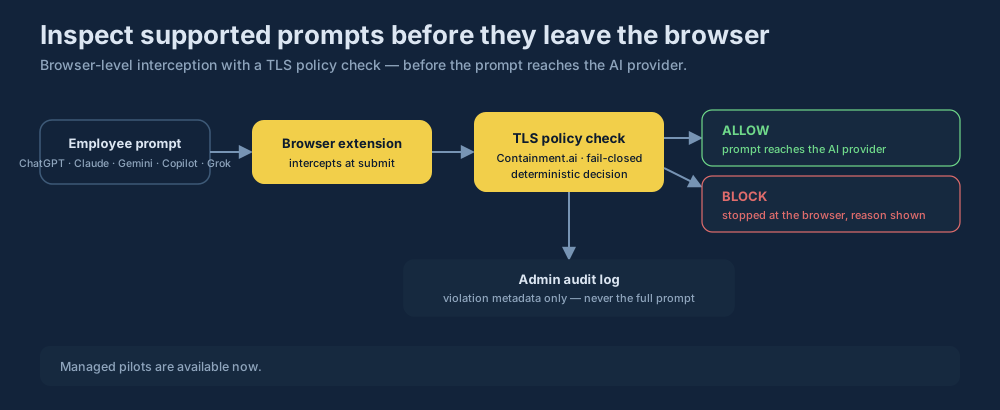
What a specification cannot do is intercept a prompt before it leaves your employee's browser. It cannot inspect an API call before it reaches OpenAI or Anthropic. It cannot block a finance analyst from pasting a confidential earnings draft into ChatGPT in real time, before the data is already gone.
This is the enforcement gap. And it is the gap that every enterprise AI governance buyer eventually discovers — often after an incident.
The Governance Stack Has Two Layers
Policy frameworks and open specifications operate at the governance layer. They define what your rules should be, how you should document them, and what evidence an auditor should expect to see.
Real-time enforcement operates at a different layer entirely: the request layer, where employee prompts are actually intercepted, evaluated against policy, and blocked or allowed before sensitive data leaves the organization.
These two layers are not substitutes for each other. An enterprise that has adopted AARM has done the governance layer correctly. But AARM adoption alone does not prevent a nurse from copying patient records into a consumer AI chatbot, or a defense contractor from uploading CUI into a general-purpose LLM.
For that, you need enforcement at the proxy layer and the browser layer — where the request actually happens.
Why This Matters Now
Vanta's AARM announcement lands at a moment when the regulatory pressure on AI governance is converging from multiple directions. The EU AI Act's enforcement obligations are approaching. FedRAMP's modernized authorization program — which Vanta's Government Cloud recently received authorization under — is setting expectations for federal contractors. State AI laws are layering on top.
Enterprises that are just now building their AI governance programs have a narrow window to get the stack right. Adopting an open specification like AARM is the right place to start. It gives you structure. It gives you language.
But when your auditor asks for evidence that governance policies were enforced — not just documented — you will need enforcement tooling that generates real-time intercept logs, not just a policy framework that says interception should happen.
What Enterprise Buyers Should Be Asking
When evaluating any AI governance vendor, the right question is: at what point in the data flow does your product actually enforce policy?
- Pre-submission (before the prompt leaves the employee's browser or application): requires browser extension or endpoint enforcement
- At the proxy layer (before the API request reaches the model provider): requires an intercepting proxy
- Post-hoc (after the request has already been processed and logged): audit trail, not enforcement
Post-hoc logging is useful for compliance reporting. It is not useful for preventing the incident.
An open specification like AARM tells you that the industry has agreed pre-submission and proxy-layer enforcement is what "governed" looks like. Enforcement tooling is what makes that description true at the moment of the request — not after the audit.
The Market Signal
Vanta donating AARM to the CSA is a bet that governance frameworks, not enforcement products, are where the category winner should play. That's a legitimate strategic choice for a company with 16,000 customers and $300 million ARR, most of whom are using Vanta for SOC 2 evidence collection and GRC workflow automation.
For enterprises that need AI requests actually intercepted and blocked before data leaves the organization, that's a different product category — and a different layer of the stack.
Containment.AI operates at the pre-submission and proxy enforcement layers, evaluating AI prompts and API requests against your organization's policies in real time. When a specification like AARM defines what governed AI agents should look like, we're the layer that makes it true before the request is sent.
Vanta's May 19, 2026 announcement is available via Business Wire. The AARM specification is published through the Cloud Security Alliance at vanta.com/resources/vanta-donates-aarm-to-csa.