At its Knowledge 2026 conference in Las Vegas, ServiceNow made its most aggressive AI governance push to date. The company formally expanded its AI Control Tower into a five-dimensional governance platform — Discover, Observe, Govern, Secure, Measure — with 30 new enterprise integrations across AWS, Azure, Google Cloud, SAP, Oracle, and Workday, plus five new risk frameworks aligned to NIST and EU AI Act standards.
General availability is expected in August 2026. And ServiceNow is offering AI Control Tower free for one year to accelerate adoption.
That's a serious platform play. But there's a systematic gap in what it covers — and compliance teams need to understand where it ends before they sign the paperwork.
What ServiceNow AI Control Tower Actually Does
ServiceNow's pitch is that it provides "a single pane of glass" across registered AI systems — agents, models, identities — within the enterprise CMDB and ITSM layer. It's genuinely impressive in scope:
- Discover: Automatically inventory AI agents, models, and MCP servers across first- and third-party environments via cloud integrations
- Observe: Runtime monitoring of how agents reason, decide, and execute — surfacing when to course-correct
- Govern: AI-driven risk assessment with NIST and EU AI Act compliance packs built in
- Secure: Identity access governance extended to hyperscaler environments via Veza integration — least-privilege enforcement, prompt injection blocking for ServiceNow-governed workloads
- Measure: Cost tracking and ROI dashboards across the AI lifecycle
The kill-switch demonstration at Knowledge 2026 — shutting down a rogue agent attempting a prompt injection attack — was theatrically staged but technically honest. Agent misbehavior in production is a real operational risk, and ServiceNow has built real plumbing to address it at the infrastructure layer.
The Governance Gap: What Happens in the Browser
Here's what AI Control Tower cannot do: stop your VP of Finance from opening chatgpt.com in Chrome and pasting next quarter's earnings model into the prompt box.
That action happens entirely outside the ServiceNow CMDB. There's no registered agent to discover. There's no ServiceNow workflow to intercept. The compliance risk materializes the moment an employee hits Enter — and it's invisible to every governance platform that operates at the cloud-infrastructure or ITSM layer.
This isn't a criticism of ServiceNow's architecture; it's a reflection of where enterprise AI risk actually lives in 2026. ServiceNow governs the AI you built and registered. It doesn't govern the AI your employees are using right now — the ChatGPT sessions, the Claude tabs, the Gemini integrations that appear on employee desktops the same week a new model ships.
According to ServiceNow's own EVP Jon Sigler: "Enterprises are under real pressure to deploy AI and show results, but there's a major gap between adoption and accountability."
He's describing the registered AI stack. The browser stack is a separate accountability problem entirely.
The Compliance Stack Your Policy Documents Assume
Every governance policy — NAIC Model Bulletin for insurers, NYDFS Part 500 for financial institutions, HIPAA Security Rule for healthcare, NERC CIP for utilities — assumes that when an employee uses a third-party AI tool, there's a mechanism to evaluate the content before it leaves the organization.
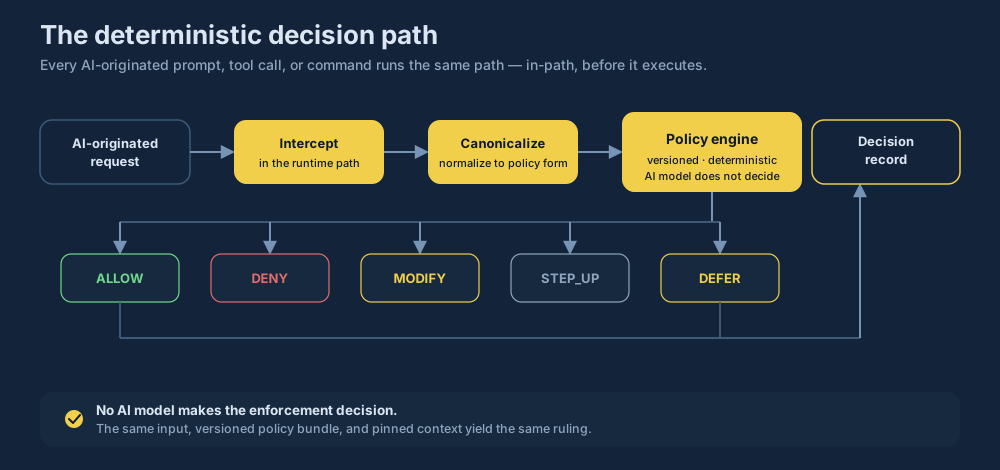
ServiceNow AI Control Tower handles the cloud-deployed, CMDB-registered fraction of that use. Containment.AI covers supported browser surfaces — ChatGPT, Claude, Gemini, Microsoft Copilot, and Grok — with in-path policy evaluation. Managed pilots are available now.
These aren't competing platforms. They solve different layers of the same problem.
The Complementary Stack
For compliance teams building out an AI governance posture in 2026, the complete picture looks like this:
| Layer | Tooling | Scope |
|---|---|---|
| Cloud-deployed AI agents (CMDB/ITSM) | ServiceNow AI Control Tower | Registered models and agents across AWS, Azure, GCP, enterprise SaaS |
| Browser-level employee AI usage | Containment.AI | In-path policy on ChatGPT, Claude, Gemini, Copilot, and Grok; managed pilots available now |
ServiceNow's GA is August 2026. The shadow AI compliance risk is happening today.
If your governance policy says "employees must not submit regulated data to third-party AI systems" — you need a mechanism that enforces that at the point of use, not one that audits the CMDB afterward.
That's the gap. That's what Containment.AI closes.
Containment.AI is an AI governance browser extension and proxy layer that enforces real-time compliance policies when employees use ChatGPT, Claude, Gemini, Microsoft Copilot, and other AI tools. Policies are configured by admins; enforcement happens in the browser, before content leaves the organization. See how it works →