The AI governance market got a real product launch this week. On June 2, 2026, Portal26 announced a free tier of Claude governance and security capabilities for enterprises standing up Claude, Claude Code, and Claude Cowork. The pitch is direct: as enterprise Claude adoption accelerates, the management layer has to keep pace, and Portal26 is making the foundational capabilities — discovery, visibility, token control — free of charge.
That's a category-expanding move, and one worth taking seriously. But it also surfaces a question that anyone building an AI governance program should be asking right now: which boundary are we actually governing? Because the answer changes the architecture.
What Portal26 just made free
Portal26 is calling itself "the AI Adoption Management Platform." The press release distributed via BusinessWire from Los Gatos, California names the new free offering for Claude deployments and lists exactly what it covers:
- User, Model, and Agent Discovery
- Agent Access Graphs
- Tool Call Visibility
- Token Usage and Costs
- Conversation Threads
Paid tiers add real-time security policy enforcement, MCP controls, enterprise integrations into IDP, SSO, SIEM, and IR systems, and what Portal26 describes as "the industry's only NIST FIPS certified AI forensic audit vault."
The context Portal26 cites for the launch is worth quoting directly. "As Claude AI, Claude Code, and Claude Cowork become core to how enterprises work, the need for a dedicated management layer has never been clearer," said Arti Raman, CEO. Pakshi Rajan, Chief GenAI & Product Officer, framed the problem more operationally: "Deploying Claude is the starting point. What organizations need upfront is the infrastructure to discover all Claude AI, Claude Code, and Claude Cowork usage, surface all conversations and tool calls, govern it, protect it, and prove its value."
The market backdrop they point to is real. According to early 2026 data Portal26 cites, Anthropic accounts for nearly 30% of enterprise LLM spend. And in its April 9, 2026 blog post, Anthropic itself acknowledged that while the company has begun to provide some oversight, governance and controls are still recommended.
In other words: the model vendor said the deployer needs governance. Portal26 just lowered the price of one of those layers to zero. That's a real contribution to the category.
The boundary Portal26 is governing
Read Portal26's feature list closely and a clear picture of which boundary it governs emerges. Discovery, agent access graphs, tool call visibility, token usage — every one of these capabilities looks at traffic that has already entered the Claude API surface. The data is being measured, governed, and audited at the point where an authorized agent or API client is calling Claude on the enterprise's behalf.
That's an excellent place to govern agent behavior. It's where you catch a runaway agent burning through tokens, an MCP tool call going to a system it shouldn't, an agent goal that drifted mid-run. It is the right architecture for the agent-side of the relationship — the layer that asks what is this agent allowed to do next, and at what cost?
It is also, by construction, blind to one specific thing: data that an employee paste into the consumer Claude web UI from their browser. Because that traffic never touches the API the enterprise platform is monitoring. It goes from the user's browser, through their personal authentication context, into claude.ai. No agent. No API key. No tool call. No conversation thread that the deployer's API-side monitoring can see.
That is the data-boundary layer — and it's a different problem.
Why the browser boundary matters for defense and NatSec
Nowhere is this gap more operationally visible than in the defense and national security sub-sector. The pattern is the same one every defense prime is wrestling with right now: an engineer with a clearance, working on a CUI program, has Claude open in a personal browser tab because it makes their job faster. They paste a fragment of a controlled technical specification, or a prompt that references a specific weapons-system component, or a chunk of a CDI-tagged design document, and ask Claude to clean up the language or summarize the implications.
The model does its job and returns useful output. From inside Portal26 (or any API-side governance product), this event is invisible. It never crossed the API boundary the enterprise is monitoring. It crossed a different boundary: the data left the cleared environment when the engineer's keystrokes flowed into the consumer browser. By the time anything an API-side product can see, the data has already moved.
The consequences are not theoretical. NIST SP 800-171, the protections required for non-federal systems handling CUI, has explicit requirements around data flow and audit. CMMC examiners are asking program offices to demonstrate where CUI is being processed and what controls govern that movement. "We monitor our API consumption with a best-in-class platform" is a true and useful statement. It is not an answer to "what happens when a cleared engineer pastes CUI into claude.ai?" That question gets answered at a different layer.
Two complementary layers
The useful frame is not Portal26 versus Containment.AI. It's Portal26 and Containment.AI, governing different boundaries. The industry is converging on this two-layer model — the Cloud Security Alliance's AI Agent Resource Management (AARM) workgroup has been pushing toward exactly this kind of Protocol-Gateway pattern, where agent-side governance and data-boundary enforcement are explicitly separable concerns. Containment.AI publicly self-attests that AARM requirements R1–R6 Core and R8 are satisfied, with R7 documented as a gap and R9 out of scope. That is an alignment claim, not certification.
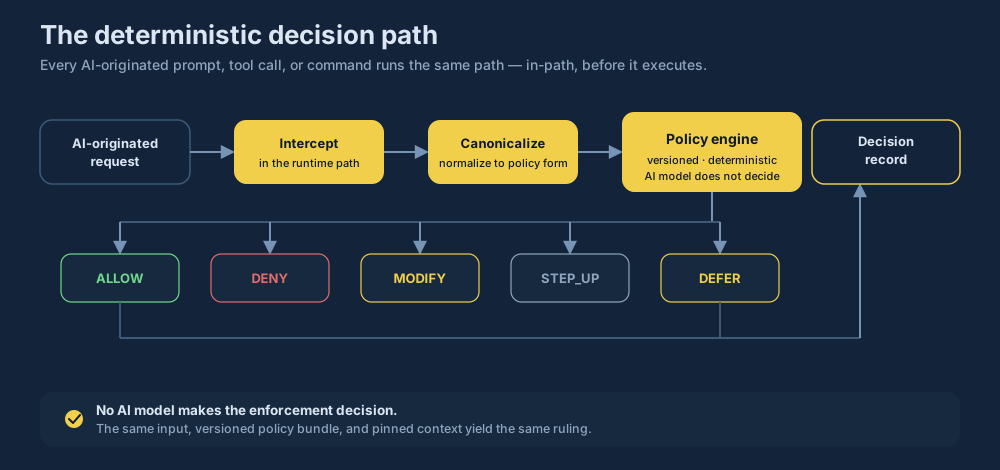
Portal26's free Claude tier closes a real gap on the agent-and-API side. Containment.AI's browser extension and policy proxy close the gap on the data side — inspecting what's about to leave the organization at the prompt boundary, evaluating it against the customer's policy (NIST SP 800-171 controls, FedRAMP boundary scope, NAIC bulletin, HIPAA category, FERPA student-record class, internal CDI tags, etc.), and allowing, redacting, or blocking the data movement in real time, before any model sees it. Both layers produce audit trails that survive an examiner's question six months later. Neither one alone answers every question regulators are asking.
What to do this week
If you're operationalizing Claude across an enterprise — defense, financial services, healthcare, or any regulated environment — three concrete steps:
- Separate the two boundaries explicitly in your architecture document. Agent-side governance (API consumption, tool calls, token spend, MCP control) and data-side governance (what content is allowed to cross the LLM boundary at all) are different layers with different evidence requirements. Buying one and assuming it covers the other is the most common mistake we see in pilot deployments.
- Inventory your consumer-browser surface. For every team using Claude, count how many users are on the consumer claude.ai web UI versus how many are routed through your API-governed deployment. The gap is almost always larger than the platform team thinks.
- Match the audit evidence you can produce to the regulation that will examine you. For CMMC, NIST SP 800-171, FedRAMP, and adjacent regimes, the examiner's question is about the boundary where data crossed, not the API the enterprise platform happens to monitor.
Portal26 just made one half of the Claude governance problem free. The other half — the boundary between a cleared user's keyboard and the model — is the half that's still entirely the deployer's responsibility, and that responsibility doesn't get any easier when the agent-side market consolidates around a strong free tier.