On May 1, 2026, the War Department announced it had entered into agreements with "eight of the world's leading frontier artificial intelligence companies, SpaceX, OpenAI, Google, NVIDIA, Reflection, Microsoft, Amazon Web Services, and Oracle" to deploy their models on the Department's classified networks "for lawful operational use." The systems will run inside Impact Level 6 (IL6) and Impact Level 7 (IL7) network environments, the release said, to "streamline data synthesis, elevate situational understanding, and augment warfighter decision-making."
The same announcement quietly disclosed how far AI adoption has already gone on the unclassified side. GenAI.mil — described as "the War Department's official AI platform" — has been used by "over 1.3 million Department personnel," generating "tens of millions of prompts and deploying hundreds of thousands of agents in only five months." Its users, the release notes plainly, are "warfighters, civilians and contractors."
Read those two facts together and the strategic picture is unambiguous: the U.S. military is moving frontier AI into the center of how it operates, fast. But there's a governance distinction buried in the announcement that every defense contractor and program office should sit with — because most of the public conversation collapses it.
The agreements govern the model. That's real — and it's half the job.
When a frontier lab signs a deal like this, what it is mostly negotiating is model behavior: what the model will do, what it will refuse, and how it is deployed.
OpenAI's own write-up of its Department of War agreement is explicit about this. The company says it operates under three "red lines" — "No use of OpenAI technology for mass domestic surveillance," "No use of OpenAI technology to direct autonomous weapons systems," and "No use of OpenAI technology for high-stakes automated decisions" — and that it enforces them with model-side controls: "we retain full discretion over our safety stack, we deploy via cloud, cleared OpenAI personnel are in the loop." The deployment, it adds, is "cloud-only," not on edge devices.
That is meaningful governance. But notice precisely what it governs: the outputs of the model and the conditions of its deployment. A safety stack decides what the model is willing to say and do. It does not decide what a user is allowed to send to the model in the first place.
The other half: the data crossing into the model
Governance has a second surface, and it points the opposite direction. Not "what comes out of the model," but "what goes in."
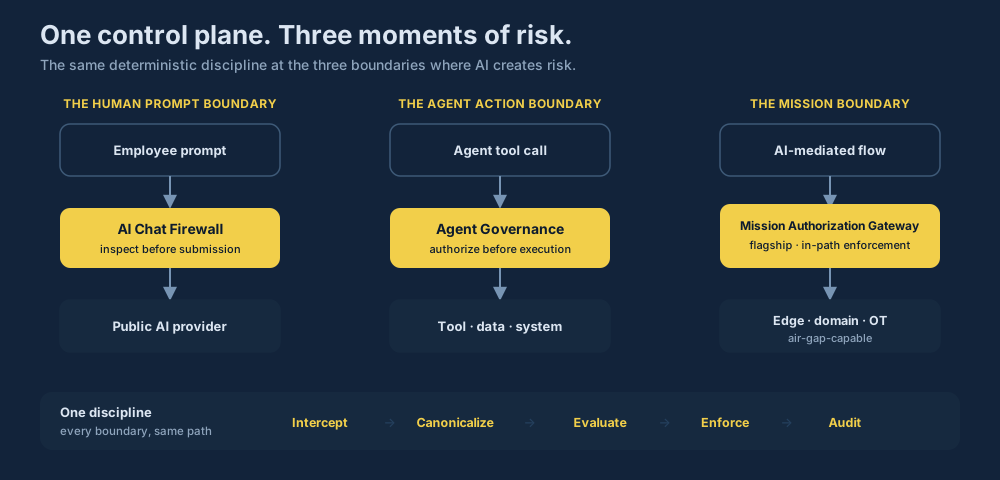
When an analyst, an engineer, or a contractor opens a chat window and pastes in a block of text, the model provider's safety stack is not the thing that decides whether that text should have left the building. Whether the input contains controlled unclassified information (CUI), ITAR-controlled technical data, source code, a teaming-agreement detail, or the contents of a sensitive working document — that is a determination about the data, made at the boundary the user sits on, before the prompt is ever transmitted.
The model vendor doesn't own that boundary. The deployer does.
This is why "we picked a governed model" and "our AI usage is governed" are not the same sentence. You can run the most safety-constrained frontier model in the world and still leak CUI into it, because the leak happens on the way in — on an endpoint the vendor never sees.
For the defense industrial base, the boundary is explicitly yours
The May 1 release names contractors among GenAI.mil's 1.3 million users — and that platform is only the government-run slice. Across the defense industrial base, the larger exposure is the everyday one: employees at primes, aerospace OEMs, and cleared subcontractors using commercial AI assistants in their browsers to move faster on proposals, code, and engineering work.
Those are exactly the workflows where CUI and export-controlled data go for a walk. And the obligation to control them does not sit with OpenAI or Google or Oracle. It sits with the contractor — increasingly as a matter of contract, not just good practice, as the FY26 NDAA's AI provisions and CMMC push data-handling controls into the terms of doing business with the Department.
A program office can choose a vendor. It cannot outsource the question of what its own people are pasting into that vendor's model.
The vendor mix will change. The boundary requirement won't.
The most durable lesson in the May 1 announcement is how fluid the vendor list is. The Department's official release lists eight companies; Defense News, reporting the same day, listed seven — Oracle being the difference. Anthropic, which the Department designated "a supply-chain risk to U.S. national security" in March — "the first of its kind against an American firm" — was excluded entirely, has since filed two lawsuits, and is now reportedly the subject of rapprochement talks. The Department itself said it is building "an architecture that prevents AI vendor lock."
If you are a contractor, the takeaway is not "bet on the right lab." It's that the model layer underneath you is going to keep shifting — by procurement decision, by policy, by court order — and your governance posture cannot be coupled to any one of them. The single constant across every reshuffle is the data boundary: the point where your people's inputs either get checked or get sent.
Where this leaves a CISO or program security lead
If your AI governance program can answer "which models are approved" but not "what is being sent to them, by whom, and was it allowed to leave" — you have governed half the system.
Containment.AI is built for the other half. The browser extension and proxy sit at the data boundary and apply configured policy to governed submissions — flagging or blocking CUI, controlled technical data, secrets, and other sensitive content before it crosses into the model, and recording the resulting policy decision. The proxy is model-neutral; browser enforcement currently supports ChatGPT, Claude, Copilot, Gemini, and Grok.
The Pentagon just demonstrated, at the scale of 1.3 million users, that frontier-AI adoption is not slowing down. The governance question for everyone in its supply chain isn't whether to adopt — it's whether you can see the boundary your data crosses. See how Containment.AI governs that boundary.