OpenAI announced ChatGPT for Healthcare, a HIPAA-eligible offering covered by a Business Associate Agreement, with launch partners including AdventHealth, Baylor Scott & White Health, Boston Children's Hospital, Cedars-Sinai, HCA Healthcare, Memorial Sloan Kettering, Stanford Medicine Children's Health, and UCSF. (openai.com/index/openai-for-healthcare)
For health systems that have spent the last 18 months trying to figure out how to let clinicians use ChatGPT without breaking HIPAA, this is meaningful. A model-vendor BAA closes one well-known gap: the question of whether OpenAI itself can lawfully process PHI on behalf of a covered entity. The eight launch organizations now have an answer to that specific question.
It does not close the bigger gap.
What a Vendor BAA Actually Covers
A Business Associate Agreement is a contract between a covered entity and a vendor that creates, receives, maintains, or transmits PHI on its behalf. It binds the vendor to a set of specific obligations: use PHI only for the purposes the BAA permits, implement HIPAA-compliant safeguards, report breaches, and ensure that any subcontractors operate under equivalent terms.
A BAA tells you what OpenAI can do with PHI that arrives at its API. It tells you that OpenAI will not use that data to train general models, that the data is handled under enterprise security controls, and that the vendor has signed up to the breach-notification timeline HIPAA requires.
What it does not tell you is whether any given prompt your workforce submits should contain PHI in the first place. The BAA governs what happens after data reaches the vendor. The compliance question that bites most healthcare organizations happens upstream of that — at the keyboard.
The Upstream Gap
Consider a realistic scenario inside one of the launch partners. A care coordinator at a large health system is now told that the organization has a HIPAA-eligible ChatGPT deployment. The BAA is signed. IT has provisioned access. The Acceptable Use Policy has been updated.
That care coordinator still has thirty other browser tabs open. Microsoft Copilot, embedded in the productivity suite. A consumer Claude account she uses for personal writing. Gemini, surfaced inside her email. Perplexity, which she used last week to look up a drug interaction. A specialty AI summarization tool her colleague mentioned on Slack.
Which of those tools is covered by a BAA? Which of them is the one she pastes a discharge summary into when she is running late for a shift change?
The vendor BAA cannot answer that question. The BAA is a static contract with one vendor. The risk is a runtime decision made by a human, in a browser, dozens or hundreds of times a day, across an AI surface that now includes both BAA-covered tools and the much larger universe of tools that an employee can reach with a single tab.
OCR's enforcement framework does not care which tool the employee thought they were using. The disclosure happened. The audit log either documents it or it does not.
What the December 2024 Security Rule Update Implies
The proposed update to the HIPAA Security Rule — published by HHS OCR on December 27, 2024 — moves several controls from "addressable" to required, and explicitly scopes ePHI used in AI training, prediction models, and algorithmic decision-making as protected health information. The proposed rule treats AI governance as a technical-controls problem, not a policy problem.
Read against the OpenAI for Healthcare launch, the implication is direct. Having a BAA-covered AI tool inside the organization does not satisfy the Security Rule. The Security Rule asks whether you have implemented hardware, software, and procedural mechanisms that record and examine activity in systems containing ePHI (45 CFR 164.312(b)). The mechanism that matters is the one that captures the interaction before the prompt leaves your network — including the interactions that go to tools the BAA does not cover.
A BAA with OpenAI tells an OCR investigator that one specific vendor is operating under contract. It does not tell the investigator what happened when an employee opened a different tab.
The Anthropic Compliance API Doesn't Close It Either
Anthropic announced a Claude Compliance API on May 22, oriented toward providing audit-grade logging and policy hooks for enterprise Claude deployments. That is a useful primitive for organizations that have standardized on Claude. It expands the universe of vendor-provided compliance tooling.
It also illustrates the same structural point. Vendor-side compliance APIs govern interactions that reach the vendor through the sanctioned pipe. They do not govern the interactions that reach the vendor through the personal account, the consumer URL, or the embedded AI feature inside another product the employee uses. The compliance API knows about its own traffic.
The growth of vendor-side compliance tooling — OpenAI's BAA, Anthropic's Compliance API, Microsoft's enterprise Copilot configurations — is the right direction of travel. It is also evidence of a market truth: each vendor is solving its own slice of the problem. None of them is solving the cross-vendor, employee-layer problem that healthcare compliance teams actually have.
What Runtime Governance Looks Like Across BAA and Non-BAA Surfaces
For a healthcare CISO or compliance lead reading the OpenAI for Healthcare announcement, the practical question is not whether to use the new offering. It is what governance architecture makes the offering safe to deploy alongside everything else employees already touch.
Three requirements:
Coverage of the full AI surface, not just the sanctioned one. Policy enforcement that operates at the browser and proxy layer, evaluating AI submissions across ChatGPT (BAA and consumer), Copilot, Claude, Gemini, Perplexity, and the long tail of embedded AI features inside SaaS tools your workforce uses every day. The BAA-covered deployment is one node in a graph. Governance has to see the rest of the graph.
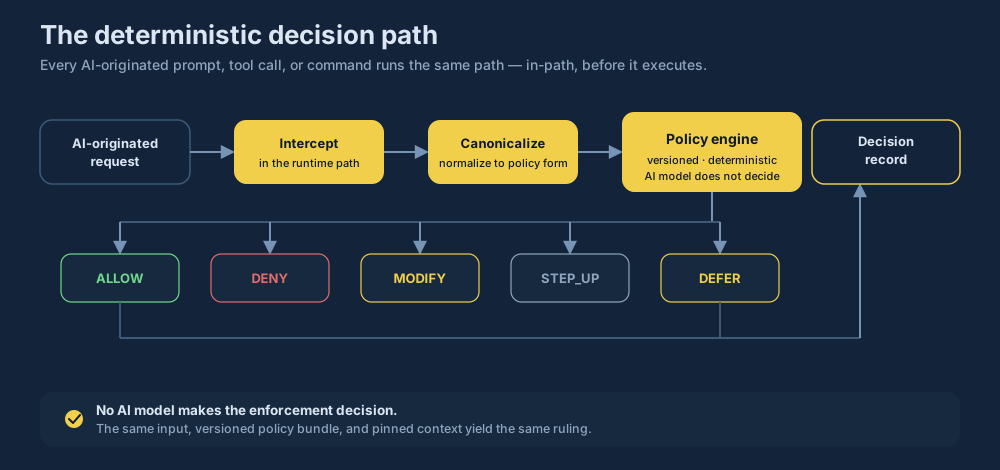
Pre-submission policy evaluation. Before a prompt reaches any AI vendor — BAA-covered or not — a policy engine evaluates whether the content contains PHI patterns and applies your organization's rules about what may be submitted, to which destination, under what conditions. The BAA tells you what the vendor will do with PHI after it arrives. The policy engine decides whether PHI should arrive at all.
A unified audit trail for governed interactions. User, timestamp, destination, policy decision, and matched content are written to tamper-evident records. Whether that evidence satisfies an OCR investigation depends on the organization's complete control environment.
The Practical Read
OpenAI for Healthcare is good news for the eight launch organizations and the health systems that will follow. It removes one specific obstacle from the AI-in-healthcare adoption curve.
What it does not do is change the underlying shape of the compliance problem. PHI governance in healthcare is, and remains, an employee-layer enforcement problem. The BAA closes the vendor question. The runtime layer closes everything else.
For health systems building toward an OCR-ready posture, the order of operations is: deploy the BAA-covered tools, then deploy the governance layer that enforces policy across both the BAA-covered tools and the universe of tools the BAA does not reach. Skipping the second step leaves you with a defensible answer for one vendor and an open question for the rest.
Containment.AI applies AI-governance policy at the proxy and on supported browser surfaces, with the dashboard providing policy and audit administration. Talk to us about healthcare AI governance.
Source: OpenAI for Healthcare announcement (verified 2026-05-21).