Today in London, EY and Microsoft announced a $1 billion+ initiative to accelerate enterprise AI transformation. EY is rolling out Microsoft 365 E7: The Frontier Suite to more than 400,000 people as "Client Zero" — one of the first organizations to adopt the suite at enterprise scale.
For enterprise security and compliance teams watching this space, the announcement is significant. E7 bundles Microsoft 365 E5, Copilot, Agent 365, and the Entra Suite into a single governance-forward offering at $99 per user per month. Microsoft explicitly positions Agent 365 as "the control plane for customers to observe, govern, and secure both Microsoft and third-party AI agents."
That's a real capability. And it covers a real layer of enterprise AI risk.
But it leaves another layer completely uncovered — and it's the layer where most AI-related compliance incidents are actually happening.
What E7 Governs
Agent 365 is designed to manage agents that run inside the Microsoft ecosystem: Copilot, agents built on Copilot Studio, and integrations published through Microsoft's agent marketplace. These are the agents IT registers, deploys, and oversees through the Microsoft 365 admin center.
E7 also includes Purview for data classification and Entra Suite for identity governance. Microsoft has built a genuinely capable governance stack for the AI workloads it controls.
For organizations standardizing on Microsoft's agentic infrastructure, this is exactly the right investment. EY recorded a 15% productivity boost after deploying Copilot to 150,000 users. The $1 billion initiative is a bet that helping enterprises govern and scale that deployment is where the market is headed.
What E7 Can't See
Here is the problem that E7 doesn't solve: most AI-related compliance risk in 2026 is not coming from sanctioned Copilot deployments. It's coming from the unsanctioned ones.
According to Vanta's own data — released alongside their $300M ARR announcement — 70% of companies now have shadow AI: tools being used without formal security review. Employees are reaching for ChatGPT, Claude, Gemini, and Perplexity because they're fast, capable, and available from any browser.
None of those tools are registered in Agent 365. None of them are visible to Purview's data classification. When a finance analyst pastes a draft earnings summary into ChatGPT.com, that request doesn't pass through the Microsoft governance stack at all.
E7's control plane governs what Microsoft makes. It cannot intercept a browser tab.
The Enforcement Gap
This gap isn't a criticism of E7. It reflects a structural reality: Microsoft can only govern traffic that flows through its infrastructure.
The result is that enterprises deploying E7 will have strong governance over their Copilot workloads and weak-to-zero governance over the AI usage happening in browsers, on personal devices, and through direct API calls to competing model providers. For organizations in regulated industries — financial services, healthcare, defense — that browser-layer gap is exactly where regulators are looking.
The OCC's updated model risk guidance expects coverage of all AI tools employees use in their work, not just the ones IT sanctioned. HIPAA's guidance on employee use of AI tools doesn't distinguish between approved and unapproved systems. EU AI Act deployer obligations apply to any AI system employees interact with in the course of their duties.
A governance posture that covers Copilot but not ChatGPT is not a compliant governance posture.
The Complementary Layer
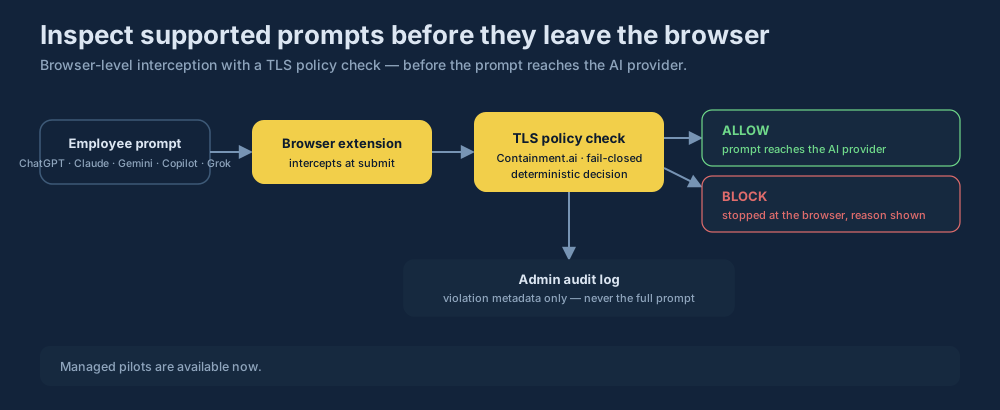
The right framing for enterprise buyers is not E7 versus something else. It's E7 plus the browser-layer enforcement that Agent 365 was never designed to provide.
Microsoft's $99/user/month Frontier Suite handles the Microsoft-native AI governance problem. The browser extension and proxy enforcement layer handles the shadow AI problem. They operate at different points in the data flow and address different threat surfaces.
When EY scales Copilot to 400,000 people, those same employees have browsers. They will use them. The governance question is whether your organization has enforcement at the layer where requests actually happen — before the prompt is sent, not after the audit.
Containment.AI applies your organization's configured policies on governed proxy traffic and supported browser surfaces before submission. It works alongside Microsoft E7 to cover ChatGPT, Claude, Gemini, Copilot, and Grok interactions that do not flow through Agent 365's control plane.
The $1 billion signal from EY and Microsoft today is that enterprise AI governance has entered the main stage. The organizations that get it right will need both layers.
EY and Microsoft's May 21, 2026 announcement is available at news.microsoft.com. Microsoft 365 E7 pricing and Agent 365 details are available via Microsoft Learn.