When your legal team started requiring SOC 2 Type II from every SaaS vendor, it was not because SOC 2 had been law for years. It was because the market decided the certification was a credible signal that governance controls existed and worked. ISO/IEC 42001 is following the same path, faster.
Published by the International Organization for Standardization in December 2023, ISO 42001 is the first certifiable international standard for Artificial Intelligence Management Systems (AIMS). Microsoft has achieved ISO 42001 certification for its AI systems. Enterprise procurement teams are starting to require it in RFPs. And the compliance frameworks your regulated enterprise already manages — NIST AI RMF, the EU AI Act, NAIC, HIPAA — map to it cleanly.
If you are building an AI governance program at a bank, health system, insurer, or large enterprise, ISO 42001 is worth understanding now, before it becomes a procurement gate you did not prepare for.
What ISO 42001 Actually Is
ISO/IEC 42001 specifies requirements for establishing, implementing, maintaining, and continually improving an AI management system within an organization. An AIMS is a set of interrelated elements — policies, processes, accountability structures, controls — intended to establish objectives and processes for the responsible development, provision, or use of AI systems.
This is distinct from ISO 27001, which governs information security management systems. ISO 42001 builds on the same Plan-Do-Check-Act methodology and High-Level Structure (HLS) familiar from 27001 — but instead of securing data, it governs how your organization makes decisions about AI: risk assessment, human oversight, third-party vendor management, transparency, and continuous improvement.
Critically, ISO 42001 is the only major AI governance framework that is certifiable. NIST AI RMF is a framework for organizing your governance program. The EU AI Act is a regulatory obligation. ISO 42001 produces a third-party certificate that an independent accredited body has verified your AIMS meets the standard's requirements.
The U.S. National Accreditation Board (ANAB) is now accrediting certification bodies to audit and certify organizations against ISO 42001. That infrastructure is operational today.
Why It Matters for Your Compliance Program in 2026
It Is Showing Up in Procurement Gates
Major technology vendors are pursuing ISO 42001 certification to satisfy enterprise procurement requirements. As AI systems move into regulated workflows — claims processing, credit decisioning, patient triage, defense contracting — buyers are asking for evidence that governance is operational, not just documented. ISO 42001 certification is a credible answer to that question.
It Maps to Frameworks You Are Already Managing
One of ISO 42001's practical advantages is its alignment with other governance frameworks:
- NIST AI RMF: ISO 42001's structure overlaps substantially with NIST AI RMF's Govern-Map-Measure-Manage functions. Organizations that have built an AI RMF program have significant overlap with what ISO 42001 requires.
- EU AI Act: For organizations with EU operations, ISO 42001 is one of the fastest credible documentation frameworks for demonstrating conformance with high-risk AI system obligations.
- NAIC Model Bulletin: The Bulletin requires a written AIS Program with governance, risk management, and internal audit functions — a structure that maps directly to ISO 42001's core requirements.
The Gap It Reveals
Here is where ISO 42001 creates an important forcing function: it requires governance at the point of use, not just at the point of procurement.
Most organizations in 2026 have some version of an AI policy — a PDF describing acceptable use, perhaps a vendor approval process, maybe a model inventory. According to Deloitte's analysis of ISO 42001, 87% of executives claim to have AI governance frameworks, but fewer than 25% have fully operationalized that governance. ISO 42001 certification requires demonstrating that this gap is closed.
The standard requires documented controls for:
- AI system lifecycle oversight: governance does not start at deployment — it starts at procurement or development
- Risk assessment per AI system: not a general AI risk appetite, but specific assessments for each system in production
- Third-party AI supplier management: if your employees are using ChatGPT, Claude, or Microsoft Copilot, those are third-party AI suppliers, and the standard requires documented oversight
- Human oversight mechanisms: the ability to detect, respond to, and correct AI system failures, with documented evidence of that capability
- Monitoring and audit processes: ongoing, not point-in-time
The third, fourth, and fifth items are where most enterprise governance programs fall short. A policy document does not satisfy them. Real-time enforcement and an audit trail do.
Runtime Enforcement and ISO 42001
Documenting that you have governance over AI is different from demonstrating it. The gap ISO 42001 reveals most clearly is the distance between documented policy and enforced policy.
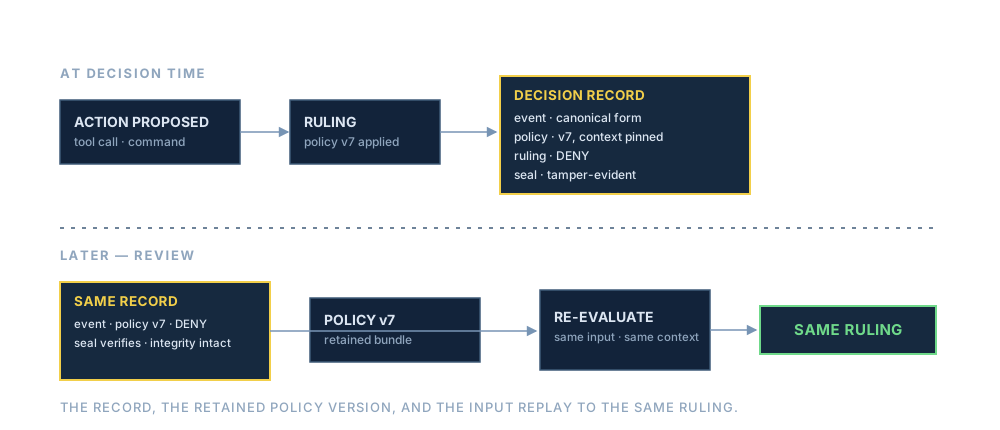
When an employee uses a public AI tool to process customer data in violation of your acceptable-use policy, your AIMS audit cannot produce evidence that the violation was blocked, because it was not. When an AI agent takes an action outside its intended scope, your governance framework needs to produce a logged, reviewable record of what happened and what your policy required.
That enforcement layer — a proxy or gateway that sits between your users and your AI services, evaluates each interaction against your policies, and produces a logged decision — is what turns an AI management system from a document into an operating control.
An AIS Program is evidence your governance exists. Runtime policy enforcement is evidence your governance works.
Getting Started With ISO 42001
For organizations beginning this work:
Start with a gap assessment. Map your current AI systems inventory, risk assessments, and governance controls against ISO 42001's clauses. Most enterprises find the gap is widest in monitoring, supplier management, and documented human oversight mechanisms.
Build on what you already have. If you have NIST AI RMF alignment, SOC 2 Type II controls, or existing ISMS infrastructure under ISO 27001, you have significant reuse. The High-Level Structure of ISO 42001 is designed for integration with existing management systems.
Treat runtime enforcement as infrastructure. The hardest requirement to satisfy with documentation alone is ongoing monitoring and audit of AI system behavior. Build the enforcement layer early — it generates the evidence your certification audit will need.
Microsoft's ISO 42001 certification demonstrates that enterprise-scale AI governance can satisfy the standard. The challenge for regulated enterprises is not understanding what is required — it is building the operational controls to demonstrate compliance continuously, not just at audit time.
Containment.AI provides the runtime enforcement layer that regulated enterprises need to turn AI governance programs from documentation to practice — producing the logged, auditable evidence that ISO 42001, NIST AI RMF, the NAIC Model Bulletin, and SOC 2 Type II audits increasingly require. Read our compliance approach or schedule a conversation with our team.