Healthcare organizations are already using AI at scale — 46% of U.S. healthcare organizations are currently implementing generative AI technologies. But in 2026, the regulatory environment just got dramatically more complex.
Three state laws took effect on January 1, 2026 alone. And they're just the beginning.
Three State Laws That Changed the Rules on January 1, 2026
Texas TRAIGA: Disclosure Before Every AI Interaction
Texas's Responsible Artificial Intelligence Governance Act (TRAIGA) is one of the most far-reaching state AI laws in the country. TRAIGA requires licensed healthcare practitioners to provide patients with conspicuous written disclosure of the provider's use of AI in the diagnosis or treatment of the patient — before or at the time of interaction.
In emergencies, disclosure must be provided "as soon as reasonably practicable." That's not a documentation checkbox — it's an operational requirement that flows down to every AI tool your clinical staff uses, including the consumer chatbots they're opening in Chrome right now.
California AB 489: No Implying AI Has a Healthcare License
Effective January 1, 2026, AB 489 prohibits developers and deployers of AI systems from using terms, letters, phrases, or design elements that indicate or imply the AI possesses a healthcare license. If your organization deploys any AI assistant — even an internal one — in a clinical context, this applies to you as a deployer, not just the vendor.
California SB 942: AI Detection Tools for Large Platforms
California's AI Transparency Act (SB 942), also effective January 1, 2026, requires "covered providers" with one million or more monthly users to offer free tools allowing users to determine whether content was AI-generated. Telehealth platforms, patient portals, and healthcare marketing operations with significant user bases need to assess applicability now.
HIPAA Is Still the Floor — But States Are Raising the Ceiling
The layered compliance problem is real. HIPAA still sets the floor, but states are rapidly raising the ceiling. For healthcare organizations, compliance now means layering federal rules with state-specific privacy demands, rewriting procurement contracts, and training clinicians on patient-facing consent.
HIPAA breach notification requirements apply if AI systems expose patient data, creating potential liability for organizations with inadequate safeguards. And that means every AI tool your employees use — including consumer chatbots like ChatGPT, Claude, and Microsoft Copilot — is in scope.
Organizations must ensure responsible management of patient data used in AI systems, with particular attention to data provenance, quality, and security. When protected health information is involved, healthcare entities must establish appropriate business associate agreements with AI vendors and implement robust data protection protocols.
The Governance Gap Your Employees Are Creating Right Now
Employees don't wait for policy. Clinical staff, administrative teams, and operations personnel are already using ChatGPT, Claude, and Microsoft Copilot in their daily workflows — often without organizational oversight. Every time a healthcare worker pastes a patient summary into an AI chatbot, they may be:
- Creating an unauthorized HIPAA disclosure
- Violating TRAIGA's disclosure requirements
- Exposing your organization to breach notification liability
Manual training and policy memos can't keep pace with employee AI adoption at scale.
Real-Time Enforcement Is the Only Viable Answer
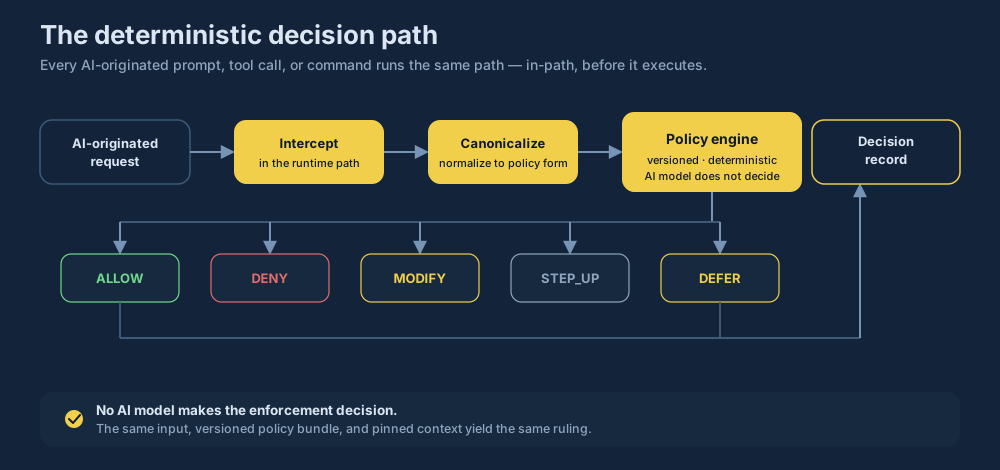
Containment.AI's browser extension and AI proxy apply configured governance policies at the prompt boundary on supported browser surfaces and governed proxy traffic. Current browser coverage is ChatGPT, Claude, Gemini, Copilot, and Grok. When a team member attempts to paste patient data into one of those governed surfaces, Containment.AI:
- Detects PII/PHI in real time before it leaves your organization
- Blocks the submission according to your policy configuration
- Logs the incident to a tamper-evident audit trail for HIPAA compliance reporting
No VPN or proxy reconfiguration is required for the browser surface. The Chrome extension supports ChatGPT, Claude, Gemini, Copilot, and Grok and can be managed through enterprise browser deployment. Managed pilots are available now.
The state law cascade isn't slowing down. The Colorado AI Act takes effect June 30, 2026. More states are following Texas and California's lead. Healthcare organizations need governance infrastructure that can adapt as regulations change — not a compliance team rework for every new law.
See how Containment.AI enforces HIPAA-aligned AI policies in real time → app.containment.ai