On January 9, 2026, the Secretary of War signed a memorandum titled "Artificial Intelligence Strategy for the Department of War," directing the entire Department to become an "AI-first" warfighting force "across all components, from front to back." The strategy is organized around seven "Pace-Setting Projects" (PSPs). One of them aims squarely at the desktop and the browser of nearly everyone who works for the Department.
That project is called GenAI.mil. The memo describes it as "Democratizing AI experimentation and transformation across the Department by putting America's world-leading AI models directly in the hands of our three million civilian and military personnel, at all classification levels."
Read that scope again: three million people, every classification level, frontier models kept current. This is one of the largest enterprise generative-AI rollouts ever contemplated — and it reshapes the AI-governance problem for the defense industrial base in a specific way most compliance programs haven't priced in yet.
"Speed Wins" Is Now Written Into Doctrine
The strategy is unusually explicit that friction is the enemy. Under the heading "Speed Wins," the memo states: "We must accept that the risks of not moving fast enough outweigh the risks of imperfect alignment." That single sentence reorders the risk calculus that most security and compliance teams are built around.
The rest of the document operationalizes it:
- It directs the Chief Digital and AI Office (CDAO) to establish a delivery cadence with vendors that enables "the latest models to be deployed within 30 days of public release," and makes that "a primary procurement criterion for future model acquisition."
- It establishes a monthly "Barrier Removal Board" with authority to waive non-statutory requirements that "inhibit rapid experimentation and fielding."
- Under a section titled "Clarifying 'Responsible AI,'" it directs that the Department "must also utilize models free from usage policy constraints that may limit lawful military applications," and orders standard "any lawful use" language into AI procurement contracts.
Whatever your read on the policy, the operational consequence is clear: the Department is deliberately removing the speed bumps between a user and a frontier model. That is the right call for warfighting tempo. It also means the governance burden does not disappear — it moves.
The Governance Question Moved From the Model to the Prompt Box
Most defense AI-compliance work to date has focused on the model and the infrastructure: Is the cloud service authorized? Has it cleared its ATO? Is it on the FedRAMP prioritization list? Those are real questions, and the memo accelerates the answers — it directs "rapid ATO reciprocity" and authorizes the CDAO to "direct release of any DoW data to cleared users with valid purpose."
But none of those authorizations govern the one thing that actually determines whether sensitive data leaks: what a user types into the prompt box, and what comes back.
An authorized model running on authorized infrastructure will still faithfully process whatever a cleared user pastes into it — a contract clause, a system diagram, a fragment of CUI, a name that shouldn't travel. Authorization is a statement about the service boundary. It is silent on the data boundary that every one of three million users crosses on every prompt. When you democratize frontier AI to that many people and explicitly accept "imperfect alignment" in exchange for speed, the prompt box becomes the largest unguarded surface in the enterprise.
The same memo makes this sharper, not softer. Its "DoD Data Decrees" direct components to build "federated data catalogs exposing their system interfaces, data assets, and access mechanisms across all classification levels," and to make more of that data reachable, faster. More accessible data plus more model access plus less procedural friction is a force multiplier for mission — and, without a control at the boundary, a force multiplier for accidental exposure.
Why the Defense Industrial Base Inherits This Overnight
This is not a problem confined to government networks. The memo directs "each Military Department, combatant command, and defense agency and field activity to identify within 30 days at least three projects they will prioritize to fast-follow these PSPs." That fast-follow expectation flows directly into the contractor base that builds, integrates, and operates these capabilities.
Defense contractors already handle Controlled Unclassified Information under CMMC, and their employees already reach for commercial AI assistants in the browser to draft, summarize, and analyze. An AI-first Department that rewards speed will pull its industrial base toward the same posture — more AI tools, used by more people, on more sensitive work, sooner. The contractors who treat "is the tool authorized?" as the whole compliance question will discover the gap the same way they discovered it with shadow SaaS: after the data has already left.
The strategy's own agent-focused projects raise the stakes further. The "Enterprise Agents" PSP is about "rapid and secure AI agent development and deployment to transform enterprise workflows," and the "Agent Network" PSP pushes AI agents into "decision support, from campaign planning to kill chain execution." Agents act on data at machine speed across many steps. The governance layer that records and constrains what data crosses the model boundary becomes more load-bearing, not less, as autonomy increases.
Governance at the Boundary Is How You Go Fast Safely
The lesson of the AI-first strategy is not "slow down." It's that the only governance model compatible with wartime tempo is one that lives at the boundary and enforces in real time — not a review board that approves tools and then loses visibility into how they're used.
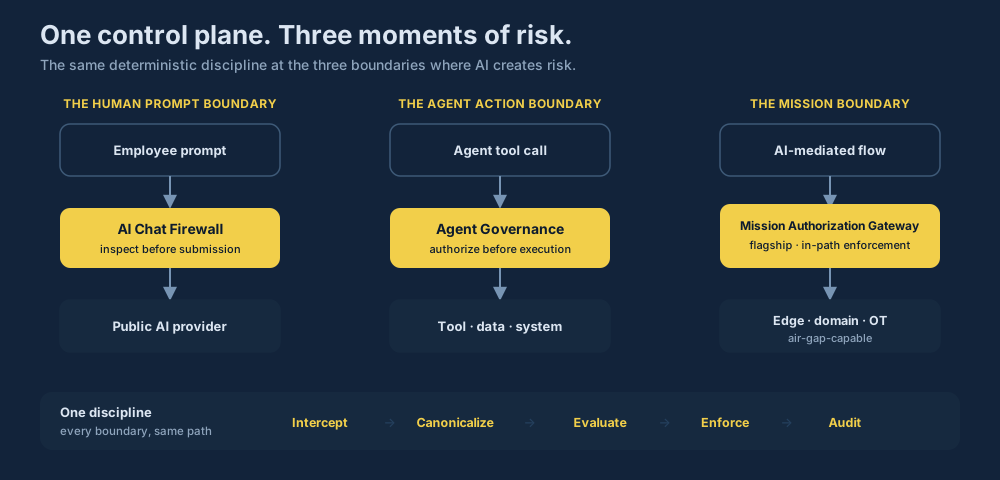
That is the layer Containment.AI operates: real-time policy enforcement at the browser and proxy layer, sitting between the user and the model. It monitors AI sessions, enforces rules on what sensitive data can cross into a prompt, and generates the audit evidence that program security and assessors will ask for. It complements an authorized model rather than competing with it — the model handles the mission, the boundary layer makes sure the data that reaches it is data that's allowed to.
The Pentagon has decided that speed wins and that imperfect alignment is an acceptable trade for tempo. For the defense industrial base preparing to fast-follow, the practical move is to put the control where the exposure actually is — at the prompt box, in real time — so the organization can adopt frontier AI at the pace the mission now demands without the data leaving with it.
Containment.AI enforces AI governance policies at the browser layer in real time — monitoring AI sessions, enforcing data-sensitive policy rules, and generating the audit evidence defense contractors need as DoD AI requirements take shape. See how it works →