Why ChatGPT and Student Data Don't Mix Without Governance Controls
Every week, thousands of teachers type student names, assignment scores, IEP notes, and behavioral records into ChatGPT. They're not being careless — they're trying to save time. The problem is that FERPA doesn't know that.
The Family Educational Rights and Privacy Act has governed student data privacy since 1974. As the National Education Association noted in its 2025 federal regulations overview, "education institutions that are subject to FERPA must interpret this law for how data is accessed, used, and stored in light of artificial intelligence." That interpretation creates an immediate compliance gap for nearly every K-12 district and university in the United States.
The School Official Exception — and Why It Doesn't Cover Free AI Tools
FERPA allows educational institutions to share student data with third-party vendors under the "school official exception" — but only when specific conditions are met. The vendor must have a legitimate educational interest, must be under the institution's direct control, and must be contractually prohibited from using student data for any purpose outside the scope of that contract.
Consumer-tier AI tools — free ChatGPT accounts, personal Gemini, unmanaged Copilot — don't qualify. As the Future of Privacy Forum's analysis of generative AI in schools notes, ChatGPT's terms of service prohibit children under 13 from using the service and require parental consent for teens. There is no Data Processing Agreement (DPA) between your district and a consumer AI account. No DPA means no school official exception. No exception means any student education record that enters that chat window may be an unauthorized disclosure under FERPA.
What Counts as a Student Education Record in an AI Context
The definition is broader than most IT leaders assume. Education records under FERPA include academic records, grades, test scores, course enrollment, disciplinary records, IEP and 504 documentation, attendance — and critically, student-generated content processed by an AI tool and AI-generated analysis of individual student data.
That means:
- A teacher pasting a student's essay into ChatGPT for grammar feedback
- An administrator asking an AI tool to "summarize this student's behavioral history"
- A counselor using an unvetted tool to draft a college recommendation letter with student-specific details
All of these are potential unauthorized disclosures under FERPA. The data doesn't need to include a student ID number to be protected. If it can be reasonably linked to an identifiable student, FERPA applies.
Every AI tool that a district educator accesses on district devices is a potential FERPA surface. The question isn't whether the tool is "AI" — it's whether student education records flow into it.
The State-Level Compliance Wave Is Already Here
Federal FERPA guidance is intentionally technology-neutral — Congress hasn't updated the statute to address AI specifically. But state education agencies are moving fast. According to Student Privacy Compass, approximately 20 states now reference FERPA, COPPA, or CIPA compliance requirements in their formal AI guidance for K-12 schools.
The California Department of Education updated its AI guidance in April 2026 and made the data-privacy question explicit in its procurement checklist: does the tool comply with FERPA, COPPA, and state student data privacy regulations? What student or staff data is collected, stored, or inferred? Does the vendor use personal data to train its models?
Ohio's Department of Education and Workforce released a model AI policy for K-12 schools at the end of 2025, requiring every public school to adopt an AI framework by July 1, 2026. Vermont's Agency of Education published a comprehensive 50-page AI governance framework in January 2026. The FTC finalized amendments to the COPPA rule in January 2025 to address evolving digital practices and limit companies' ability to monetize children's data.
The direction is clear: districts and universities that lack proactive AI governance controls are increasingly exposed — not just under federal FERPA, but under a tightening patchwork of state requirements and updated federal regulations.
The IT Admin's Impossible Job
Here's the operational reality most compliance conversations miss: traditional security tools cannot control what teachers type into a browser tab.
Firewall rules, MDM policies, and web content filters don't inspect the semantic content of AI prompts. They can block a domain entirely — say, chatgpt.com — but that causes immediate pushback from educators who have legitimate uses for AI tools running under proper vendor agreements. Blocking everything is not a governance strategy; it's an arms race that educators will route around.
The gap is at the content layer, not the network layer. What's needed is real-time inspection of what actually flows into AI chat interfaces — policy enforcement that can allow approved AI tools while blocking attempts to enter student education records (names, IDs, grades, IEP data) into consumer AI sessions that haven't been vetted for FERPA compliance.
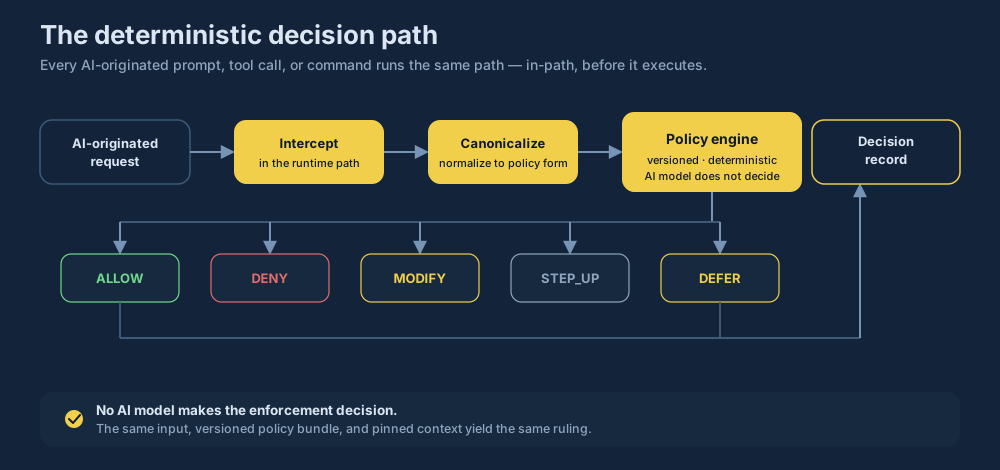
This is the enforcement problem that browser-layer AI governance is specifically designed to solve. By intercepting AI-chat submissions before they reach the model, evaluating them against configured policies (PII detection, student ID patterns, education-record markers), and blocking or flagging non-compliant inputs, an IT team can enforce FERPA-compliant AI usage across the district's device fleet — without blocking AI entirely.
A Practical Governance Checklist for Education IT Leaders
The California Department of Education's AI procurement guidance for local education agencies outlines the right questions at the procurement stage. But governance doesn't stop when the vendor contract is signed. It needs to cover runtime enforcement — what actually flows into AI tools once they're deployed.
At the procurement stage:
- Does the vendor execute a FERPA-compliant Data Processing Agreement?
- Is the vendor prohibited from using student data to train or improve its AI models?
- Are data retention, deletion, and access policies contractually defined?
- Has the vendor undergone independent security audits?
At the runtime enforcement stage:
- Can your IT team detect when student PII enters an AI session in real time?
- Do you have an audit log of AI interactions on district devices?
- Can you enforce different policies for different user groups (teachers vs. students vs. admins)?
- Can you block non-approved AI tools without blocking approved ones?
The procurement questions get answered before the contract is signed. The runtime questions get answered — or don't — every day, in every browser, on every device the district manages.
The Bottom Line
FERPA hasn't changed. The enforcement environment around AI in education is tightening at both the federal and state level. And student data continues to flow into AI tools most districts haven't vetted, through browser sessions that most security tools can't inspect at the content layer.
Districts that build governance controls where the data actually flows — at the browser layer, in real time — will be the ones that can say yes to AI adoption without accumulating FERPA liability they haven't calculated.
Learn how containment.ai enforces AI policies at the browser layer →