On June 24, 2026, FedRAMP released its Consolidated Rules for 2026 — CR26 — the program's most significant structural overhaul in years. The rules are now live at fedramp.gov/2026. The marketplace has been updated. Rev5 and 20x pilot documentation has moved to /legacy. JSON schemas for machine-readable packages are published at fedramp.gov/schemas.
If you sell AI tools to federal agencies or defense primes, your compliance picture changed yesterday.
What CR26 Actually Does
CR26 consolidates years of scattered policy memos, Requests for Comment, and program notices into a single, explicit, machine-readable ruleset. That last word — machine-readable — deserves attention. FedRAMP now publishes its requirements as structured JSON schemas. For AI governance tools and automated compliance pipelines, this means FedRAMP requirements are programmable. You can query them, validate against them, and build tooling that references the live ruleset rather than static documentation.
The FedRAMP Marketplace now reflects 528 FedRAMP Certified Services and 29 FedRAMP 20x Certified Services operating under the consolidated framework. The 20x path — FedRAMP's cloud-native, automation-forward certification track — is gaining ground. For software-first vendors targeting federal markets without legacy infrastructure overhead, 20x is increasingly the practical entry point.
The Defense AI Procurement Stakes
For defense contractors and DoD-adjacent software vendors, FedRAMP certification isn't a nice-to-have — it's the procurement gate. Any AI tool that handles federal information, whether it's an LLM interface, an agentic workflow platform, or a browser-layer governance control, operates inside a boundary that contracting officers will scrutinize.
CR26 makes that boundary more explicit and more auditable than the previous patchwork of narratives, memos, and program notices. When a defense prime's security team evaluates your stack, they're now working from a single consolidated ruleset with direct, plain-language requirements. That's good news for vendors who can actually demonstrate compliance. It's a harder conversation for vendors who have been leaning on soft designations and narrative descriptions of their security posture.
The new marketplace structure — built on CR26's certification classes — is also the reference your customers' procurement teams will use when writing SaaS requirements into contracts and SSPs.
What CR26 Doesn't Cover
Here's the gap that no certification framework closes: FedRAMP certifies the platform. It doesn't govern what your workforce does at the browser when they interact with AI tools.
An employee at a defense prime pasting controlled information into ChatGPT, Claude, or Gemini happens at the browser layer — downstream of any certified boundary. The FedRAMP authorization that covers an enterprise LLM platform doesn't extend to shadow AI usage on personal devices, unauthorized tools accessed through a standard browser, or workforce behavior that bypasses your approved stack entirely.
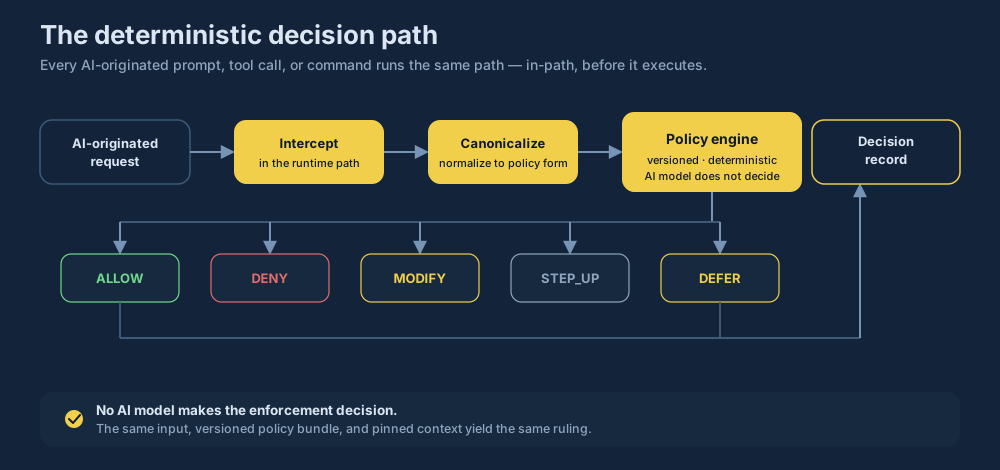
That's where real-time AI governance enforcement lives. A FedRAMP-certified LLM deployment is necessary. It's not sufficient. The data boundary between your certified environment and what your employees actually type into frontier AI tools requires an enforcement layer that runs at the endpoint — before the data leaves.
CR26 just raised the bar for what "compliant" means in federal AI procurement. For defense organizations deploying AI tools — and the vendors selling to them — the question isn't only whether your platform carries the right certification. It's whether your governance stack can prove what your workforce actually did with it, in real time, at the point of use.
The rules just got clearer. The enforcement gap didn't close itself.
Containment.AI enforces AI governance policies at the browser layer — the control point FedRAMP certification doesn't reach. See how it works.