The Shadow AI Inventory Problem: What Every Enterprise Needs Before August 2, 2026
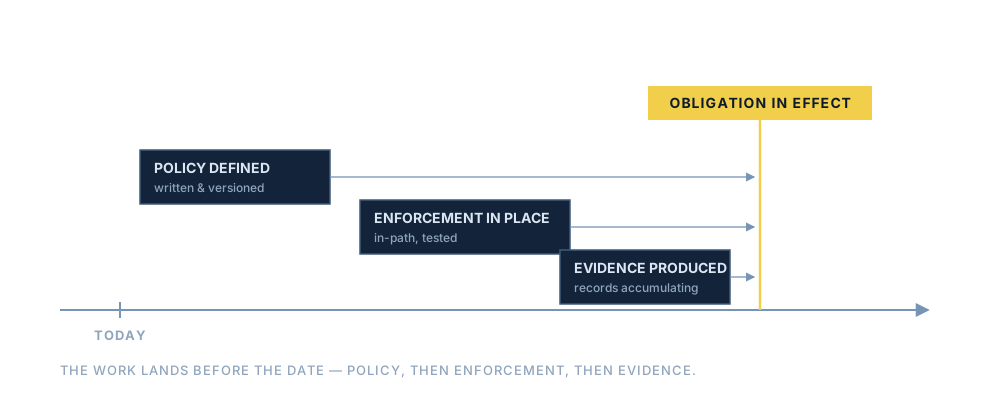
August 2, 2026 is 88 days away. On that date, the EU AI Act's high-risk obligations become enforceable — and the fines for non-compliance reach €35 million or 7% of global turnover, whichever is higher.
But the biggest compliance gap most enterprises are going to face isn't documentation or conformity assessments. It's a simpler, more embarrassing problem:
They don't know what AI is running inside their organization.
The Shadow AI Inventory Gap
Over half of organizations currently lack systematic inventories of AI systems in production or development. You can't classify risk — Annex III or otherwise — for systems nobody in compliance knows exist.
This is the shadow AI problem. An employee at a regulated financial institution pastes a customer's account summary into ChatGPT to draft a response letter. A healthcare analyst uploads patient cohort data to Claude for a quick analysis. A defense contractor's proposal team uses an AI writing tool to draft a bid. None of these get logged. None appear in any AI system inventory. And all of them represent exactly the ungoverned usage the EU AI Act's Article 26 deployer obligations are designed to catch.
The European Commission's Digital Omnibus proposal to defer the deadline to December 2027 collapsed in the April 28 trilogue. The May 13 attempt is a long shot. Plan against August 2, 2026 — that's the operative deadline.
What Article 26 Actually Requires
The EU AI Act doesn't ask whether you intend to govern your AI. It asks you to prove it — with documentation, risk assessments, continuous monitoring, and audit-ready evidence.
As a deployer (any enterprise using a third-party AI tool to make decisions about people), Article 26 requires:
- A named individual accountable for oversight — not a committee, not a team title, one human who can be held responsible
- Continuous monitoring of AI system behavior against its intended purpose
- Incident logging for any deviation from expected behavior
- Data governance records proving inputs were appropriately sourced
You cannot satisfy any of these requirements for AI usage you don't know is happening.
The Vendor's Compliance Doesn't Cover You
One of the most common misconceptions in enterprise AI compliance: "OpenAI is SOC 2 Type II certified, so we're covered."
You're not. The deployer vs. provider split in the EU AI Act is explicit: the provider's compliance doesn't transfer to the deployer. If your employees are using a third-party AI tool to make decisions that affect people — even informally, even in draft form — your organization carries its own Article 26 obligations. The vendor's certification covers their systems, not your usage patterns.
What Governance Looks Like in Practice
Effective AI governance at the enterprise level requires enforcement at the point of use — before data leaves the organization, before the prompt is submitted, before the model sees it.
That means:
- Visibility into what AI tools are being used — across every department, every role, every device
- Policy enforcement at the browser layer — where most shadow AI usage happens (ChatGPT, Claude, Gemini, Copilot, Perplexity)
- Real-time alerts when employees submit content that violates data governance policies
- Audit logs that prove, to a regulator, exactly what was submitted and what policy response was triggered
This is the difference between governance as documentation theater and governance as operational control.
SOC 2 Isn't Enough Either
For US-headquartered enterprises, SOC 2 Type II is often the default governance answer. But SOC 2 doesn't address AI-specific risks: it doesn't require you to log what employees submit to external LLMs, it doesn't require per-employee AI usage policies, and it doesn't produce the kind of AI-specific audit evidence the EU AI Act's Annex III compliance requires.
If you're a Fortune 500 company with any EU market exposure — any EU clients, EU data subjects, or EU-deployed systems — your SOC 2 posture is necessary but not sufficient. You need AI-specific governance controls layered on top.
88 Days
The enforcement clock runs regardless of whether your compliance program is ready. The organizations that will pass the first wave of EU AI Act audits aren't the ones with the most sophisticated AI systems — they're the ones with the clearest visibility into what AI is running in their environment and the controls to prove it.
Start with inventory. Then enforce at the point of use.
Containment.AI enforces AI governance policies in real time — at the proxy layer, in the browser, and in the admin dashboard. Organizations configure policies; we monitor, enforce, and audit AI usage before sensitive data leaves. See how it works →