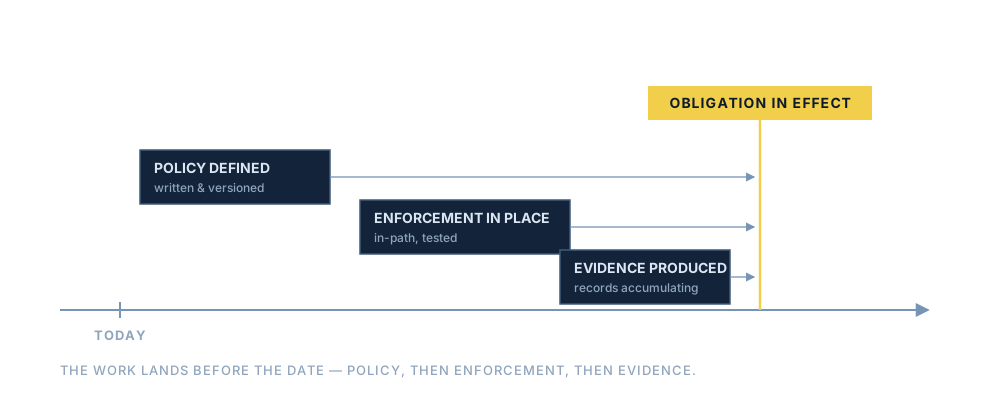
The EU AI Act's August 2, 2026 deadline for high-risk AI systems is now weeks away. And while the European Parliament and the Council of the EU have been negotiating a simplification package, the deadline itself has not moved.
This is not a rumor or a leak. The European Commission's own AI Act page states it directly: a Digital Package on Simplification was adopted by the Commission on 19 November 2025, and the Parliament and Council have been working through the Digital Omnibus on AI. On May 7, 2026 they reached a provisional agreement — but the relief it offers high-risk systems is conditional, not automatic.
The Commission's proposal includes adjusting "the timeline for the application of high-risk rules to a maximum of 16 months" — but only once the Commission confirms the required standards and supporting tools are actually available. Until that confirmation lands, August 2, 2026 remains the planning baseline.
The question for enterprise compliance teams: does this uncertainty change what you should do right now?
What August 2, 2026 Currently Means
Under the AI Act as written, August 2, 2026 is when high-risk AI obligations become fully applicable for most Annex III categories. These include:
- Credit scoring, employment, and essential services: AI systems that determine or influence access to loans, hiring decisions, or government benefits
- Critical infrastructure: AI safety components in transport, energy, water, and financial infrastructure
- Education and law enforcement: AI used in exam scoring, recruitment screening, risk assessment in law enforcement
- Transparency and disclosure obligations: Requirements for AI-generated content identification and chatbot disclosure
High-risk providers and deployers must implement conformity assessments — either self-assessment or third-party depending on the category — before their systems are placed on the EU market.
GPAI obligations for general-purpose AI model providers have already been in force since August 2025. The Commission published the GPAI Code of Practice in July 2025 as a voluntary compliance tool covering transparency, copyright, and safety.
What the Digital Omnibus Proposes to Change
The Commission's simplification package goes beyond a timeline extension. According to the official Commission AI Act page, the proposal would:
- Adjust the high-risk application timeline by up to 16 months, to ensure rules apply when organizations have adequate support tools (harmonised standards, guidelines) in place
- Centralise AI Office oversight for systems built on general-purpose AI models, reducing fragmentation across 27 Member State authorities
- Extend SME simplifications, including reduced technical documentation requirements for small and mid-cap companies
- Broaden regulatory sandbox access from 2028 onward
- Clarify the AI Act's interplay with other EU legislation (GDPR, product liability, sector-specific rules)
Important framing: a "maximum of 16 months" is not an indefinite delay. Even if the Omnibus passes in its current form, the framework becomes binding — organizations that treat a potential extension as a reprieve will simply be scrambling later.
Why Uncertainty Is the Wrong Governance Posture
Here's the practical problem with treating legislative uncertainty as a reason to wait: high-risk AI compliance is infrastructure work. It requires building:
- An AI system inventory across the organization — knowing what AI is deployed, where, and by whom
- A risk classification exercise — mapping each system against EU AI Act Annex III categories
- Governance documentation and conformity evidence — technical documentation, logging, human oversight controls
- An ongoing operational audit trail — post-market monitoring, incident reporting, continuous evidence collection
None of that is a last-minute project. Organizations that start in Q4 2026, under any timeline scenario, will be building under examination pressure rather than in preparation for it.
The enterprises that will be caught — whether the deadline holds or shifts six months — are the ones that haven't started the inventory. The ones that will be ready are the ones already running governance infrastructure that generates the operational evidence the Act requires.
If the Omnibus passes and grants an extension, that is time to operationalize more deeply. If it doesn't, you're compliant. The correct hedge is identical in both scenarios: build the governance infrastructure now.
What Runtime Enforcement Adds That Documentation Alone Doesn't
ISO 42001 certification demonstrates that your organization has an AI Management System — documented policies, risk assessment processes, and leadership commitments. But EU AI Act conformity assessment requires evidence that those controls function in operation.
In the words of one compliance implementation guide: in the 2026 compliance environment, "screenshots and declarations are no longer sufficient — only operational evidence counts."
That evidence comes from a runtime governance layer: a record of every AI interaction that ran through your organization's policy engine, with user, timestamp, AI tool, policy outcome, and matched content category. Not a declaration that employees were trained on the policy — evidence that the policy ran, and that it caught or allowed the right things at the right times.
The August 2026 deadline, moving or not, is the trigger for the question your auditor will ask: "Show me how AI governance actually works in your environment."
Containment.AI enforces AI governance policies in real time — at the proxy layer, in the browser, and in the admin dashboard — giving compliance teams in regulated enterprise environments the runtime audit trail and operational evidence that EU AI Act conformity assessments require. Learn more or request a demo.