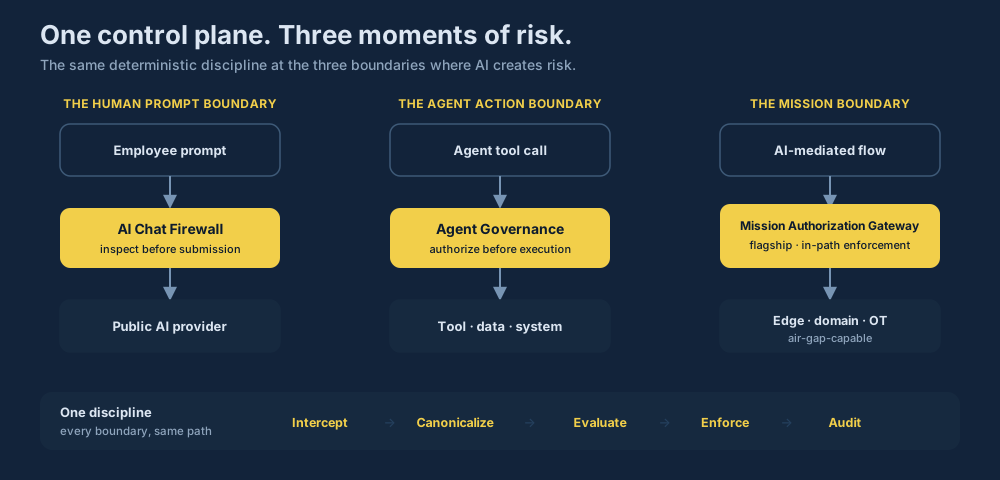
On June 10, 2026, Drata launched an AI Agent Governance product and, in doing so, did something more strategically significant than ship a feature: it named a category. When a trust-management platform with Drata's footprint declares that autonomous AI agents need to be discovered, inventoried, permission-mapped, and continuously audited, the rest of the enterprise security market hears the message. Agent governance is now a line item, not a research topic.
For national-security and defense buyers, this is worth taking seriously. It is also worth reading precisely — because what Drata governs and what a defense prime most needs governed are two different layers of the same problem, and the distinction is the whole ballgame.
What Drata Actually Launched
Drata's product governs the AI agents an organization builds and operates. It discovers which agents are running in your environment, maps what permissions and data each one can reach, and logs their decisions to an audit-grade record. Help Net Security, reporting the launch on June 10, captured Drata's own framing of the enforcement model: "every action is evaluated against its individual policy in real time, with violations blocked inline before execution" (Help Net Security, June 10, 2026).
Read that sentence carefully, because it is doing a lot of work. "Every action" refers to the actions of the agents Drata governs — the service accounts, the autonomous workflows, the AI systems your organization has stood up and connected to its data. For those agents, Drata evaluates each action against policy and can block it inline. That is a real capability, and it closes a real gap: the sprawl of homegrown and third-party agents that proliferate inside an enterprise faster than any GRC team can track them.
It is also, for now, a capability being introduced to a specific set of buyers. Drata's early-access program is limited to financial services, healthcare, and software — not defense or the national-security base. So the defense prime evaluating this category today is reading about a product it cannot yet buy, governing a layer that is not where most of its AI risk currently lives.
The Layer Drata Doesn't Reach
Here is the question a defense CISO should ask in front of any agent-governance demo: does this see what my engineer just pasted into a browser?
Drata's trust graph knows about the agents your organization provisions. It does not — and is not designed to — know about the cleared software engineer who copies a controlled requirement out of a program repository and pastes it into ChatGPT to ask for a rewrite. It does not see the program manager who drops a procurement memo into Claude for a summary, or the analyst who uploads a slide deck to a consumer chatbot to get a one-liner for a status report.
Those are not agent actions. They are human actions, taken in a browser tab, against a frontier model that sits entirely outside the organization's certified boundary. No agent inventory contains them, because no agent took them. The trust graph is blind to the single most common way controlled technical data leaves a defense contractor in 2026: an employee typing it into someone else's model.
This is not a criticism of Drata's design. Agent governance and point-of-use enforcement are different problems, solved at different layers. The mistake would be assuming that buying the first one covers the second.
Why FedRAMP Makes This Sharper, Not Softer
The GRC compliance layer is increasingly FedRAMP-covered. Vanta's Government Cloud, for instance, recently received FedRAMP 20x Moderate authorization — a meaningful signal that the compliance-tooling layer is maturing toward federal-grade assurance.
But FedRAMP authorization covers the platform — the compliance system and the data it holds. It does not cover the employee's browser session with an external LLM. A defense prime can run a fully FedRAMP-authorized GRC stack, maintain a pristine agent inventory, and still have no control whatsoever over a CUI-bearing prompt leaving an engineer's workstation and landing in a commercial model's logs. Authorization of the audit layer is not enforcement at the point of use. Compliance posture and real-time data control are not the same property, and a FedRAMP boundary drawn around the trust platform does not extend to the browser tab.
That distinction is exactly where the DoD's own direction is heading. The relevant frameworks — from CMMC's expanding AI scope to NIST AI RMF's continuous-monitoring expectations — increasingly ask not just what did you document but what did you enforce, at the moment it mattered. An audit trail that records an exfiltration after it happened is evidence of a breach, not prevention of one.
What This Means for a Defense Prime
Take the category signal seriously. Drata naming AI Agent Governance confirms what the defense base already suspected: the AI attack surface is now broad enough that it needs its own governance discipline, its own inventory, and its own controls. Map your agents. Govern them.
Then ask the second question — the one agent governance doesn't answer. Where, in your environment, does policy actually fire on a human pasting controlled data into an external model? For most defense primes and aerospace OEMs, the honest answer today is: nowhere. The browser is the boundary the trust graph cannot see across, and it is the boundary your engineers cross every working day.
That is the layer Containment.AI was built for. The proxy and supported browser surfaces evaluate AI-use policy before dispatch, can block a controlled-data paste inline, and produce an auditable record for each governed interaction. Managed pilots of the browser extension are available now.
Drata governs the agents you build. Containment.AI governs what your people type into the models you don't.
Drata's AI Agent Governance launch was reported by Help Net Security on June 10, 2026. If your organization supports DoD programs and needs real-time enforcement — not just an audit trail — at the point your engineers interact with frontier models, see how Containment.AI handles the compliance boundary.