On January 9, 2026, the Secretary of War signed a strategy memorandum titled "Artificial Intelligence Strategy for the Department of War," published two days later on the Pentagon's media site. Its single organizing idea is speed. The memo directs the Department to become "an 'AI-first' warfighting force across all components, from front to back," and it sets an explicit expectation that the Department will move faster than its own risk-review instincts.
For the defense industrial base and for every program office now standing up AI pilots, the strategy is a clear signal of where procurement is headed. It also quietly relocates the entire burden of data governance — and most people reading it have not noticed where it landed.
The strategy is an acceleration mandate, not a guardrail
The memo's "Acceleration Expectations" are blunt. Under the heading Speed Wins, it states: "We must internalize that Military AI is going to be a race for the foreseeable future, and therefore speed wins... We must accept that the risks of not moving fast enough outweigh the risks of imperfect alignment."
Under AI Model Parity, it goes further. "The Department cannot be working off models that are months or years old. We must have the latest and greatest AI models deployed for our warfighters." It then sets a hard cadence: the Chief Digital and AI Office (CDAO) is directed "to establish a delivery and integration cadence with AI vendors that enables the latest models to be deployed within 30 days of public release," and adds that this "shall be a primary procurement criterion for future model acquisition."
The scale is enormous. One of the seven "Pace-Setting Projects" the strategy launches, GenAI.mil, is described as "putting America's world-leading AI models directly in the hands of our three million civilian and military personnel, at all classification levels." Another, Enterprise Agents, is a playbook for "rapid and secure AI agent development and deployment to transform enterprise workflows."
Put those directives together and the picture is concrete: millions of people, across every classification level, prompting whatever frontier model shipped in the last 30 days.
The strategy deliberately removes the model as a control
Here is the part that should reorganize how defense contractors and program offices think about AI governance. The strategy does not just demand newer models faster. It explicitly removes the safety behavior built into those models as a procurement requirement.
In a section titled "Clarifying 'Responsible AI' at the DoW — Out with Utopian Idealism, In with Hard-Nosed Realism," the memo directs that "we must not employ AI models which incorporate ideological 'tuning'" and that "The Department must also utilize models free from usage policy constraints that may limit lawful military applications." It directs the Under Secretary of War for Acquisition and Sustainment to "incorporate standard 'any lawful use' language into any DoW contract through which AI services are procured."
Whatever one thinks of that policy choice, its governance consequence is unambiguous. A model procured under "any lawful use" terms, selected partly because it is "free from usage policy constraints," is a model whose own refusal behavior cannot be relied on as a control. The strategy says as much when it accepts "the risks of imperfect alignment" as the price of speed. The model will answer. It is not the thing standing between a user and a data-handling mistake.
That is a coherent warfighting bet. But it means the control has to live somewhere else.
Which leaves the data boundary
The strategy itself points to where. Even as it tears down blockers, it preserves the one distinction it cannot afford to lose: classification. GenAI.mil reaches three million people "at all classification levels" — the levels still matter. The memo reaffirms the "DoD Data Decrees" and directs Components to maintain "federated data catalogs exposing their system interfaces, data assets, and access mechanisms across all classification levels." It directs the CDAO to enable "cross-domain data access" — language that only makes sense if domains, and the boundaries between them, are still being enforced.
So the strategy creates a precise tension. Models must be the newest available, swapped in within 30 days, stripped of usage-policy guardrails, and accepted with imperfect alignment — while the data those models touch must still respect classification and Controlled Unclassified Information (CUI) handling rules that have not been relaxed at all. The faster the model layer churns, the more the data layer has to hold.
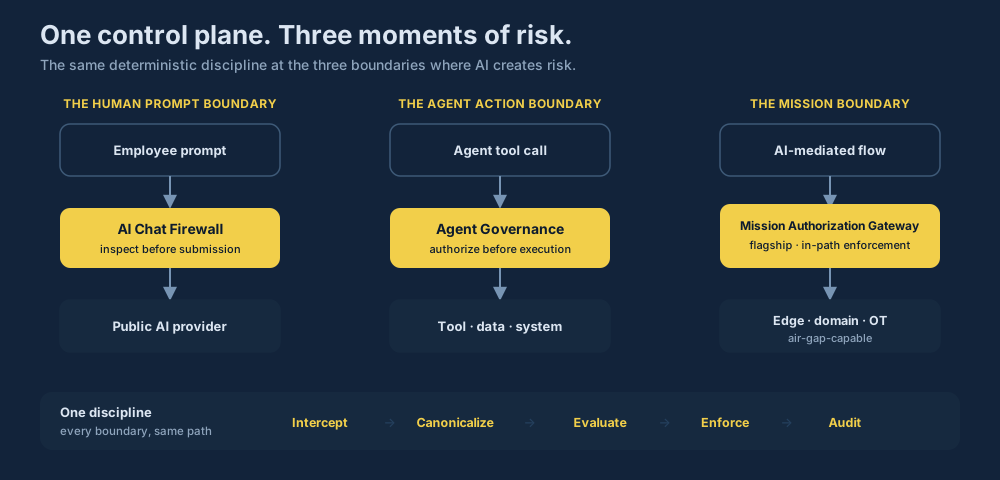
That is the definition of a data-boundary control: the thing that decides what information is allowed to cross from a user's session into a model — independent of which model it is this month, and independent of whether that model would have refused on its own.
What "keeping pace" actually requires
If you are a program office or a cleared contractor trying to operationalize this strategy, the data-boundary control has to satisfy four properties the strategy implies but does not build:
- Model-agnostic. A 30-day refresh cadence means the control cannot be coupled to any one vendor's model or API. It has to sit between the user and whatever model is deployed, and survive the swap.
- Real-time. "Imperfect alignment" accepted at the model means the enforcement point has to be the prompt, before data leaves — not a log reviewed after a spill has already happened.
- Classification- and CUI-aware. The control's job is exactly the distinction the strategy refuses to relax: keeping the wrong data out of the wrong domain.
- Audit-generating. The strategy puts the CDAO on a monthly metrics-and-reporting cadence and Congress on an oversight cadence. Someone will have to prove what data did and did not cross. That evidence has to be generated at the boundary, as enforcement happens.
None of that is a reason to slow the model layer down. It is the opposite. A real-time data boundary is what lets a program adopt the newest model within 30 days without re-litigating data risk every single time — because the control that matters never depended on the model in the first place.
The reading most people are missing
The DoW AI Strategy is being read as a green light — and for model adoption, it is. But the same document that says "speed wins" also says, in effect, do not trust the model to protect your data. It removes the model's guardrails on purpose and leaves classification untouched on purpose. The only place those two instructions reconcile is a control that governs the data crossing the boundary, in real time, regardless of the model.
The organizations that move fastest under this strategy will not be the ones that pick the right model. They will be the ones that already enforce the boundary — so they can pick a new model every month.
Containment.AI enforces AI governance policies at the browser layer in real time — monitoring AI sessions, enforcing CUI-sensitive policy rules, and generating the audit evidence defense programs and contractors need as AI adoption accelerates. See how it works →