On April 22, 2025, the Federal Trade Commission published substantial amendments to the Children's Online Privacy Protection Rule in the Federal Register (90 FR 16918). The changes took effect June 23, 2025. School districts and EdTech vendors had until April 22, 2026 to come into full compliance.
That deadline passed three weeks ago.
If your district has deployed AI-powered tutoring platforms, writing assistants, attendance systems, or classroom chatbots that interact with students under 13 — and you haven't audited your vendor agreements against the new requirements — you are operating with a compliance gap that the FTC has made clear it intends to close.
What the 2025 Amendments Actually Changed
The 2025 COPPA amendments are the first significant update to the rule since 2013. Several of the changes land directly on the AI tools running in K-12 classrooms today.
Biometric identifiers are now explicitly regulated personal information. The amended rule now specifically includes biometric identifiers in the definition of "personal information" — covering fingerprints, handprints, retina patterns, iris patterns, genetic data, voiceprints, gait patterns, facial templates, and faceprints. That language is verbatim from the final rule published in the Federal Register.
In practical terms: if your AI-powered attendance system uses facial recognition, if your read-aloud tool processes voice data to adapt pacing, or if your classroom engagement platform captures movement patterns — that data is now regulated personal information under COPPA. Collecting it from students under 13 requires proper notice and, in most cases, verifiable parental consent.
Separate parental consent for third-party disclosures. The 2025 amendments require separate parental consent for disclosures to third parties beyond what is necessary to deliver the core service. An AI tutoring vendor that shares student interaction logs with a "learning analytics" partner or a model provider for improvement purposes needs to obtain separate consent for that disclosure — not bundle it into a general terms-of-service acceptance.
Most AI vendor privacy policies were not written with this in mind.
Tightened support for internal operations. The rule clarifies that operators relying on the "support for internal operations" exception — which lets them collect certain data without parental consent — may use that data only for the specific enumerated activities in the definition. The exception does not permit using student data to contact individuals, build profiles, or run behavioral advertising, even if those activities are framed as improving the product.
The School Authorization Exception and Its Limits
COPPA includes a practical provision that allows schools to consent on behalf of parents for educational technology used in the classroom. This exception is the legal foundation for the entire K-12 EdTech ecosystem.
But the FTC's existing guidance — which the 2025 Federal Register rule explicitly preserves — draws a boundary that many AI vendors are crossing.
The school authorization exception covers data collection and use that is necessary for the educational purpose. It does not extend to:
- Using student data to train or improve AI models
- Sharing student interaction data with advertising or analytics networks outside the school's educational purpose
- Building persistent behavioral profiles that follow students across products or time
- Disclosing data to sub-processors for purposes unrelated to the specific educational function
Note what the FTC said in the 2025 rule itself: the Commission chose not to finalize new EdTech-specific amendments at this time because the Department of Education was working on related FERPA amendments that could create conflicts. But the Commission explicitly stated it "will continue to enforce COPPA in the ed tech context consistent with its existing guidance." The FTC did not suspend EdTech enforcement — it deferred codifying new EdTech-specific rules while retaining full enforcement authority under the existing framework.
Many AI tools deployed in K-12 settings were designed for adult-use contexts and adapted for school deployments. The "school edition" may restrict advertising, but it may still route student interaction data to the vendor's servers for model retraining and improvement. That data flow is not covered by the school authorization exception. And under the 2025 amendments, the explicit separate-consent requirement for third-party disclosures makes those practices harder to obscure in a DPA.
The FTC Is Watching
The enforcement signal from the FTC is direct. At an IAPP summit in late March 2026, FTC Commissioner Mark Meador emphasized that "keeping children safe as they navigate a digital world" is a priority and that the Commission is "willing and eager" to enforce compliance with forthcoming obligations.
Associate Director of the FTC's Division of Privacy and Identity Protection Ben Wiseman was similarly explicit: "The commission has been loud and clear for a while that protecting kids is going to be a high priority, and we're going to continue to bring cases on that."
The FTC has a consistent enforcement track record on COPPA violations. The agency has levied hundreds of millions of dollars in penalties against operators who knowingly collected children's data without proper consent. The 2025 amendments give the FTC sharper tools to identify when AI operators are treating children's data as model training material without the parental consent the rule requires.
What Districts Need to Do Right Now
The compliance gap for most districts isn't a single policy decision — it's a systemic audit problem. The typical K-12 district manages a large and growing portfolio of educational technology vendors, many of which now incorporate AI components that interact directly with students.
The most urgent steps:
Identify every AI tool that touches students under 13. This means the tutoring platform, the writing assistant, the read-aloud tool, the attendance system, and the chatbot the librarian deployed for research help. Any service that processes personal information from children in that age group is in scope.
Review vendor Data Processing Agreements against the new requirements. Does the DPA explicitly prohibit using student data to train AI models? Does it cover sub-processors? Does it address third-party disclosures separately? If the DPA was signed before June 2025, it almost certainly needs to be reviewed against the amended rule.
Map disclosure flows. Which AI vendors share student data with third parties? For what purposes? Does that sharing fall within the educational purpose the school authorized, or does it require separate parental consent that no one has obtained?
Implement real-time policy controls. Vendor agreements describe what should happen with student data. They don't enforce it in practice. The gap between a DPA and actual data flows is where compliance risk concentrates.
The Visibility Problem
COPPA's school authorization exception requires that data collected under it be used only for the educational purpose — not disclosed for commercial purposes, not used for AI model training, not shared with partners outside the scope of what the school authorized. That obligation sits primarily on the EdTech vendor. But school districts bear responsibility for selecting compliant vendors and maintaining oversight of those commitments.
The compliance problem is that that oversight is manual and visibility-limited. A district IT team reviewing vendor privacy policies is working with marketing-edited summaries of what the tool does, not real-time evidence of what data flows during a student session. When a student types a question into an AI tutor at 2pm, the district has no direct visibility into where that prompt goes, what the model does with it, or whether it ever comes back as a training signal.
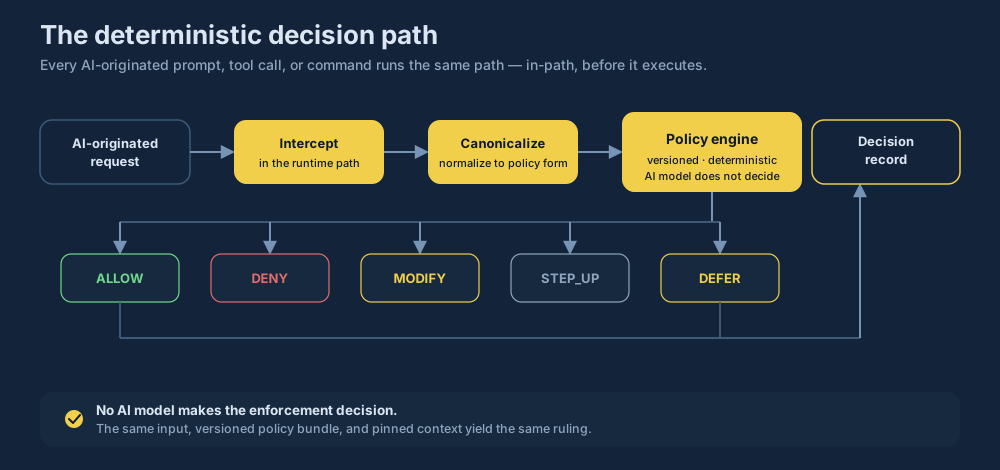
Policy governance at the browser and API layer changes that equation. When every AI session is visible to the district's governance layer — which models students are querying, what data is being submitted, whether content is being routed to third-party endpoints not covered by the district's authorization — enforcement becomes operational rather than aspirational.
That visibility gap is what Containment.AI is designed to close. Real-time policy enforcement at the AI interaction layer means districts can enforce the boundaries the school authorization exception requires — not just describe them in a vendor contract.
The COPPA compliance deadline has passed. The question for K-12 IT teams is no longer "are we preparing?" It's "what does our current posture look like, and where are the gaps?"