Enterprise security teams can now monitor Claude usage directly in the Cloudflare dashboard. No endpoint agents required.
That's the headline from Cloudflare's recent CASB integration with the Claude Compliance API. Anthropic built the Compliance API to give enterprises programmatic access to security-relevant data about their Claude organizations, workspaces, and usage. Cloudflare CASB consumes this endpoint to surface findings — projects, uploaded files, chat messages, provider-generated content — in the same dashboard where you manage Microsoft 365, Google Workspace, and Salesforce.
This is genuinely useful infrastructure. For any CISO running Claude at enterprise scale, having AI activity surfaced in your existing security tooling is table stakes. The Compliance API closes a real visibility gap.
But visibility and enforcement are not the same thing, and the difference matters for your compliance program.
The Architecture Gap: Monitoring vs. Enforcement
The Compliance API works out-of-band. It shows you what happened after AI sessions occur. When a developer pastes an internal API key into a Claude prompt, Cloudflare CASB will surface that finding in your dashboard — after the data has already reached Anthropic's infrastructure. When a finance analyst shares customer revenue figures in a chat, the Compliance API provides a log. What it does not provide is a block.
For three specific compliance requirements, the distinction is material:
SOC 2 Trust Service Criteria CC6.1 — Logical and Physical Access Controls requires evidence that access to sensitive data was prevented, not merely detected. Post-hoc discovery satisfies the logging control. It does not satisfy the prevention control.
GDPR Article 5(1)(f) — Integrity and Confidentiality requires "appropriate technical measures" to prevent unauthorized processing of personal data. Auditors increasingly ask: does your technical measure stop the transmission, or does it surface a finding after transmission has already occurred?
ISO 27001 A.8.22 — Filtering of Web Services requires controls at the network or endpoint layer that restrict access based on content classification — not controls that review what was transmitted.
Where in the Data Flow Does the Control Live?
The Compliance API and its SIEM/CASB integrations live at the end of the flow. The prompt left the user's device, reached the AI provider, and the session completed — then the finding surfaces for triage.
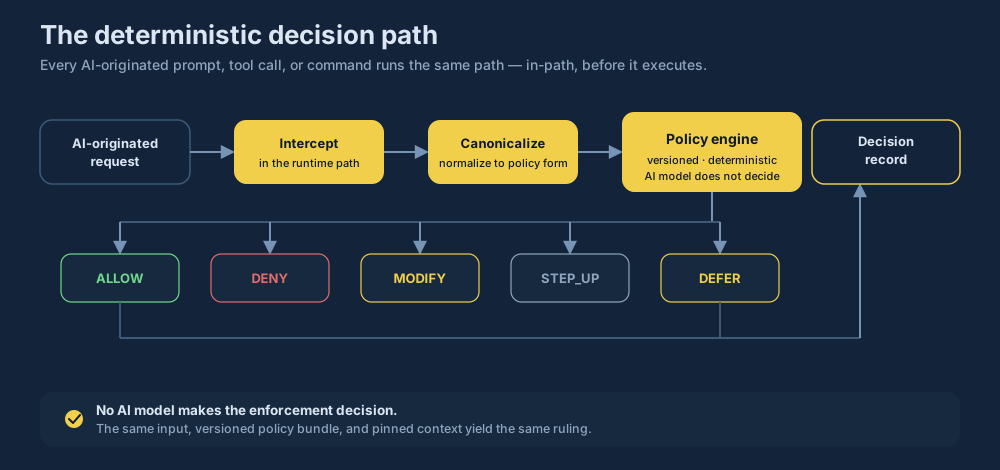
A proxy or browser-level enforcement layer intercepts the prompt before it leaves the user's device. Regardless of which AI tool the user is accessing — ChatGPT, Claude, Gemini, Microsoft Copilot, Grok, Perplexity — the same policy applies. No per-vendor API integration required. The enforcement happens at the point where the user submits, before the data moves.
For regulated enterprises with SOC 2, GDPR, or ISO 27001 programs, the defensible posture combines both layers: enforcement at the source to satisfy prevention controls, and the Compliance API ecosystem to satisfy detection, logging, and incident response requirements. Neither alone is sufficient.
Anthropic and Cloudflare are building excellent monitoring infrastructure. The enforcement layer remains a separate architectural requirement — and the one that regulators ask about first.
Containment.AI enforces AI governance policies in real time — at the proxy layer and in the browser — before sensitive data leaves your organization. Create a free workspace.