Yesterday, Anthropic launched the Claude Compliance API with three serious launch partners: SailPoint for identity governance, Proofpoint for DLP, and CrowdStrike for endpoint and SIEM. Claude Enterprise prompts, responses, and activity logs now flow directly into the platforms enterprise security teams already operate.
That is a real, useful piece of infrastructure. It is also a narrowly-scoped one — and for F5000 and healthcare buyers running multiple AI tools across their workforce, the gap it leaves open is bigger than the gap it closes.
What Anthropic Actually Shipped
The Compliance API is an activity-export layer for Claude Enterprise. SailPoint can apply identity and access policies to Claude usage, Proofpoint can scan prompts and responses against DLP rules, CrowdStrike can ingest the activity feed alongside the rest of its SIEM telemetry. As IDTechWire summarized on May 22, 2026, SailPoint and security vendors are integrating Anthropic's Claude Compliance API for AI governance — making Claude one of the first foundation model surfaces with a native, tier-1 path into established enterprise security tooling.
For organizations that have standardized on Claude Enterprise, this is a meaningful step. Audit trails that previously lived in Anthropic's admin console can sit next to Okta logs and Microsoft Defender alerts. Compliance teams can answer "what did our employees submit to Claude this quarter" with a SIEM query instead of a vendor ticket.
That is the upside. Now the scope question.
The Single-Vendor Assumption Doesn't Hold in 2026
The Compliance API governs Claude. It has no visibility into ChatGPT, Microsoft Copilot, Gemini, Perplexity, or Grok.
In an enterprise where every employee uses Claude and only Claude, the API closes the governance loop. That enterprise does not exist. Large organizations now routinely run five or more generative AI tools concurrently — sanctioned ChatGPT Enterprise alongside sanctioned Claude Enterprise alongside Microsoft Copilot bundled with M365, Gemini riding along with Google Workspace, plus whatever the marketing team signed up for last quarter.
Employees do not pick tools by which one IT sanctioned. They pick the tool that opens fastest on the tab they were already on. A clinical analyst with Claude Enterprise access will still paste a patient summary into ChatGPT if that's the tab already open. A financial analyst with a corporate Anthropic seat will still ask Gemini to summarize an earnings draft if Workspace is where the document lives.
The Compliance API does not see any of that traffic. That is not a product flaw — it is a scope choice. The architectural question for the buyer is what governs everything else.
Audit Layer vs Enforcement Layer
The second gap is more subtle. Even within Claude Enterprise, the Compliance API is fundamentally an export interface — it makes activity visible to downstream systems, which then evaluate that activity and generate findings. That is the audit layer: post-hoc visibility into what was submitted, what was returned, who did it, and when.
It is not the enforcement layer. The enforcement layer is the point at which a prompt is intercepted before it leaves the browser and evaluated against organizational policy — blocking the submission of a patient identifier or a customer contract to any AI tool before the data is transmitted. That is the control auditors increasingly ask about, because logged-and-leaked data is still leaked data.
The Claude Compliance API documents what happened. It does not stop what is about to happen. For organizations whose risk model treats AI data exposure as a breach event rather than a paperwork event, that distinction matters.
F5000: The SOC 2 / ISO 27001 Finding Already Forming
Under SOC 2 Trust Services Criteria CC6.6 and CC6.7, an organization must restrict and monitor data flowing to external systems. ISO 27001 Annex A controls A.5.34 and A.8.12 require equivalent oversight.
An F5000 enterprise that governs Claude through the new Compliance API but leaves ChatGPT, Copilot, Gemini, and Grok ungoverned has not satisfied either standard. They have evidence for one of five surfaces. The other four are documented exposure waiting to surface in the next audit cycle — and the auditor's question writes itself: "What about the other AI tools your employees use?"
Healthcare: A BAA With Anthropic Doesn't Cover ChatGPT
For HIPAA-regulated entities, the gap is sharper. A Business Associate Agreement with Anthropic gives a hospital the legal foundation to send PHI through Claude Enterprise. It gives that hospital nothing if a clinician pastes a discharge summary into ChatGPT.
The Compliance API will faithfully log the PHI that flowed through Claude. It will report exactly zero of the PHI that flowed through the other four tools. For a HIPAA audit, the inventory that matters is total ePHI disclosure across all channels — and the channel an employee actually used does not need to be the one the BAA covers.
NatSec and CUI: Every Surface Is a Spillage Risk
For organizations handling Controlled Unclassified Information under DFARS 252.204-7012 or the FY2026 NDAA AI governance provisions, the same logic applies with sharper teeth. A CUI spillage event is a CUI spillage event regardless of which AI vendor received the data — governing every surface is the obligation, not just the one the contracting officer asked about.
What Vendor-Agnostic Enforcement Looks Like
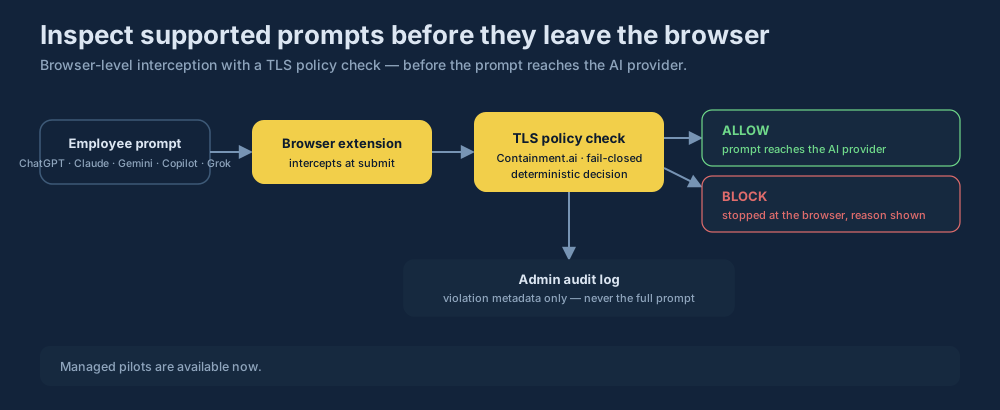
The architectural answer to a multi-vendor governance problem is a governance layer that sits in front of all the vendors. Browser-layer enforcement intercepts AI submissions in the tab, before the prompt is transmitted, and applies the same organizational policy regardless of whether the destination is Claude, ChatGPT, Copilot, Gemini, Grok, or whatever ships next quarter.
That layer does not require a separate SIEM integration per AI vendor, does not depend on each vendor shipping its own compliance export, and does not break when an employee uses a tool the security team has not yet inventoried. It operates at the enforcement layer — blocking sensitive submissions before they leave — not the audit layer.
The Claude Compliance API is the right move for Claude. Pairing it with browser-layer enforcement is what closes the gap across the rest of the AI estate.
Containment.AI enforces AI governance policies on supported browser surfaces — Claude, ChatGPT, Copilot, Gemini, and Grok — with no per-vendor SIEM integration required. Managed pilots are available now. Create a free workspace.
Sources: SailPoint press release, May 22, 2026 · IDTechWire coverage, May 22, 2026.