Earlier today, Akamai Technologies (NASDAQ: AKAM) announced a definitive agreement to acquire LayerX — a provider of browser-based AI usage control and secure enterprise browser (SEB) technology — for approximately $205 million. The transaction is expected to close in Q3 2026. At close, LayerX is projected to have annual recurring revenue of approximately $10 million.
That is a roughly 20x ARR multiple. In 2026's M&A market, that number is not noise. It is a signal about how large acquirers are pricing the AI governance category.
What Akamai is actually buying
LayerX's core capability is browser-native visibility and control over how employees interact with AI tools — ChatGPT, Claude, Gemini, Microsoft Copilot, and the emerging class of agentic browsers. Mani Sundaram, Akamai's Executive Vice President and General Manager for the Security Technology Group, explained the purchase rationale clearly: "Their existing controls cannot see how employees are interacting with AI tools and sharing with large language models."
That is the fundamental gap. Enterprise security stacks — firewalls, DLP platforms, secure web gateways — were designed for a world where sensitive data moved over the network in structured formats. They have no meaningful visibility into what an employee types into a browser tab pointed at an LLM. The prompt goes in. The response comes back. The network logs record a TLS handshake.
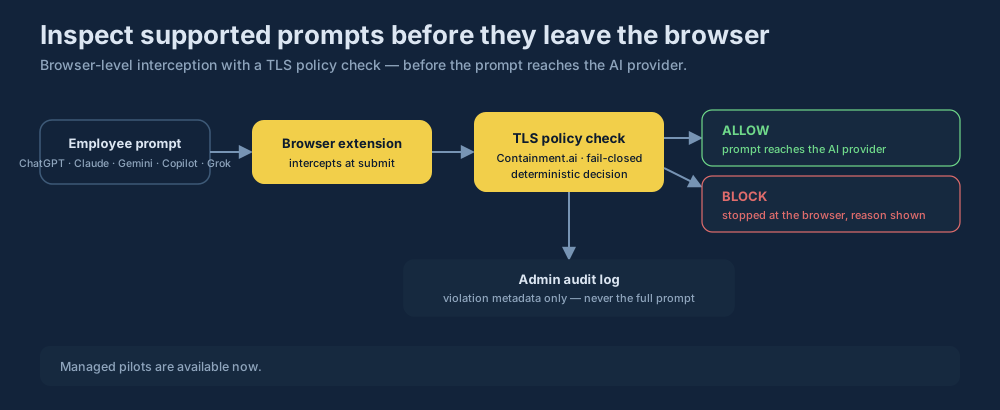
LayerX built a product that sits at that gap: a lightweight browser extension that intercepts AI interactions before submission and enforces policy at the point of use. Or Eshed, LayerX's CEO and Co-Founder, framed the category simply: "Securing human and agentic AI usage has become one of the defining challenges in enterprise security."
Akamai agreed — at $205 million.
What this means for enterprise buyers evaluating their AI governance stack
Several practical dynamics shift for enterprise buyers after an acquisition like this.
Distribution accelerates, but integration takes time. LayerX now has Akamai's enterprise sales organization, F500 relationships, and Zero Trust customer base behind it. That is a meaningful distribution advantage. But product integrations after acquisitions take time to stabilize — typically 12 to 18 months before a combined offering is sold as a coherent unified SKU rather than two products with a shared roadmap slide. Buyers who need AI governance now, rather than in 2027, should evaluate what is available today.
The vendor landscape is consolidating. A $205M acquisition at 20x ARR validates the category in a way that accelerates responses from competing incumbents. Zscaler, Palo Alto Networks, and CrowdStrike each have browser-layer or workforce security investments that now have clearer competitive justification. Expect AI usage control capabilities to appear in more platform bundles over the next 12 months — which means evaluating purpose-built governance solutions now, before the market assumes this is solved by your existing vendor's next release.
Purpose-built versus bolt-on is a real distinction. Akamai is a CDN and network security company adding an AI governance capability through acquisition. That brings real strengths — Akamai's edge scale, Zero Trust architecture, and enterprise trust — alongside a constraint: AI governance is an extension of Akamai's product motion, not its center of gravity. For organizations where governing employee AI usage is a primary compliance requirement — not a secondary network security feature — the architecture question matters. A dedicated governance proxy that evaluates governed traffic before sensitive data reaches an LLM, records tamper-evident policy decisions, and integrates with existing compliance workflows is a different tool than browser-layer enforcement added to a SASE platform.
Both approaches exist. The right choice depends on your compliance posture, regulatory exposure, and where AI governance sits in your 2026 risk priorities.
The validation signal
At a 20x ARR multiple, today's announcement definitively answers whether AI usage governance at the browser and proxy layer is a real, monetizable product category. It is.
The question enterprise security and compliance teams should be asking now is not whether to govern AI tool usage across the workforce — that debate is over. The question is how: a network security vendor's bolt-on browser layer, a hyperscaler's built-in policy toggle, or a purpose-built governance platform that enforces policies in real time, generates audit-ready evidence, and lets your compliance team configure what "allowed" actually means for your regulatory environment.
What is clear after today: the window for acting before AI governance becomes a regulatory finding — rather than a voluntary program — is closing.
Containment.AI enforces AI governance policies in real time at the proxy layer and in the browser, generating tamper-evident audit logs for governed AI interactions. Create a free workspace or contact us to discuss a managed pilot.