The White House signed a new AI executive order on June 2, 2026, and most of the coverage went to the parts about "covered frontier models" and a voluntary pre-release access framework for frontier labs. For the defense industrial base, the more consequential line is buried in Section 4 — and it has nothing to do with frontier labs.
Section 4: "Without Authorization" Is Now an AI-Agent Problem
The Executive Order, "Promoting Advanced Artificial Intelligence Innovation and Security," directs the Attorney General to prioritize enforcement of 18 U.S.C. 1028, 18 U.S.C. 1030 (the Computer Fraud and Abuse Act), and 18 U.S.C. 1343 "against anyone who utilizes AI to illegally access or damage a computer without authorization." The order is explicit that this "includes ... employing AI agents to unlawfully access data or information that is subsequently used for a criminal or unlawful purpose."
That single clause moves agentic AI from a productivity story to a liability story. The hinge word is authorization. When an AI assistant — or an agent acting on a workforce member's behalf — reaches data it had no authorization to touch, "authorization" stops being an abstract access-control diagram and becomes the line a federal enforcement priority is now drawn around. For contractors who handle Controlled Unclassified Information (CUI) or operate against National Security Systems, the boundary between authorized and unauthorized access is exactly the boundary your governance has to be able to prove — after the fact, to an auditor, and increasingly to an enterprise customer's counsel.
The government-contracts group at McCarter & English put it plainly: "Section 4's emphasis on agentic AI used to access computers 'without authorization' places CFAA risk at the center of agent design," and enterprise customers "will increasingly demand stronger contractual representations that agents act only within authorized scopes."
The 30-Day Clock Already Started (Section 2)
Section 2 puts defense systems on a fast timeline. Within 30 days of the order, the Committee on National Security Systems must prioritize the cyber defense of National Security Systems, and the Secretary of War must do the same for Department of War information systems. On the civilian side, the Secretary of Homeland Security, through the Cybersecurity and Infrastructure Security Agency (CISA), must release Binding Operational Directives and other guidance to expedite cyber defense of federal systems and "facilitate access to cybersecurity tools and services including, where appropriate, covered frontier models" for agencies, state and local authorities, and operators of critical infrastructure such as "rural hospitals, community banks, and local utilities."
The order also stands up an "AI cybersecurity clearinghouse" under the Treasury within the same 30 days, directs the Office of Management and Budget to find grant funding for "advanced AI vulnerability detection," and gives the Office of Personnel Management 60 days to expand the "United States Tech Force Information Cybersecurity Specialist" hiring pathways. One small detail signals where the center of gravity sits: Section 5 specifies that "the costs for publication of this order shall be borne by the Department of War."
McCarter's analysis pegs the first wave of deliverables to July 2, 2026 and August 1, 2026 — weeks, not quarters, away. For the defense industrial base, the practical translation is flow-downs: the firm expects "tightened SSP/POA&M scrutiny, compressed patch SLAs, and AI-monitoring integration," with CMMC-relevant subcontractors facing "requirements that exceed current baseline expectations." Those obligations land on contract vehicles that already exist.
"Covered Frontier Models" and the 30-Day Window (Section 3)
Section 3 directs a classified benchmarking process — with the Director of the National Security Agency making the designation — to identify "covered frontier models" by advanced cyber capability, plus a voluntary framework letting developers give the federal government access to those models "for a period of up to 30 days before they plan to release such models to other trusted partners." Section 3(c) is careful to disclaim any "mandatory governmental licensing, preclearance, or permitting requirement."
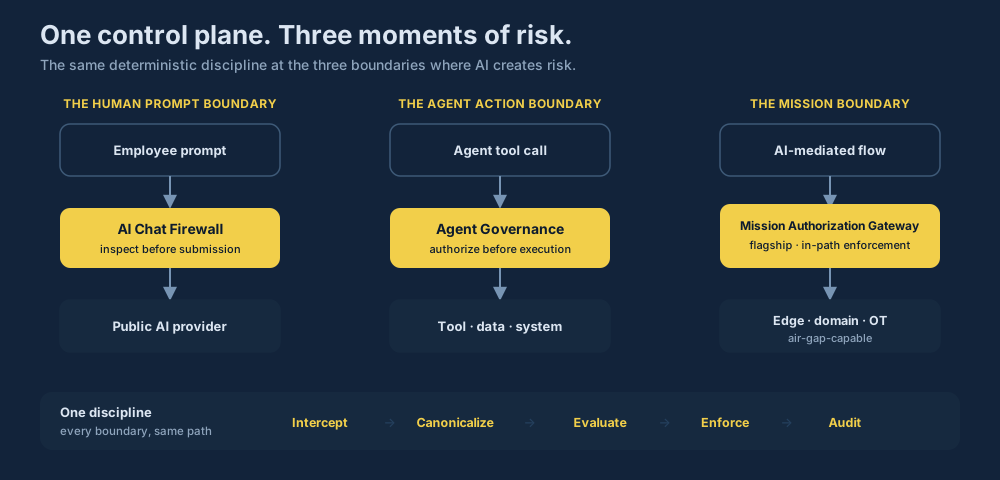
That section matters most to the frontier labs. But notice the through-line across all three: the government is hardening the boundary around what AI systems touch — the data going in, the systems being reached, and the authorization scope that says whether either was allowed.
The Control That Maps to All of This Lives at the Data Boundary
CFAA exposure under Section 4 turns on whether an AI tool or agent accessed data within authorized scope. The Section 2 hardening mandate turns on defending and monitoring the systems where regulated data lives. And every CMMC-style flow-down ultimately asks the same audit question: can you show what your workforce's AI tools did with regulated information, and prove the policy held?
That is a data-boundary problem, and the model vendor does not solve it. A platform being authorized — through FedRAMP, or by being selected as a "trusted partner" under the new framework — governs the infrastructure. It does not govern what an employee types into a browser AI session, what an agent reaches for mid-task, or whether CUI crossed a line it shouldn't have. The governance layer that records AI sessions, enforces authorization scope in real time, and produces the audit evidence sits between the user and the model — and it has to exist before the Binding Operational Directives, the clearinghouse criteria, and the contract flow-downs start asking for it.
The defense industrial base learned this the slow way with CMMC: the contractors who waited for the final rule before building controls spent the enforcement window scrambling. (We looked at that dynamic in our piece on the NDAA Section 1513 "CMMC for AI" framework.) Section 2's 30-day clock does not offer that kind of runway.
Containment.AI enforces AI governance policies at the browser layer in real time — monitoring AI sessions, enforcing CUI-sensitive policy rules, and generating the audit evidence defense contractors need as AI cybersecurity requirements take shape. See how it works →