On April 28, 2026, Vanta announced that "its Vanta Government Cloud offering has received its FedRAMP 20x Moderate Authorization from the Federal Risk and Authorization Management Program (FedRAMP®) Program Management Office (PMO)" (BusinessWire). The FedRAMP Marketplace confirms it at the source: "FedRAMP Authorized · As of 4/24/2026 · FR2525556241XM · Moderate · 20x."
This is a real milestone. For a DoD prime program lead or an aerospace OEM CISO who relies on Vanta for compliance evidence, it's worth taking seriously. But it authorizes a layer — and the layer it authorizes is not the one where defense AI programs actually get in trouble.
What FedRAMP 20x Moderate Authorizes
Per Vanta's own announcement, the platform "helps organizations demonstrate compliance with essential government frameworks including the Department of Defense's Cybersecurity Maturity Model Certification (CMMC), FedRAMP Rev 5 and 20x, NIST 800-53, NIST 800-171, NIST AI RMF." That's the GRC stack: control attestation, CMMC and NIST documentation, evidence collection, audit readiness.
FedRAMP 20x Moderate authorizes the environment Vanta runs in — the compute, storage, identity, and logging substrate assessed against the FedRAMP baseline. It's the layer that answers the auditor's question, "can you prove you have a control and a process for protecting government data?"
That question matters, and it's about to matter more. Draft GSA guidance from April 2026 signals that 20x "will become the default for new authorizations starting Q3 2026" (Cabrillo Club, 2026-04-25). The evidence layer is consolidating around 20x. Vanta is well-positioned there. This post is not a knock on that.
The Layer It Doesn't Touch
Here's the gap. FedRAMP 20x authorizes the environment. It does not govern what a cleared engineer types into ChatGPT or Claude in a browser tab, and it does not govern what an autonomous AI agent does at the tactical edge.
Consider the scenario a GRC dashboard never sees. An engineer on a controlled program is stuck on a subsystem calculation, so they paste a section of a controlled technical document — CUI, possibly export-controlled under ITAR — into a consumer LLM to get unstuck. It takes four seconds. Nothing in the compliance platform registers that it happened. The evidence layer will faithfully report a clean control posture and say nothing about the spillage that just crossed the boundary.
Two layers, two different problems:
- Layer 1 — what Vanta covers: compliance evidence, control attestation, CMMC and NIST documentation, audit readiness. The system of record.
- Layer 2 — what FedRAMP 20x does not cover: runtime LLM prompt enforcement, browser-level AI policy, edge-device AI boundary control, autonomous agent governance at inference time. The system of control.
A CMMC assessor's toughest question lives in Layer 2: not "do you have a CUI flow-control policy," but "show me the thing that sat between the engineer and the model, stopped the flow, and logged that it did." An authorization of the environment does not answer that. You have to build it.
Where the Enforcement Boundary Sits
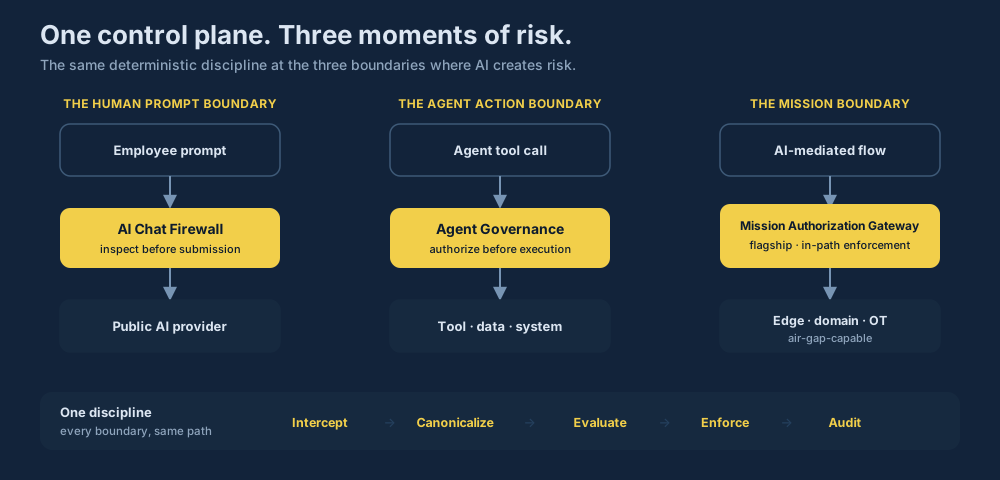
Containment.AI's Mission Authorization Gateway operates at exactly the layer FedRAMP 20x doesn't reach — the point of use, where the cleared engineer, the autonomous agent, and the LLM actually meet.
- Runtime prompt enforcement at the browser and proxy: controlled or export-controlled content is detected against a CMMC-aligned policy and blocked — or stepped up for review — before it reaches ChatGPT, Claude, or Gemini.
- Edge and agent coverage: the same non-bypassable boundary governs what an autonomous AI agent does at inference time, at the tactical edge, not just what a human types.
- Signed, deterministic receipts: every decision is logged — who, what content class, which policy fired, which control it maps to — producing the runtime evidence an assessor can't get from a policy document.
FedRAMP 20x tells your AO the environment is authorized. It doesn't tell your CMMC assessor the CUI boundary held when it mattered.
The Question to Ask Before Your Next Assessment
Keep Vanta. The GRC layer is real work, and 20x is a genuine step. But pair it with the question its dashboard can't answer:
When a cleared engineer — or an autonomous agent — sends controlled data to a frontier AI tool, what stops it, and what proves it was stopped?
If the answer is your acceptable-use policy and a clean evidence package, you have documentation without enforcement. FedRAMP 20x authorizes the environment. Only a control running at the runtime boundary closes the gap.
Containment.AI is the Mission Authorization Gateway for AI use in defense environments — a non-bypassable runtime enforcement layer at the browser, proxy, and edge that intercepts controlled data before it reaches ChatGPT, Claude, or Gemini, with signed receipts mapped to CMMC and NIST controls. See the Mission Authorization Gateway or request a demo.