Vanta published a post last week titled "Introducing AI Governance from Vanta." Their framing: "building the trust layer for AI, so you can go all in on AI without losing sight of what it's doing."
That's a real problem worth solving. Enterprises genuinely don't know which AI agents are running, what they're authorized to do, or whether they're behaving as expected. Visibility matters.
But for a DoD prime, an aerospace OEM operating autonomous systems, or a defense-AI platform team shipping agents into contested environments — a trust layer is not an enforcement layer. And the difference is not a nuance. It's the entire threat model.
What a Trust Layer Does
A GRC-expansion play at AI governance typically looks like this:
- Inventory: catalog which AI agents exist in your environment
- Policy documentation: record what each agent is authorized to do
- Questionnaire automation: answer vendor security questions about your AI posture
- Continuous monitoring: flag anomalies after they occur
This is genuinely valuable for a SaaS company preparing for a SOC 2 audit, a healthcare system documenting its AI governance posture, or an enterprise that needs to answer "which AI tools are we using?" for a procurement review.
It is the compliance layer — post-hoc, probabilistic, audit-oriented.
What an Enforcement Layer Does Differently
In defense contexts, the threat model is different in two ways that matter:
1. The decision happens at the edge, not at the dashboard.
An autonomous system operating in a DDIL (disconnected, denied, intermittent, low-bandwidth) environment cannot phone home to a compliance platform to validate whether a given action is authorized. The enforcement decision has to happen locally, deterministically, at the moment of execution — or it doesn't happen at all.
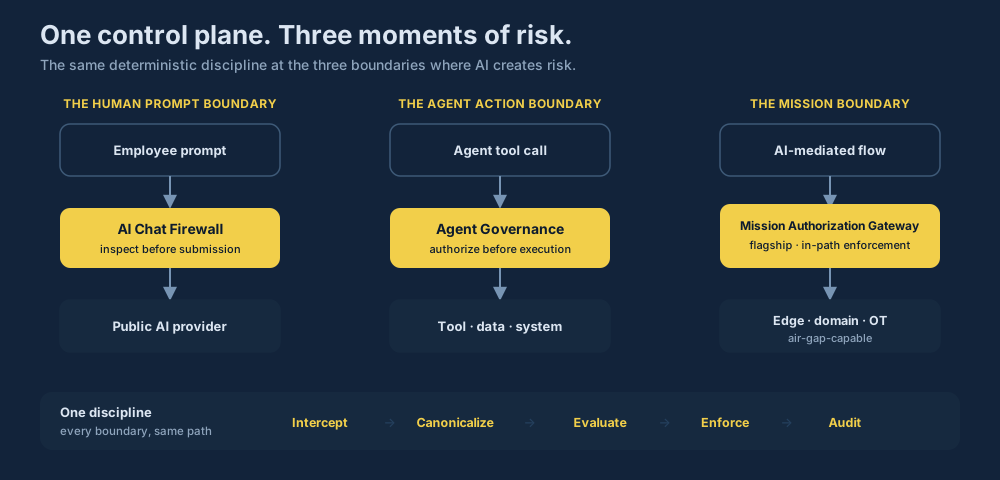
A trust layer that catalogs your agents after the fact provides no enforcement guarantee on the forward edge. A Mission Authorization Gateway that evaluates every proposed action against a signed policy set — and produces a cryptographically signed decision receipt before execution proceeds — does.
2. Probabilistic guardrails are not acceptable for safety-critical systems.
Software-defined governance that "monitors" agent behavior and "flags anomalies" relies on a detection model. Detection models have false negative rates. In a safety-critical autonomous system — a logistics drone routing around civilians, a sensor fusion pipeline feeding a weapons engagement decision, an ICS controller responding to an anomalous sensor reading — a missed flag is not a compliance finding. It's a mission failure or a safety incident.
Deterministic enforcement means the action either clears the policy evaluation or it doesn't execute. No probabilistic middle ground. No "we'll catch it in the audit log."
The Category Distinction
The GRC-expansion vendors — compliance platforms moving upmarket into AI governance — are building inventory and visibility tools. That is a legitimate and large market. It is not the same market as real-time, deterministic, non-bypassable policy enforcement at the point of AI execution.
Containment.AI's Mission Authorization Gateway sits at the enforcement layer: every action proposed by an AI agent passes through a policy evaluation engine before it executes, producing a signed receipt that proves what was evaluated, what policy applied, and what decision was returned. That receipt is immutable audit evidence — not a monitoring log that gets written after the action completes.
Vanta's new product answers: which agents do you have, and what does your policy say they should do?
The Mission Authorization Gateway answers: did this specific agent action clear policy, and here is the cryptographic proof.
For a DoD prime under CMMC, for an aerospace OEM whose autonomous system has to demonstrate human-authority preservation, for a defense-AI platform team building into an IL environment — the second question is the one that matters.
The EU AI Act Timing
This distinction is becoming regulatory, not just architectural. The EU AI Act's transparency rules take effect August 2026, with high-risk AI system rules phasing in through the same window. High-risk AI systems — including those used in critical infrastructure, defense-adjacent autonomous systems, and law enforcement — face requirements for activity logging, traceability, and human oversight measures that go significantly beyond "we have an agent inventory."
A compliance dashboard that shows your AI agent inventory is a starting point. It is not a sufficient answer for high-risk AI deployers facing binding obligations.
What This Means for Defense Buyers
If you're evaluating AI governance tooling for a defense or safety-critical program:
- Ask whether enforcement is pre-execution or post-hoc. Post-hoc monitoring is a compliance tool. Pre-execution enforcement is what DDIL and safety-critical deployments require.
- Ask whether the decision record is a log entry or a signed receipt. A log can be amended. A cryptographically signed receipt with a policy hash and an agent identity commitment cannot.
- Ask whether it operates disconnected. A governance platform that requires cloud connectivity to enforce policy doesn't work on the forward edge.
GRC vendors moving into AI governance are doing important work for the enterprise compliance market. They are not building for the threat model that defense and safety-critical AI teams actually face.
That's the gap the Mission Authorization Gateway is built to close.
Containment.AI builds deterministic AI governance infrastructure for defense and safety-critical environments. The Mission Authorization Gateway evaluates, enforces, and cryptographically receipts every AI agent action before it executes — in connected, disconnected, and air-gapped deployments. Learn more about the gateway →