Vanta published research this week confirming what anyone managing enterprise AI adoption already knows: agentic AI is proliferating faster than governance can keep up. Eight in ten organizations are already deploying — or planning to deploy — AI agents, according to Vanta's new "AI Sprawl Governance" resource. AI-related incidents, meanwhile, increased 56% year-over-year in 2024.
Vanta's framing of the problem is accurate. The proposed fix doesn't go far enough.
What Vanta gets right
Vanta's research identifies a real pattern: organizations that move fast on AI agent deployment without clear ownership, defined permissions, or consistent monitoring end up with a stack they can't audit. Their prescription — start with visibility, then add guardrails, then define accountability — is a reasonable maturity arc for organizations just beginning to grapple with AI risk.
For compliance automation across SOC 2, ISO 27001, and similar frameworks, Vanta's platform does exactly what it's designed to do: collect evidence, surface control gaps, and help teams stay audit-ready year-round.
Where it stops short
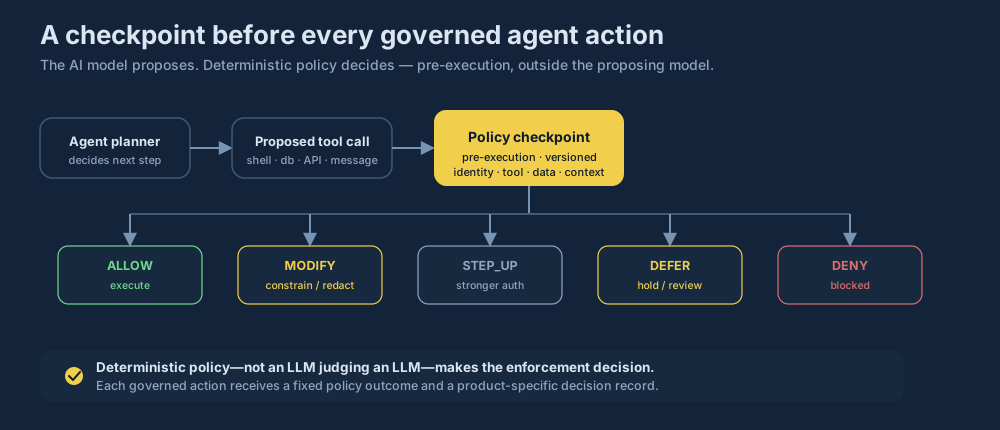
The gap is the difference between knowing an AI agent lacked oversight after the fact and preventing a policy violation before it happens.
Vanta's model is periodic monitoring and evidence collection. An agent accesses data it shouldn't, a workflow triggers incorrectly, sensitive information surfaces in a downstream system — and Vanta surfaces this in the next review cycle. That's valuable. It isn't enforcement.
For regulated enterprises — financial services firms subject to SR 11-7, healthcare organizations under HIPAA, defense contractors operating under AI-use restrictions — the question isn't "can we audit what our AI agents did last quarter?" It's "can we prevent a violation before it leaves our perimeter?"
NIST's AI RMF "Govern" function explicitly requires organizations to establish policies that constrain AI behavior at runtime, not merely document it after the fact. The EU AI Act's Article 9 risk management requirements apply to operating AI systems, not just audit artifacts. ISO/IEC 42001's continuous monitoring clause assumes controls that actually interrupt non-compliant behavior.
The enforcement gap
Here's the operational reality Vanta's AI-sprawl research doesn't address: when an employee pastes customer data into ChatGPT, or an AI agent pulls sensitive records into an output that then reaches an uncleared recipient, the incident has already occurred by the time a monitoring dashboard updates.
Real-time policy enforcement — at the proxy layer, before the request completes — is what closes that gap. Not as a replacement for compliance automation, but as the enforcement layer that makes audit evidence meaningful: you can prove not only that violations were detected, but that they were blocked.
Containment.AI sits at that enforcement layer. Policies configure once in the admin dashboard. The AI proxy and browser extension enforce them in real time across ChatGPT, Claude, Gemini, Copilot, and Grok — before sensitive data leaves the organization. Violations create an audit trail that satisfies the "operational evidence" standard regulators are increasingly demanding.
What this means for your AI governance program
Vanta's AI-sprawl research is a useful starting point for organizations building AI governance programs. The maturity progression they describe — visibility, then guardrails, then accountability — maps correctly to how most organizations will actually roll this out.
The question is where you want the enforcement boundary. If your risk tolerance or regulatory environment requires prevention rather than detection, a compliance automation platform alone isn't sufficient. You need an enforcement layer running upstream of your AI tools.
The good news: these approaches are complementary, not competitive. Vanta tells you what your AI governance posture looks like on paper. Containment.AI enforces it in real time.
Containment.AI applies enterprise policy at the proxy layer and on supported browser surfaces — ChatGPT, Claude, Gemini, Copilot, and Grok. Managed pilots are available now.