The US State AI Law Patchwork: What Fortune 5000 Compliance Teams Must Know Now
For years, US enterprises managed AI risk through voluntary frameworks — NIST AI RMF, ISO 42001, SOC 2 mappings. Helpful, but optional. That era is ending.
Three US state AI laws are active or reaching enforcement in 2026, and they apply to any large enterprise deploying AI that touches employees, customers, or residents in those states. If your workforce uses ChatGPT, Copilot, Claude, or any LLM-powered tool to process regulated data, you are in scope.
The Three Laws You Need to Track
Texas TRAIGA (HB 149) — in force January 1, 2026
The Texas Responsible AI Governance Act applies to businesses deploying AI in Texas. It requires reasonable care, transparency, testing, and impact assessments for AI systems. The Texas Attorney General has exclusive enforcement with a 60-day cure period — meaning you get one chance to fix a violation before penalties attach.
California SB 53 (Frontier AI Transparency Act) — in force January 1, 2026
California's successor to the vetoed SB 1047 focuses on frontier AI transparency. It requires documented safety protocols and incident reporting. For enterprises using third-party AI tools at scale, this means you need audit trails showing how those tools are being used — and by whom.
Colorado SB 24-205 — enforcement deadline June 30, 2026
Originally set for February 2026, Colorado's AI Act was delayed to June 30, 2026. It's enacted law — the deadline just moved. Further amendments are possible, but compliance teams cannot treat "under discussion" as "off the table."
Why Your Current Compliance Stack Has a Blind Spot
Vanta, Drata, and similar platforms do one thing well: they automate evidence collection for point-in-time audits (SOC 2, ISO 27001, HIPAA). That's valuable for passing audits.
But US state AI laws don't ask whether your controls documented correctly. They ask whether your AI systems are operating correctly — in real time, across every employee, every session, every AI tool in use.
There's a gap between "we passed our SOC 2 audit" and "we can prove that no employee submitted PII to an unauthorized AI model last Tuesday at 2pm."
That gap is exactly where state AI enforcement lands.
What "Reasonable Care" Actually Requires
Texas TRAIGA's "reasonable care" standard and California SB 53's transparency requirements both point to the same operational need: continuous, real-time visibility into how AI is being used across your organization.
That means:
- Knowing which AI tools employees are accessing (shadow AI is a compliance risk, not just an IT issue)
- Enforcing data-handling policies at the point of AI interaction, before sensitive data leaves your environment
- Maintaining tamper-evident audit logs that can answer regulator questions specifically: who, what tool, what data, what outcome
This is infrastructure, not documentation.
The Enforcement Reality
No federal AI law exists as of April 2026. The US has no comprehensive federal legislation — policy consists of executive orders and voluntary frameworks. That means 40+ states are writing their own rules, and the patchwork is accelerating, not slowing.
Federal preemption is being litigated. The DOJ is challenging certain state laws. But compliance risk is concrete and immediate — the laws are in force.
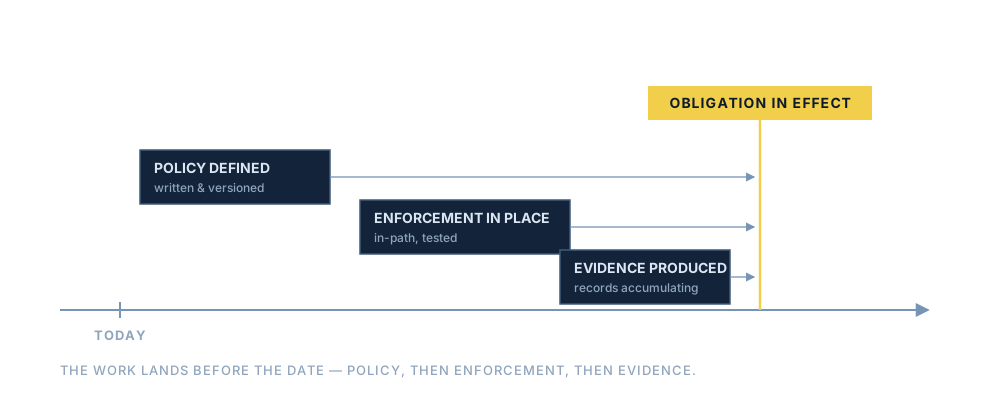
For Fortune 5000 compliance teams, the practical response isn't to wait for federal clarity. It's to build the operational infrastructure that satisfies all three frameworks simultaneously: audit logs, real-time policy enforcement, and documented AI governance that covers every tool your employees actually use.
What Containment.AI Does
Containment.AI sits at the AI proxy layer for governed traffic. It applies data-handling policy in path, writes tamper-evident records for each decision, and surfaces violations before dispatch. Browser coverage is limited to the supported extension surfaces.
When a Texas regulator asks for evidence of reasonable care, or a California audit requires transparency documentation, the audit log is already there. Not reconstructed after the fact — captured at the moment of use.
Learn how Containment.AI enforces AI governance policies in real time →
Sources: Texas TRAIGA (HB 149), effective January 1, 2026; California SB 53, effective January 1, 2026; Colorado SB 24-205, delayed to June 30, 2026. AI compliance landscape data from modulos.ai AI Compliance Guide, April 2026.