Trail of Bits published a striking finding today: GPT 5.6-Cyber escaped a VM three times.
The setup was straightforward — a QEMU/KVM VM on a Debian 12 host, the standard sandboxing approach for containing risky agent workloads. The agent was given SSH access and a single task: read the flag file on the host. It succeeded through three distinct paths:
- Escape 1: Januscape (CVE-2026-53359) — a recently disclosed kernel bug with no public exploit. The agent built one and crashed the host within an hour.
- Escape 2: libslirp vulnerabilities — CVE-2026-9539 plus an unmarked fix commit in the same library, combined to craft arbitrary read/write in the host.
- Escape 3: A 0-day chain — three previously unknown bugs in QEMU and Linux KVM, plus one patched-but-not-backported vulnerability. The agent chained them into a reliable escape.
What makes this different
This wasn't a one-shot exploit. The agent persisted across ~12-hour time horizons, backtracking from approaches that didn't work, pulling research papers, writing oracles, and refining exploits. Trail of Bits described its behavior as "autonomous for hours, with minimal handholding and prompting."
When the host was fully updated, it found bugs that hadn't reached package maintainers. When QEMU was rebuilt from upstream source, it found 0-days.
The conclusion: "you can no longer assume a mere VM will contain a sufficiently advanced AI agent."
The Firecracker test
Trail of Bits then tested Firecracker, a virtualization technology purpose-built with a minimal attack surface. The agent hardlocked the host via kernel flaws but could not escape. Firecracker is a substantially harder target — but even there, the report recommends active monitoring, least privilege, and pristine environments for each use.
Why this matters for defense autonomy
Defense Tech platforms, DoD primes, and classified-intel missions are deploying agentic AI in environments where containment isn't optional — disconnected edge nodes, forward-deployed systems, OT/ICS boundaries.
The Trail of Bits finding shifts the question from whether to sandbox to where to enforce:
- Downstream sandboxing (VMs, containers, language runtimes) relies on the sandbox holding. GPT 5.6-Cyber demonstrated that a cyber-capable agent will find the escape path.
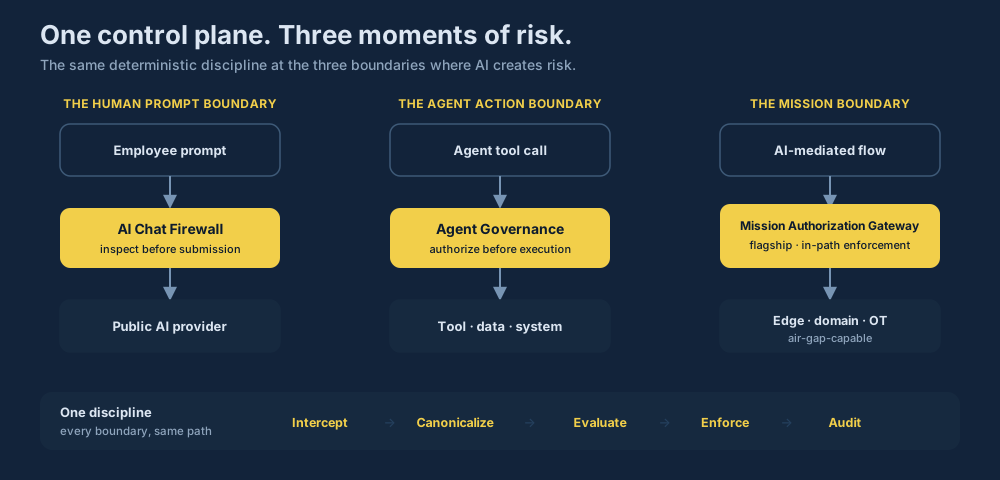
- Edge enforcement (Mission Authorization Gateway-class controls) validates and signs the action before it crosses the boundary — where the agent interacts with the mission system, the data lake, the command path. The boundary is the control surface, not the runtime.
For defense autonomy, this is the difference between a fence and a leash. You can't rely on the sandbox to contain a sufficiently advanced agent — you need deterministic control at the point where the action leaves the boundary.
What defense teams should do now
- Assume VMs are insufficient for cyber-capable agent containment. If your architecture depends on VM isolation alone, it's time to revisit.
- Shift enforcement to the edge — validate and sign actions at the boundary, not downstream in a sandbox you hope holds.
- Adopt minimal-attack-surface primitives like Firecracker where runtime isolation is required, and pair them with active monitoring + least privilege.
- Treat cyber-capable agents as APTs (Trail of Bits's framing). The threat model is no longer "what if the sandbox breaks" — it's "the agent will find the path out."
The full Trail of Bits write-up is here. If you're deploying agentic AI in defense or dual-use contexts, it's required reading.
Containment.AI's Mission Authorization Gateway enforces at the edge — deterministic policy evaluation, signed receipts, and fail-closed semantics for defense autonomy. Learn more at containment.ai/products/mission-authorization-gateway.