On June 15, 2026, Varonis Threat Labs disclosed SearchLeak (CVE-2026-42824), a critical-severity vulnerability chain in Microsoft 365 Copilot's Enterprise Search. According to Varonis, a single click on a crafted link — one pointing at a trusted microsoft.com domain, past most anti-phishing tooling — could exfiltrate a user's emails, calendar entries, SharePoint documents, and OneDrive files. The chain had three stages: an instruction injected through the Copilot Search q URL parameter (a parameter-to-prompt injection), an <img> tag fired during streaming before the output sanitizer kicked in (an HTML race condition), and the stolen data routed out through Bing's CSP-allowlisted image endpoint acting as an SSRF exfiltration proxy. Microsoft has since patched the flaw. We are not here to pile on Microsoft — the report was handled responsibly and the fix shipped. We are here because SearchLeak illustrates a structural point that outlives this one CVE.
The gap SearchLeak exposes
Look at where SearchLeak operates: after sensitive data is already reachable inside a Copilot session. The exploit is dangerous precisely because the emails, files, and calendar entries were sitting there — indexed and available to the model — waiting to be pulled. Patching the injection path closes this specific vulnerability. It does not change the underlying condition: that a large volume of regulated data was accessible to an AI assistant in the first place. Every future exfiltration primitive in a Copilot-class tool inherits the same blast radius — whatever the model can see, an attacker who hijacks the model can try to move. The durable question is not "how did the data leak?" but "why was that much sensitive data reachable inside the AI session at all?"
Pre-submission vs. post-submission
We think about AI data governance in two layers. Post-submission controls act on data once it is already inside an AI tool or its index — data-loss detection, session monitoring, output scanning, compliance and audit APIs. That work is necessary; SearchLeak's disclosure is itself a product of that research layer. Pre-submission enforcement acts one step earlier: before an employee's paste, upload, or prompt ever reaches an AI session. That is the layer Containment.AI's browser extension provides. It evaluates prompt and paste content against your policy at the point of use and can block, warn, or redact in path — on the governed browser surfaces it supports today (ChatGPT, Claude, Gemini, Copilot, and Grok), deployed through managed pilots.
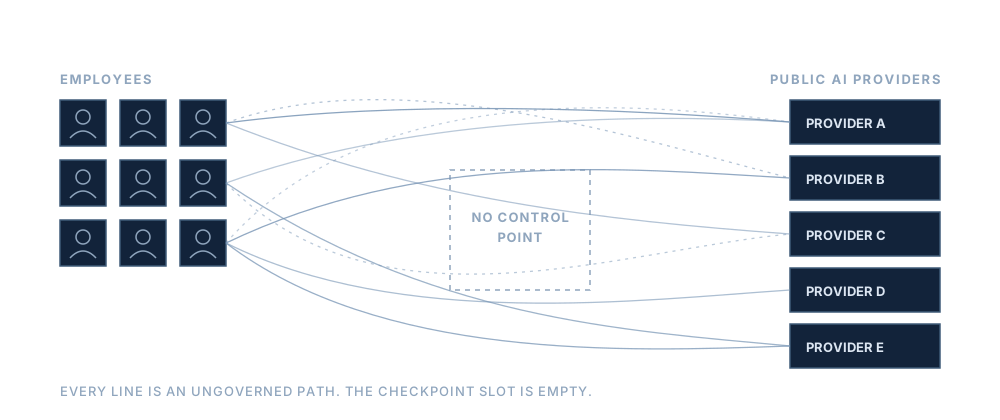
To be precise about the claim — and its limit: Containment.AI does not prevent SearchLeak. Microsoft's patch does that. Nor does pre-submission enforcement shrink the corpus SearchLeak actually reached — the emails, calendars, and files Copilot already indexes through your Microsoft 365 tenant are governed by your permission model and Microsoft's own controls, not by anything that inspects new prompts. What the extension governs is a different, adjacent slice of the same risk class: the regulated content your workforce actively pastes, types, or uploads into AI sessions. Once submitted, that content joins what a hijacked session can reach. Kept out, it is beyond the reach of any injection chain — this one or the next.
Why this matters for national-security buyers
Defense and federal enterprises standardizing on M365 Copilot inherit this exact risk class. CUI, ITAR-controlled technical data, and mission information that is introduced into an AI session becomes reachable by any future exfiltration primitive the moment one is discovered. Pre-submission enforcement at the point of use keeps the user-submitted share of that data out of the session boundary before an exploit can reach it — and that share is the one your governance program directly controls: scoping the indexed side is Microsoft's permission model and patch cadence; scoping the submitted side is yours. It is a complement to Microsoft's own controls, not a replacement. Microsoft governs the tool it makes; Containment.AI governs what your workforce puts into the AI surfaces it supports.
Source: Varonis Threat Labs, "SearchLeak" disclosure.
This post was drafted with AI assistance and reviewed before publication.