74% of AI's Value Goes to 20% of Companies. The Differentiator Is Governance.
PwC published its 2026 AI Performance Study on April 13, and the headline number is stark: nearly three-quarters of AI's economic value is being captured by just one-fifth of organizations.
But the more important finding is why.
The companies pulling ahead aren't deploying more AI tools. They're not spending more on models or moving faster on proofs-of-concept. According to PwC's survey of 1,217 senior executives across 25 sectors, the top performers share two structural traits:
- They are 1.7x more likely to have a Responsible AI framework in place
- They are 1.5x more likely to have a cross-functional AI governance board
As a result, their employees are twice as likely to trust AI outputs — which means AI decisions actually get acted on, not second-guessed or bypassed.
The governance gap is a performance gap
Most enterprises treat AI governance as a compliance checkbox: something you do after deployment to satisfy auditors. The PwC data suggests that framing is exactly backwards.
The organizations generating real financial returns from AI have made governance a prerequisite for scale — not a retrofit. They treat every AI deployment as something that needs a clear policy, accountability structure, and monitoring layer before it goes into production. That discipline is what lets them automate decisions safely and move faster than peers who are still stuck in pilot mode.
For compliance and security teams at Fortune 5000 companies, this reframes the conversation. AI governance isn't a cost center. It's the structural foundation that determines whether your organization ends up in the 20% or the 80%.
What "governance" actually means at runtime
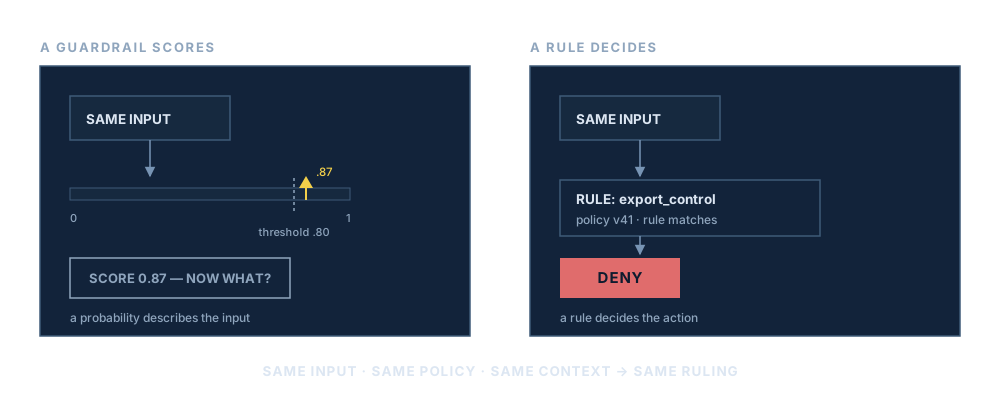
The gap between having a Responsible AI policy document and actually governing AI in production is significant. A policy that lives in a SharePoint folder doesn't stop an employee from pasting customer PII into ChatGPT. A governance board that meets quarterly doesn't detect a model producing biased outputs in a credit decision.
Real AI governance requires three things that most frameworks still treat as aspirational:
- Real-time policy enforcement — policies that intercept AI interactions as they happen, not after the fact
- Audit trails that hold up — logs that capture what was sent to which model, by whom, when, and what came back
- Cross-tool coverage — governance that spans ChatGPT, Claude, Copilot, Gemini, and whatever shadow AI your employees are using this quarter
This is the gap between compliance automation (what Vanta and Drata do well) and AI governance at the proxy layer. Compliance automation tells you whether your controls are configured correctly. It doesn't intercept a live data leak.
The window for treating governance as a future concern has closed
The PwC study lands as three major compliance deadlines are converging:
- EU AI Act full high-risk enforcement begins August 2, 2026 — 97 days away
- Colorado AI Act takes effect June 30, 2026
- NIST AI RMF Critical Infrastructure Profile released April 7, 2026, setting new expectations for utilities, energy, and financial services operators
For any regulated enterprise — financial services, healthcare, insurance, industrial — the answer to "when do we get serious about AI governance?" is now "you're already late."
The companies that will capture the next wave of AI value are the ones that can prove their AI is governed, audited, and compliant — not just deployed.
Containment.AI enforces AI governance policies in real time — at the proxy layer and in the browser — so your Responsible AI framework isn't just a document. See how it works →