On April 7, 2026, NIST quietly published something that should be required reading for every CISO, compliance officer, and operations lead at a utility, energy company, or large industrial operator: a concept note for an AI Risk Management Framework (AI RMF) Profile specifically for Trustworthy AI in Critical Infrastructure.
This isn't a final rule. It's a concept note — the opening move in a standards development process. But concept notes from NIST have a track record of becoming the de facto expectations against which regulators and auditors measure your program. The AI RMF 1.0, released in 2023, is already cited by the SEC, referenced in NERC discussions, and treated by federal contractors as effectively mandatory. A sector-specific profile for critical infrastructure will carry the same weight — and it's coming for your environment.
What the Profile Is Addressing
Critical infrastructure operators — utilities, pipelines, water systems, manufacturing facilities — are increasingly deploying AI across both IT and operational technology (OT) environments: predictive maintenance on industrial control systems, anomaly detection on SCADA networks, demand forecasting for grid management, and AI-assisted safety monitoring. These aren't chatbots. They're systems where a governance failure can mean physical consequences.
NIST's concept note frames the problem clearly: adopting AI in high-stakes environments requires those AI systems to be worthy of trust. The profile is designed to extend the AI RMF's four core functions — Govern, Map, Measure, Manage — into the specific risk landscape of IT/OT convergence, Industrial Control Systems (ICS), and critical infrastructure sectors.
For operators who are already navigating NERC CIP-014, TSA pipeline cybersecurity directives, and sector-specific ISAC guidance, this profile will add a new dimension: not just "is your OT environment secure?" but "are the AI systems operating in that environment governed in a way that regulators can audit?"
Why This Matters Now
The timing is deliberate. AI adoption in industrial environments has accelerated faster than the governance frameworks meant to manage it. Utilities are using machine learning for predictive outage prevention. Pipeline operators are using anomaly detection to flag physical intrusions. Grid operators are deploying AI for real-time load balancing. In almost every case, the AI layer sits on top of OT infrastructure that was designed before AI existed — and the governance of that AI layer is an afterthought, if it exists at all.
NIST's move to create a dedicated critical infrastructure profile signals that regulators are paying attention. And in critical infrastructure, where NERC CIP compliance is already a board-level conversation, a new NIST profile on AI governance is not optional reading — it's the preview of what auditors will ask about in 12–18 months.
The Gap Most Operators Haven't Closed
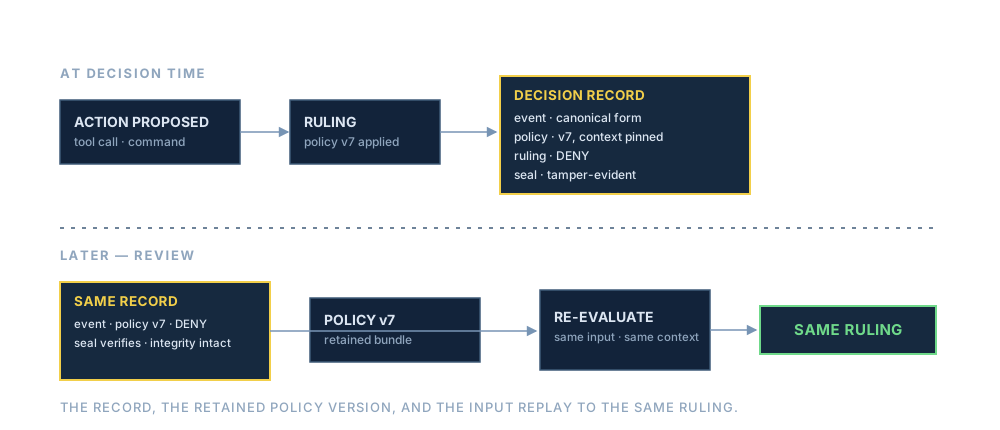
The core governance gap in OT environments is visibility: most operators cannot answer the question "what AI-generated decisions affected our operations last week, and how were those decisions made?" The AI systems are running. The outputs are being acted on. But there is no audit trail, no policy engine enforcing guardrails on what those systems can recommend, and no mechanism to flag when an AI output falls outside expected parameters before a human acts on it.
This is the gap Containment.AI is built to address at governed enterprise boundaries: in-path policy evaluation, tamper-evident decision records, and configurable guardrails before covered data or recommendations cross the enforcement point. The scope is the traffic routed through the proxy or a supported browser surface.
What Operators Should Do Right Now
The concept note phase is the right time to act — before the profile becomes a formal standard and before regulators start asking for evidence of compliance.
1. Map your AI systems against your OT environment. Which AI systems have visibility into or influence over operational technology? Which of those have governance controls? The answer at most operators is "fewer than we think."
2. Establish a policy layer for AI outputs in high-stakes workflows. If an AI system is recommending maintenance scheduling, anomaly triage, or grid load decisions, there should be an enforceable policy governing what that system can and can't recommend — and a log of every recommendation it made.
3. Start building your audit trail now. NIST's AI RMF emphasizes accountability and transparency across the AI lifecycle. When your next NERC CIP audit asks about AI governance, "we haven't documented that yet" is not an acceptable answer.
4. Track this profile's development. The concept note is the start, not the end. Submit comments. Send your compliance team to the stakeholder workshops NIST will run as this profile develops. Organizations that shape the standard are better prepared when it lands.
The NIST AI RMF Profile for Critical Infrastructure is the clearest federal signal yet that AI governance in industrial environments is moving from best practice to baseline expectation. The question for operators isn't whether this will affect their compliance program — it will. The question is whether they're building the governance infrastructure now, while there's time to do it deliberately, or waiting until the standard is finalized and the auditors are already asking.
Containment.AI enforces AI governance policies in real time — at the proxy layer, in the browser, and in the admin dashboard. If your team is deploying AI in regulated or high-stakes environments and needs a defensible audit trail, request a demo.