On July 29, 2026, NIST released an initial public draft of Guidance and Templates for Public-Facing AI Documentation: An AI Standards 'Zero Draft.' Public comments are open through September 16, 2026.
The title sounds bureaucratic. The implications for defense AI developers are not.
What NIST Is Actually Asking For
The Zero Draft is NIST's attempt to standardize what organizations must be able to say about their AI systems — publicly, verifiably, and in a form that auditors, procurement officers, and oversight bodies can evaluate. It sits alongside the AI RMF Critical Infrastructure Profile (released April 7, 2026) and the AI Agent Standards Initiative that NIST formally launched in February 2026.
Taken together, these three documents sketch a clear direction: AI systems deployed in consequential environments need to be able to produce documentation of their own decisions on demand.
For a ChatGPT integration in a marketing department, that's a compliance checkbox. For an autonomous system operating in a contested environment, it's a fundamentally different engineering constraint.
The Defense AI Documentation Problem
DoD primes and aerospace OEMs building AI-enabled systems face a specific version of this problem. The systems they ship often:
- Make decisions faster than any human can review
- Operate in environments where connectivity to a central logging infrastructure isn't guaranteed
- Cross classification boundaries where data provenance becomes a legal question, not just a technical one
- Are subject to Concept of Operations (CONOP) approval processes that assume the system's behavior can be characterized in advance
The NIST Zero Draft — and the broader regulatory trajectory it represents — implicitly requires that these systems be able to generate their own accountability record. Not a log reviewed by humans later. Not a dashboard in a SOC. A machine-readable, tamper-evident, decision-by-decision receipt that answers: what did this AI system do, against what policy, with what outcome?
This is the gap that most AI governance tools don't close. Monitoring what an AI system did is not the same as enforcing what it's permitted to do — and generating a signed, policy-grounded receipt at the moment of each decision is a different architectural requirement than post-hoc logging.
What "Public-Facing Documentation" Means at the Edge
The phrase "public-facing AI documentation" in NIST's Zero Draft is aimed primarily at commercial AI deployers — chatbots, recommendation engines, hiring tools — where the public is the affected party. But the transparency standard it's trying to establish has a parallel in defense procurement: the requirement to demonstrate, to program offices and contracting officers, that an AI system behaves according to its stated policy.
For a defense prime submitting an AI-enabled system for CONOP approval or FedRAMP-adjacent authorization, the documentation burden is the same problem with a classified audience. You need to show that the system did what you said it would do, when it was supposed to do it, and that you can prove it.
That proof requirement doesn't disappear in a disconnected, denied, intermittent, or limited (DDIL) environment. It gets harder.
The Signed Receipt as the Answer
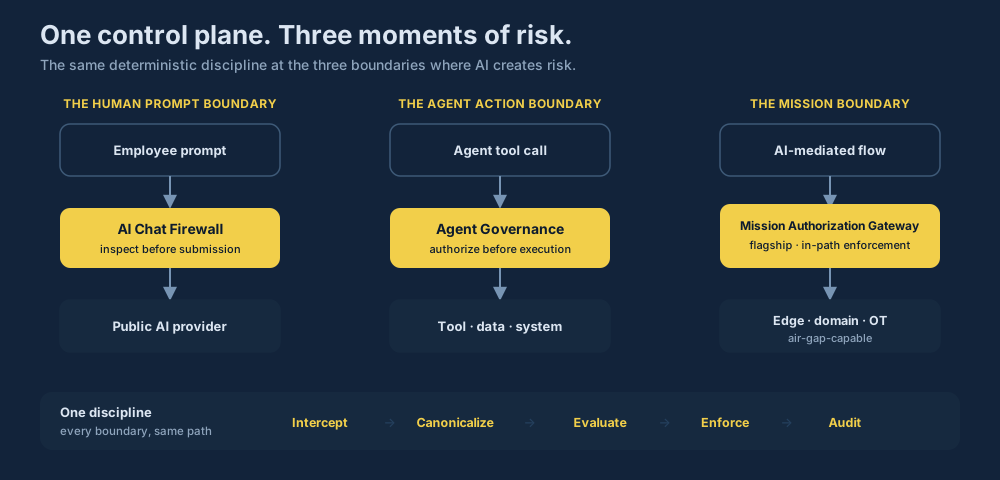
The architectural response to this requirement is straightforward in principle and difficult in practice: every AI decision should generate a signed, policy-grounded receipt at the point of enforcement — not logged centrally after the fact, but produced deterministically at the edge, before the action executes.
A receipt of this kind answers NIST's transparency question directly:
- What policy governed this decision? (version-locked, tamper-evident)
- What was the input to the policy check? (canonicalized, not raw)
- What was the outcome? (PERMIT / DENY / CLAMP with reason code)
- Who can verify it? (signed with a key the program office holds)
This is what the Mission Authorization Gateway is designed to produce. The receipt isn't a compliance artifact appended after deployment — it's the output of every enforcement decision, generated before the AI action executes, in a form that can be verified offline.
The Comment Window Is the Signal
NIST's comment period closes September 16, 2026. For defense AI developers and the primes responsible for their supply chain, this is the window to engage with how "AI documentation" will be defined for the contexts that matter most — not just commercial chatbots, but autonomous systems, edge-deployed AI, and AI that crosses classification boundaries.
The organizations that participate in shaping those definitions will also be the ones best positioned when the documentation requirements become procurement conditions.
The question isn't whether NIST's transparency mandate will reach defense AI. It's whether your systems can generate the required evidence when the program office asks.
Containment.AI's Mission Authorization Gateway enforces policy at the edge and generates signed, verifiable decision receipts for every AI action — in connected and DDIL environments. Learn more about the gateway architecture.