On June 2, at Build 2026, Microsoft introduced Scout — the first of what it calls Autopilots: agents that stay on in the background, hold their own identity, and act on your behalf without waiting for a prompt. Scout is built on the open-source OpenClaw agent framework, and it shipped as an experimental release to customers in Microsoft's Frontier program.
If your mental model of enterprise AI risk is still an employee pasting something sensitive into a chatbot, Scout is the announcement that retires it. Agent governance stopped being a future problem the day an always-on agent got a seat in the directory.
The Access Surface Is the Story
Read Microsoft's own documentation and count what Scout can reach:
- The Microsoft 365 graph — Teams, Outlook, OneDrive, and SharePoint, including chats, email, calendar, and contacts.
- The desktop — Scout reads and writes files, runs shell commands under a tiered permission system, and automates the browser.
- Everything beyond — the desktop app extends to local resources and external tools via Model Context Protocol (MCP) servers.
- Time itself — autonomous modes run on schedules and triggers, including periodic background check-ins that execute while the user is away. Scout can also launch sub-agents that work in parallel.
That is not a chatbot with plugins. That is a persistent, credentialed actor with hands on email, files, a shell, and the open web — designed to act while nobody is watching. Forrester's Jeff Pollard put the risk plainly to Computerworld: "LLM agents still struggle with goal alignment, multi-step reasoning drifts, and tool misuse."
What Microsoft Got Right
Credit where due: Scout ships with more governance than most agent deployments have ever had.
Every Scout instance runs under its own governed Entra identity — a known actor in the directory, not a shared, anonymous service account. Credentials are scoped to the task at hand and redacted from logs. Rollout requires Frontier enrollment, Intune policy configuration, and an opt-in attestation. Organizations define which resources and destinations the agent can reach, sensitive actions can require a human sign-off, and Microsoft says Purview sensitivity labels and data-loss-prevention policies apply at the moment of action. Microsoft is even contributing policy-conformance checks upstream to the OpenClaw project.
This is genuinely good. Microsoft just made per-agent identity, policy configuration, and attestation the baseline expectation for enterprise agents, and the whole market benefits from that floor.
But look at what each of those controls actually is. Identity establishes who the agent is. Intune policy establishes what it is configured to touch. Attestation and conformance checks validate that the environment was set up correctly. None of them is a runtime decision about whether the specific action the agent is about to take — this shell command, this email, this MCP call — should be allowed to execute.
Identity Doesn't Stop an Agent Mid-Flight
Here is the failure mode that provisioning-time governance cannot reach. Scout reads email as part of its job. An attacker sends a message crafted to steer it — prompt injection, the dominant vector behind the top entries in agentic-AI risk taxonomies. From that moment, every permission Scout's identity legitimately holds is working for the attacker. The Entra identity is not violated; it is performing exactly as designed, attributing the compromised actions to a known actor. Attribution is what identity buys you. Prevention is not.
The same logic applies to goal drift and tool misuse — the agent doesn't need to be attacked to wander off-task across a long, unsupervised, multi-step run. And the human-approval gate for sensitive actions depends on the runtime correctly classifying an action as sensitive — a judgment made inside the same software the adversary is steering.
The framework under Scout illustrates why that matters. An academic security analysis systematized 470 security advisories filed against OpenClaw, documenting policy-bypass, prompt-injection, and identity-spoofing vulnerability classes — including cases where the framework's own command allowlist was defeated with shell line-continuation tricks. Its structural conclusion: in the framework, trust is enforced layer by layer instead of at one unified policy boundary. In plainer terms: the referee lives inside the thing it referees. Bypass the runtime and you've bypassed the rules — and the audit trail the runtime writes about itself.
Microsoft is hardening its fork, and that work is real. But hardening the agent is not the same as governing it from outside.
The Missing Layer Is Enforcement
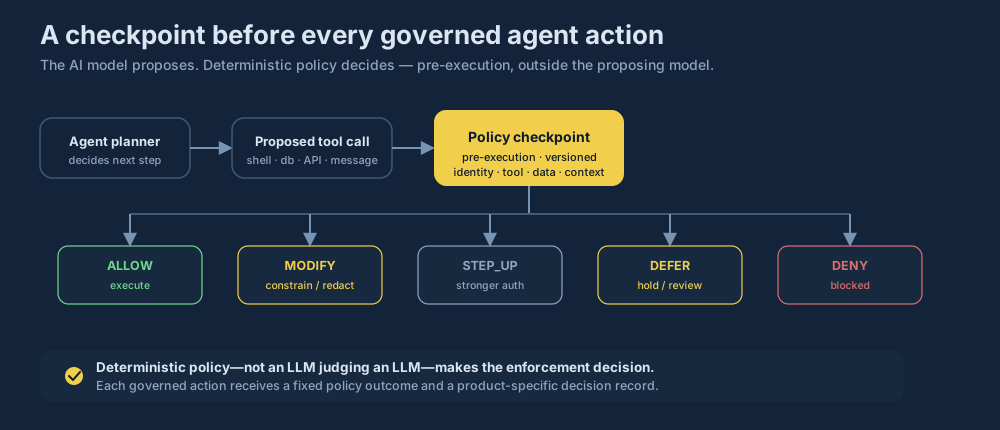
What Scout's governance story lacks isn't more identity or more configuration. It's an enforcement layer: a decision point external to the agent and its framework that evaluates each consequential action against policy and returns an allow-or-deny verdict before the action executes. Deterministic policy—not an AI model—makes that enforcement decision. It writes a product-specific decision record for each governed ruling, so the evidence of what the agent did doesn't depend on the compromised party's own diary.
External, so a subverted runtime cannot grade its own homework. Deterministic, so the same action under the same policy always yields the same verdict — no probabilistic judge to inject past. Act-by-act, because the question that matters at runtime is not "is this actor authenticated?" but "is this action authorized, right now?" And independently evidenced, because when the incident review comes, a hash-chained record of every allow and deny is the difference between a retrieval and a reconstruction.
That layer is framework-agnostic by construction. It doesn't care whether the actor is Scout, a raw OpenClaw deployment, or whatever ships next quarter. The agent proposes. Policy disposes.
Scout is experimental today, Frontier-only, and Microsoft is being appropriately careful. But the category it opens is not going back in the box: always-on agents with enterprise credentials are now a roadmap item at the world's largest software company. Before one of them goes on the payroll in your environment, the question to answer is the one identity can't: who decides, per action — and where does the evidence live?
Containment.AI builds the enforcement layer for AI-powered autonomous systems. The Mission Authorization Gateway makes deterministic, action-level policy decisions outside the agent and writes signed, hash-chained evidence receipts for every allow and deny — for any agent framework, Scout included. See how agent governance works.