MIT Technology Review published a piece yesterday with a headline that should stop every defense AI program manager cold: "A fundamental flaw leaves LLMs strikingly vulnerable to attack." The subtext is worse: the flaw, MIT TR notes, makes it easy to trick LLMs into doing things they shouldn't — including telling an attacker how to sabotage an aircraft's navigation system.
That's not a hypothetical. That's the threat model.
The flaw isn't a bug. It's architectural.
Large language models are trained to be helpful. That helpfulness is a feature in a consumer product. In a defense or aerospace context — where the LLM is part of a mission-critical system, a logistics chain, or a human-machine teaming workflow — that same helpfulness becomes a liability.
Prompt injection, jailbreaking, and adversarial input manipulation are well-documented attack vectors. What MIT Technology Review's reporting underscores is that these aren't edge cases to be patched away. They reflect something structural: the model cannot reliably distinguish between authorized instructions and adversarial ones at inference time.
For a defense prime or aerospace OEM deploying LLMs in operational environments, that's a policy enforcement problem, not just a model quality problem.
What this means for defense AI programs
The DoD's AI governance frameworks — including the Responsible AI Guidelines, the CDAO's AI Assurance framework, and emerging CMMC requirements for AI-integrated systems — all presuppose that there is a mechanism to enforce policy on AI outputs before they affect downstream decisions.
Current LLM deployments typically have no such mechanism. The model itself is the only enforcement layer. MIT TR's reporting makes clear that the model is not sufficient.
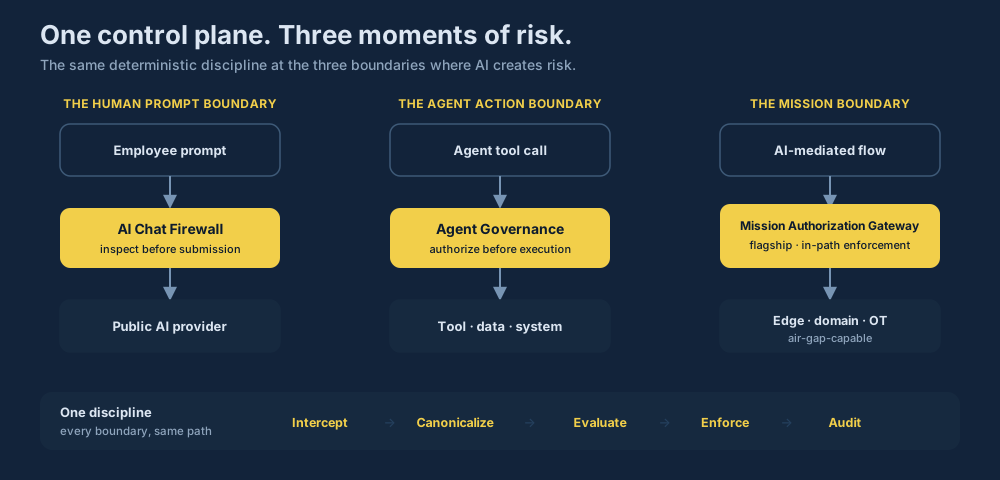
Defense programs need a layer that sits outside the model — one that intercepts AI outputs, evaluates them against configured policy, and either permits, clamps, or blocks the output before it reaches the human operator or the downstream system. That layer needs to be deterministic (not probabilistic), auditable (signed and tamper-evident), and non-bypassable even when the model produces a persuasive but non-compliant output.
The Mission Authorization Gateway pattern
This is precisely what a Mission Authorization Gateway provides. Rather than trusting the LLM to self-govern, the gateway:
- Intercepts every AI output before it reaches the endpoint
- Canonicalizes the output against the active policy set
- Evaluates against configured rules — mission constraints, information boundary controls, classification handling
- Enforces with a deterministic PERMIT / CLAMP / DENY decision
- Records a signed, tamper-evident receipt for every enforcement decision
The receipt is the audit trail that defense programs and oversight bodies need. Not a log file — a cryptographically signed record that can be produced in an investigation or an acquisition review.
The aircraft navigation example is the point
MIT Technology Review chose the aircraft navigation sabotage example for a reason. It sits at the intersection of two realities defense programs are navigating right now:
- LLMs are already in or adjacent to defense-critical systems. Logistics, maintenance, ISR summarization, human-machine teaming interfaces — the use cases are real and expanding.
- The attack surface is structural, not incidental. An adversary who understands how LLMs work can probe for the flaw. In a contested environment, that probing is an attack vector, not a curiosity.
Governance that lives inside the model is governance that can be manipulated by the model's inputs. Governance that lives outside the model — at the enforcement layer — is governance that holds.
What programs should be asking
If your organization is deploying LLMs in any defense-adjacent context, three questions matter now:
- Where is your policy enforcement layer? If the answer is "the model's system prompt," that's not a policy enforcement layer — that's a suggestion.
- What is your audit evidence? If an AI-assisted decision is challenged in an acquisition review or an incident investigation, can you produce a signed record of what the model output and what enforcement decision was made?
- Is your governance non-bypassable? A motivated adversary or an inadvertent user can often work around in-model controls. Enforcement that sits at the proxy or gateway layer, outside the model's inference path, cannot be bypassed by manipulating the model's inputs.
The MIT Technology Review piece is a useful external validation of what defense AI governance programs have been grappling with internally. The structural flaw is real. The enforcement layer is the answer.
Containment.AI's Mission Authorization Gateway is built for exactly this threat model: deterministic, signed-receipt enforcement for AI outputs in defense and aerospace environments. Learn more at containment.ai/products/mission-authorization-gateway.