On August 5, 2026, DefenseScoop reported that the Defense Department approved Salesforce's enterprise agentic AI platform — Agentforce 360 — "to securely store and process high-sensitivity workloads with Controlled Unclassified Information (CUI) and unclassified National Security Systems (NSS) data" at DOD Impact Level 5. That's a milestone: a commercial agentic platform authorized to run autonomous agents against sensitive defense data, with Army Human Resources Command named as the first DOD component to deploy it.
The pitch, in the words of one company executive, was governance. "What I want is airmen, soldiers, sailors, Marines, guardians — anybody — can innovate on this platform and go fast, because they know the basics are set. The guardrails are built in," retired Maj. Gen. Allan Day, a Salesforce industry strategy executive, told reporters. "Guardrails, to me, built-in means I can accelerate. It's not a speed bump."
A week earlier, at Black Hat 2026, Snowflake announced its Cortex AI Gateway — built on its Natoma acquisition, which it describes as "a centralized MCP gateway that enforces identity, policy and audit at the tool-call level." Snowflake was explicit about where that governance lives: the gateway "extends Snowflake's rigorous data governance framework to agent traffic," so enterprises can "deploy AI agents where they belong: inside the secure enterprise."
Two signals, three weeks apart, pointing the same direction. Agentic AI is moving into national-security environments fast, and the governance story the market is telling is guardrails built in and a centralized gateway inside the enterprise. Both are genuine progress. Both also rest on the same architectural assumption — and that assumption breaks down at the place defense AI is actually heading.
"Guardrails built in" describes the platform, not the moment of action
Start with the language. "Guardrails built in" and "governed agent interoperability" are platform properties. They describe a well-configured environment: identity is managed, tool access is scoped, activity is logged. That is real value, and for the vast majority of enterprise agent deployments it is the right place to start.
But read Snowflake's own description of what the gateway delivers and you find the center of gravity is visibility, not interdiction: "Agent actions are captured in real time: which tool was called, which system it touched, in what order and by whom. Audit trails give security and compliance teams the evidence they need." That is an audit function. It answers what did the agent do? — after the agent did it. It's worth noting, too, that most of the net-new governance surfaces Snowflake announced (Intelligent Model Routing, Access Governance, Agent Action Auditability, and others) are labeled "private preview," under a standard forward-looking disclaimer that they "are not commitments to deliver any product offerings." The category is being built in public, in real time.
None of this is a criticism. Monitoring, traceability, identity scoping, and data-exfiltration telemetry are exactly what a mature enterprise AI program needs. The point is narrower: governed and monitored are not the same as an action was evaluated against an authorization policy and blocked before it executed. In most enterprises, the difference is academic. In the environments defense is now authorizing agents to operate in, it is the whole question.
The cloud-plane assumption
Both announcements share a location. Snowflake's gateway governs agent traffic "inside the secure enterprise." Salesforce's IL5-accredited Agentforce 360 is, per DefenseScoop, "hosted on Amazon Web Services' GovCloud," which the company described as "a physically and logically isolated region operated exclusively by U.S. personnel."
A GovCloud region is the right home for a huge amount of defense work — logistics, case management, back-office automation. Salesforce's first use case is telling: Army Human Resources Command, with automated case summarization across an estimated 55 million conversations per month. That is high-value, and it lives in a connected data center.
But it is not where the hardest part of the AI-at-the-edge mission is going. The same week these governance announcements landed, the defense-tech news cycle was about attack-drone task forces, hypersonic programs, and homeland drone defense — autonomy pushed forward, into disconnected, denied, intermittent, and low-bandwidth (DDIL) environments, onto platforms and operational-technology systems that cannot assume a live round-trip to a cloud control plane.
That is the architectural break. A centralized gateway that governs agent traffic "inside the secure enterprise" is not in the call path when the agent is running on a forward-deployed system with no reachable cloud endpoint. "Guardrails built in" to a GovCloud platform do not travel with the mission to the edge. The governance layer stops at the network boundary; the autonomy does not.
What an authorization boundary looks like at the edge
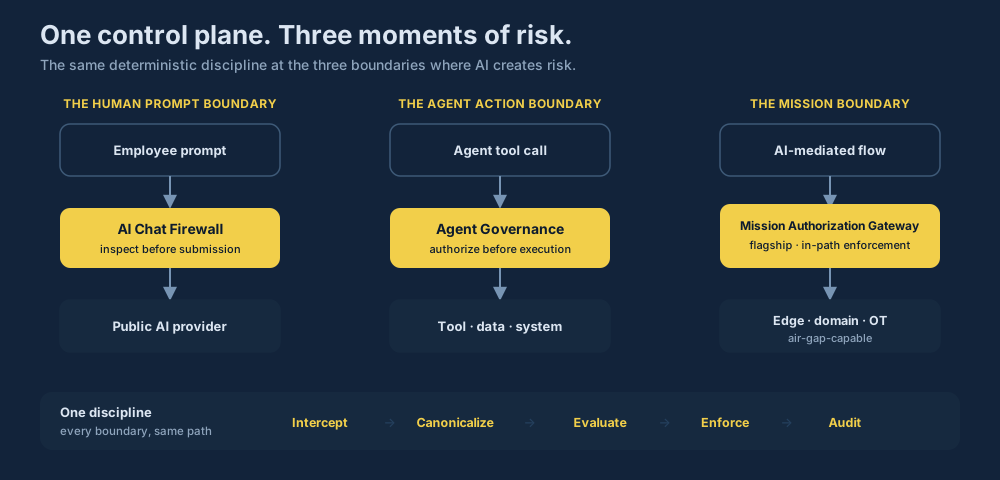
For an AI agent operating near consequential, non-recoverable action — where the wrong data crossing or the wrong tool call has no "remediate after the fact" path — the governance requirement shifts from observe to authorize. That layer has to:
- Intercept every agent action at the boundary — before execution, not after.
- Evaluate it against a deterministic policy — rules an auditor can read, not a model grading its own behavior.
- Issue a signed, verifiable decision receipt — PERMIT or DENY, with the policy clause cited, before the action proceeds.
- Be architecturally non-bypassable, and run locally — a chokepoint in the call path that works when the cloud does not.
That is the Mission Authorization Gateway pattern: an enforcement layer that lives with the agent, evaluates each action against a deterministic authorization policy at the point of action, and produces a signed receipt a mission owner can verify later. It is not a replacement for cloud-plane governance — inside the connected enterprise, Snowflake's and Salesforce's layers do essential work. It is the layer that has to exist when the agent operates where those layers can't reach.
The question defense buyers should ask
If you're evaluating agentic AI for a defense environment, "the guardrails are built in" is the start of the conversation, not the end. The follow-ups:
- Does the governance layer evaluate and block an agent action before it executes, or does it record the action after?
- Is the enforcement deterministic and auditor-verifiable, or does it depend on the model to police itself?
- Does it produce a signed decision receipt a mission commander can verify independently?
- Does it work at the edge, disconnected — or only inside a connected cloud region?
The IL5 authorization of a commercial agentic platform is a real inflection point, and the vendors driving it are doing serious work. It's also a useful moment to be precise about what "governed" means — and where the boundary actually holds.
Containment.AI builds the Mission Authorization Gateway: a deterministic, non-bypassable enforcement layer for AI agents in defense and critical-infrastructure environments, including forward-deployed and disconnected edge deployments. It intercepts, evaluates, and issues signed decision receipts on every agent action — before execution. Learn more at containment.ai/products/mission-authorization-gateway.