When a nurse asks ChatGPT to help summarize a patient's discharge notes, she probably isn't thinking about HIPAA. She's thinking about a 12-hour shift, a stack of charts, and a tool that makes the summary take two minutes instead of twenty.
That's the gap healthcare compliance teams are managing in 2026. Not a policy gap — most health systems have an AI acceptable use policy now. A runtime gap: the distance between what the policy says and what actually happens the moment a clinician opens a browser tab.
What HIPAA actually requires when AI enters the workflow
HIPAA's Privacy and Security Rules were written for a world where PHI moved between identifiable systems — EHRs, clearinghouses, billing platforms. The rules didn't anticipate that a clinician would type a patient's diagnosis into a consumer-grade chatbot hosted by a hyperscaler.
HHS OCR has made clear that the existing rules apply. If a workforce member of a covered entity inputs PHI into an AI tool, and that AI vendor processes or stores the data, the vendor is likely functioning as a Business Associate. That means a Business Associate Agreement (BAA) is required before any PHI touches the system — and most consumer AI tools either won't sign a BAA or their BAA has carveouts that leave compliance teams exposed.
The deeper problem is that covered entities can't always tell when PHI is entering an AI system. A clinician who types a patient name and date of birth into a prompt to "look up" a drug interaction has potentially created a HIPAA compliance event — whether or not anyone intended it.
The three-layer compliance failure
Most healthcare organizations are trying to solve this with one of three approaches, each of which fails in a predictable way.
Layer 1: Training. Teach staff not to input PHI into AI tools. This works until it doesn't — which is to say, it doesn't work at scale. Behavioral controls erode under workload pressure. An OCR investigation isn't satisfied by a training attestation when the breach log shows otherwise.
Layer 2: Block lists. Network-level blocks on specific AI domains (ChatGPT, Claude, Gemini). This solves last year's problem. New AI surfaces appear weekly. A block list that catches ChatGPT misses Microsoft Copilot embedded in Teams, or the AI writing assistant built into the hospital's own EHR. Block lists create false confidence without actually monitoring what matters.
Layer 3: Acceptable use policies. A document that describes what staff should and shouldn't do with AI tools. This is a necessary foundation, but a policy is not enforcement. OCR has been explicit: the Security Rule requires technical safeguards — not just administrative controls — to protect ePHI. A PDF policy does not satisfy that requirement.
The compliance failure is in the gap between Layer 3 and the actual moment of risk: the prompt.
Why the enforcement point has to be the request, not the network
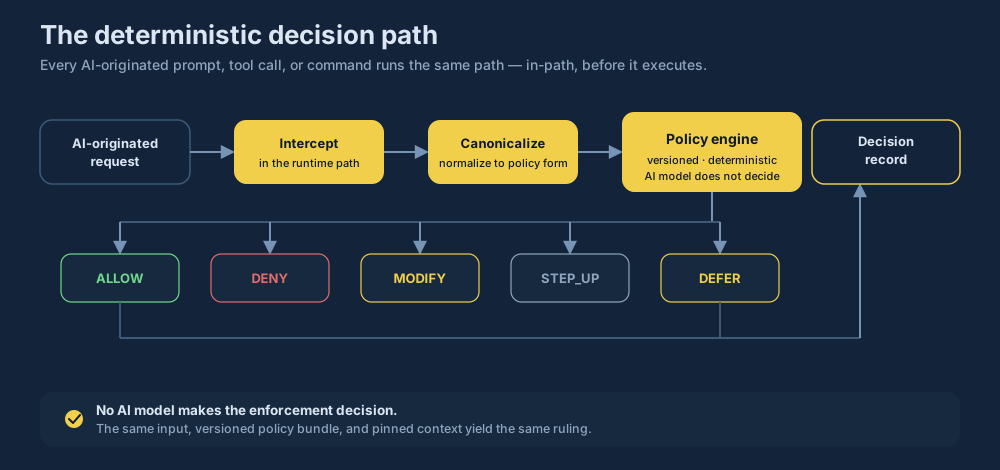
The only place where an AI governance platform can reliably detect PHI before it leaves the organization is at the point where the user constructs and submits a prompt — before the request reaches the AI provider's servers.
This is materially different from network monitoring or post-hoc log analysis. By the time a SIEM flags an anomaly, the data has already transited to a third-party system. The BAA question is already moot — or violated.
Real-time policy enforcement at the browser layer intercepts the prompt before submission. A PII detection policy can flag or block requests that contain patient names, MRNs, dates of birth, diagnosis codes, or other PHI patterns. A Business Associate policy can enforce that only AI tools with a signed BAA receive any clinical-context prompts. The enforcement happens in the workflow, not after the fact.
For healthcare organizations specifically, three policies matter most:
PHI detection. Named-entity recognition and pattern matching against common PHI fields (name + DOB, MRN, SSN, diagnosis + patient identifier combinations). A proxy-layer or browser-layer enforcement point applies this scan to every prompt, on every AI tool, for every user — not just the ones connected to the managed network.
BAA-gating. A policy that permits AI use only against a defined allowlist of vendors with active BAAs. Attempts to submit prompts to non-BAA'd tools are blocked with a policy explanation, not a generic error. The compliance team sees the attempt in the audit log regardless.
Audit trail continuity. HIPAA's Security Rule requires that covered entities be able to demonstrate the controls they have in place and produce audit evidence on request. An AI governance platform that logs every prompt event — with user identity, tool destination, policy outcome, and timestamp — gives compliance teams the documentation OCR actually looks for during an investigation.
The audit question healthcare compliance teams should be asking
OCR breach investigations now routinely ask covered entities to produce evidence of the technical safeguards they have in place for AI tool usage. "We have a policy" is no longer sufficient. "We have a system that enforces the policy at runtime and produces a tamper-evident audit log" is.
The healthcare organizations that will be ahead of this aren't the ones with the most restrictive AI policies — they're the ones that have moved enforcement out of the policy document and into the workflow itself.
That's what an AI governance platform does for healthcare. Not block AI adoption — enable it, with the controls that make it defensible.
Containment.AI enforces AI governance policies in real time — at the proxy layer and in the browser — giving healthcare compliance teams PHI detection, BAA-gating enforcement, and the audit trail HIPAA requires. See how it works or create a free workspace.