The U.S. Department of War did something in December that most large enterprises are still nervously debating: it put a frontier large language model in front of its entire workforce, all at once. On December 9, 2025, it launched GenAI.mil — described in the department's own announcement as "the Department's new bespoke AI platform" — with Google Cloud's Gemini for Government as "the first of several frontier AI capabilities" hosted there. Five months later, the department reported that "[o]ver 1.3 million Department personnel have used the platform, generating tens of millions of prompts and deploying hundreds of thousands of agents."
That adoption curve is remarkable on its own. But the detail defense contractors should study isn't the speed — it's the architecture the Pentagon chose to get there.
The Pentagon chose a boundary, not a warning label
The department did not hand 1.3 million people a policy memo telling them to be careful about what they paste into a chatbot. It built a governed environment. The GenAI.mil launch release is explicit: "all tools on GenAI.mil are certified for Controlled Unclassified Information (CUI) and Impact Level 5 (IL5), making them secure for operational use." IL5 is the impact level at which those tools are authorized to handle CUI — the department's sensitive unclassified data.
In May 2026 it went further, announcing agreements with eight frontier AI companies — "SpaceX, OpenAI, Google, NVIDIA, Reflection, Microsoft, Amazon Web Services, and Oracle" — to deploy their capabilities on the department's "Impact Level 6 (IL6) and Impact Level 7 (IL7)" classified network environments.
Read those decisions as a governance doctrine, not a procurement story. Faced with frontier models and sensitive data, the Pentagon's answer was to move the model inside an accredited boundary — IL5 for CUI, IL6 and IL7 for classified — rather than rely on the discretion of the person at the keyboard. The control lives in the boundary. Not in the user's good judgment on a busy day.
The defense industrial base doesn't have that boundary
Now look at the other side of the contract. The launch release says GenAI.mil's capabilities reach "all civilians, contractors, and military personnel," and the May release confirms that "[w]arfighters, civilians and contractors are putting these capabilities to practical use right now." That access, though, is for people working inside the department's systems and credentials. It is not the daily reality for the broader defense industrial base — the primes, subcontractors, and suppliers that actually design and build what the department buys.
Those companies' engineers, contracts teams, and analysts don't open GenAI.mil to get through a Tuesday. They open a browser on a corporate laptop and use commercial ChatGPT, Gemini, or Claude — the same class of frontier model, with none of the boundary. A propulsion engineer pastes a technical spec in to summarize it. A capture manager drops a proposal draft containing CUI into a chatbot to tighten the prose. None of those sessions is IL5-authorized, and none of them leaves a record of what crossed the line.
CMMC turns that gap into a contract problem
This is not an abstract hygiene concern. It is now a term of the contract. Under DFARS 252.204-7021 — the "Contractor Compliance With the Cybersecurity Maturity Model Certification Level Requirements" clause, in its November 2025 form — a contractor must "[o]nly process, store, or transmit FCI or CUI on contractor information systems that have a CMMC status at the CMMC level required" by the contract. CMMC status is no longer a self-attestation filed and forgotten; it is assessed, affirmed annually in the Supplier Performance Risk System, and enforced as a condition of award and continued performance.
A browser tab pointed at a consumer AI service is exactly the kind of pathway an assessor will eventually probe. If a CUI-bearing prompt crosses into a commercial LLM, that's a scoping failure — and the contractor usually has no session log to demonstrate what did or didn't happen, because consumer AI tools don't produce CMMC-grade evidence of what an employee typed into them.
The lesson the DIB should take from GenAI.mil
The Pentagon's own playbook points to the fix. It did not ban frontier AI to protect CUI — prohibiting the most productive tool available while the department goes all-in on AI was never going to hold. It governed the boundary so its people could use the tools safely. The difference is that the department could stand up a bespoke, IL5-authorized platform. A mid-tier defense supplier cannot. It has neither the budget nor the authorization pathway to build its own GenAI.mil.
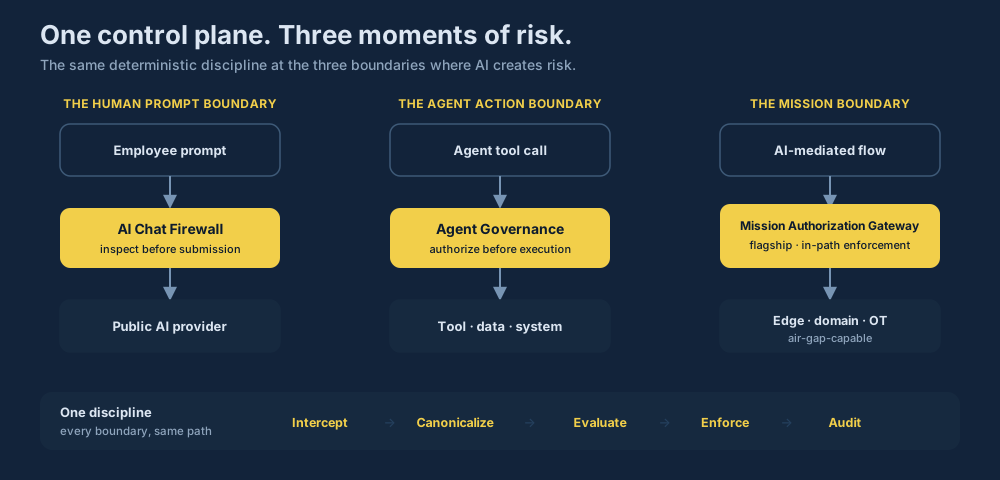
What a contractor can do is put the governance where its people actually use AI: in the browser, at the session. A policy-enforcement layer that sits between the employee and the model can inspect the prompt before it leaves the device, apply CUI-sensitive rules in real time, block or redact what shouldn't cross the boundary, and produce the audit record an assessor will ask for. That is the contractor-scale equivalent of what GenAI.mil does for the government side: the safeguard lives in the boundary, not in the hope that nobody pastes the wrong paragraph.
The frontier models are already on every desk — in the Pentagon, behind an IL5 wall; across the defense industrial base, behind nothing at all. The department has told the market, in Secretary Hegseth's words, that it is "pushing all of our chips in on artificial intelligence as a fighting force." Its suppliers will be pulled forward at the same pace, whether or not their controls are ready. The contractors who treat the AI data boundary as infrastructure — not as a line in an acceptable-use reminder — are the ones who will still be eligible to bid when an assessor asks how they governed it.
Containment.AI enforces AI governance policies at the browser layer in real time — inspecting AI sessions, applying CUI-sensitive policy rules before data leaves the device, and generating the audit evidence defense contractors need under CMMC. See how it works →