FedRAMP's Consolidated Rules 2026 — CR26 — are live, and the Marketplace now reflects them. The program released CR26 on June 24, 2026, with the rules taking effect on July 4, 2026 for FedRAMP 20x cloud service providers. On July 17, 2026, FedRAMP updated the Marketplace for CR26: a new CSP lifecycle Phase field, a "FedRAMP Certified (In Remediation)" status, and a Corrective Action Plan indicator now appear against listed services. And on July 28, 2026 — days away — the "FedRAMP Ready" designation retires.
If you run security or program compliance for a DoD prime or an aerospace OEM, your inbox is about to fill with vendors explaining why their new label is the label that matters. Here is the part worth your time.
The relabeling is cosmetic. The gate isn't.
CR26 is, in large part, a naming exercise layered on a real structural cleanup. "Authorization" becomes "Certification." "FedRAMP Ready" — the pre-authorization signal a lot of vendors leaned on in outbound decks — goes away entirely on July 28. The Marketplace gains a lifecycle Phase field and an "In Remediation" status so a certified service that has drifted is visible as such rather than quietly still-listed.
What none of that changes is the underlying question a contracting officer asks: does this service actually carry a current certification at the impact level your data demands, and can the vendor prove it? A renamed badge doesn't move a tool across that line. When a vendor's July outreach leads with "we're aligned to CR26," read it as marketing until you see the Marketplace entry. The label churn is a good moment to re-verify what your approved cloud services are actually certified for — not to accept a new adjective in place of evidence.
November 10 is the date that should be circled
For a defense contractor, the harder deadline isn't a FedRAMP relabeling — it's CMMC. Mandatory C3PAO assessments for Controlled Unclassified Information take effect November 10, 2026. After that, "we have a policy" stops being an answer; an accredited third party has to assess the control and see the evidence. FedRAMP certifies the cloud platform your data sits in. CMMC asks whether your program governs what happens to CUI across your environment — including what your workforce does with AI tools that never appear in any Marketplace at all.
That's the gap the label debate obscures. A FedRAMP-certified LLM host covers the service; it says nothing about an engineer pasting export-controlled design data into a browser-based assistant, or an agent reading a program document it was never cleared to touch. That behavior happens at the boundary — between the user's keyboard and the model — which is precisely the surface a certification of the platform does not reach and an assessor will now expect you to control.
Where this leaves an AI governance decision
A useful thing about the boundary layer: governing it doesn't require its own FedRAMP certification. AI-usage enforcement at the point where data crosses into a model runs alongside whatever FedRAMP-certified cloud your program already operates — it doesn't replace it, and it doesn't need to inherit its authorization to do its job. You keep your certified stack; you add the control and the evidence trail that turns "we told people not to paste CUI into ChatGPT" into a record an assessor can audit.
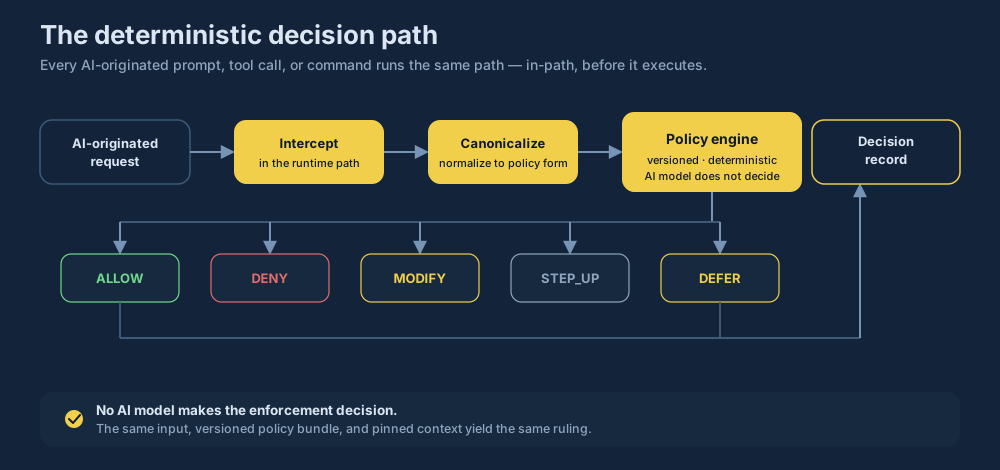
That is what Containment.AI is built for: real-time enforcement of AI-usage policy where data actually leaves the boundary, with the audit trail defense programs need to prove what crossed and under what policy. Our forward direction — a deterministic, non-bypassable Mission Authorization Gateway for edge and disconnected environments — extends the same principle to contexts a cloud service can't reach. (To be clear: Containment.AI makes no FedRAMP or IL5 certification claim for itself; it is the boundary control that sits alongside your certified environment.)
CR26 changed the names on July 4 and retires "Ready" on July 28. CMMC changes what you have to prove on November 10. The programs that come out ahead will spend the next few months building the boundary control the second date is really about — not re-lettering the badges from the first.
Containment.AI enforces AI-usage policy at the boundary — the control point a FedRAMP certification of your cloud doesn't reach. See the Mission Authorization Gateway →