Between April and May 2026, the question of whether federal agencies and their contractors can use frontier AI stopped being theoretical. FedRAMP's AI prioritization initiative — which, per FedRAMP's own AI page, "began in August 2025 and was completed in April 2026" — closed with three conversational AI services authorized for routine federal use, and at least one independent model vendor reached FedRAMP High. For a defense contractor that has spent two years asking "is this AI tool even allowed on our networks," that is finally a real answer. But it answers a narrower question than most buyers think.
A FedRAMP authorization certifies the service. It says nothing about which data your people are cleared to send into it.
What FedRAMP actually authorized
On April 27, 2026, OpenAI announced FedRAMP 20x Moderate authorization for ChatGPT Enterprise and its API Platform, adding that agencies "can now access our most powerful models, including GPT‑5.5, in our FedRAMP environment." FedRAMP's AI page lists ChatGPT Enterprise and API Platform (OpenAI), Gemini for Government (Google), and Perplexity Enterprise Pro for Government (Perplexity AI) as the prioritized services that received certification in early 2026. The initiative it ran "prioritized the authorization of AI-based cloud services that provide access to conversational AI engines designed for routine and repeated use by federal workers."
The ceiling moved higher, too. On May 12, 2026, Cohere announced it had achieved FedRAMP High through Second Front Systems' Game Warden platform — inheriting Second Front's authorization to be listed in "under 90 days" and, per the announcement, becoming "the first independent LLM company to reach the High level on its own terms."
So the model isn't the blocker anymore. Which is exactly why the next question matters more.
What a FedRAMP authorization covers — and what it doesn't
FedRAMP is a security assessment of a cloud service offering: the infrastructure, the controls the provider operates, and the shared-responsibility boundary the agency inherits. OpenAI's own announcement frames the artifact precisely — reusable authorization data covering "its Minimum Assessment Scope, shared-responsibility expectations, supported features, and supporting evidence."
Read the shared-responsibility line carefully. The provider is responsible for securing the service. The customer is responsible for what happens on the customer's side of the boundary — including what an employee types into the prompt box. A FedRAMP-authorized model will faithfully process a paragraph of Controlled Unclassified Information pasted into it. The authorization does not — and was never designed to — decide whether that paragraph should have left your environment in the first place.
NIST already named the risk FedRAMP doesn't close
You don't have to take a vendor's word for where the gap is. NIST named it. Its Generative AI Profile — NIST AI 600-1, published July 2024 as a companion to the AI Risk Management Framework — enumerates twelve risks "unique to or exacerbated by" generative AI, and two of them sit squarely on the input side of the boundary.
The first is Data Privacy, which NIST defines as "[i]mpacts due to leakage and unauthorized use, disclosure, or de-anonymization of ... personally identifiable information or sensitive data." The second is Information Security — NIST notes that "GAI itself is vulnerable to attacks like prompt injection or data poisoning," and that indirect prompt injection lets adversaries "exploit LLM-integrated applications by injecting prompts into data likely to be retrieved."
Neither risk is closed by authorizing the model host. Both are governed at the point where data crosses from your environment into the model — the boundary the AI RMF asks you to govern, map, measure, and manage, not assume away. NIST is even extending the framework toward the operational environments the defense-industrial base runs on: on April 7, 2026 it released a concept note for an AI RMF profile on trustworthy AI in critical infrastructure.
For defense programs, the residual risk is CUI
For a DoD prime or a contractor in the defense-industrial base, "sensitive data crossing the boundary" has a name: CUI — and above it, classified spillage. NIST's profile is explicit that this class of system needs specialist oversight. One of its governance actions directs organizations, "[w]hen systems may raise national security risks, [to] involve national security professionals in mapping, measuring, and managing those risks."
A FedRAMP-authorized chatbot on a program network doesn't satisfy that. The authorization tells your ISSM the service has been assessed. It does not tell them whether an engineer pasted export-controlled design data into a summarization prompt, whether that session aligned with your acceptable-use policy, or whether you can produce the audit evidence a CMMC assessor will ask for. Those are governance functions that live between the user and the model — and they remain the contractor's to build.
The governance layer is yours to own
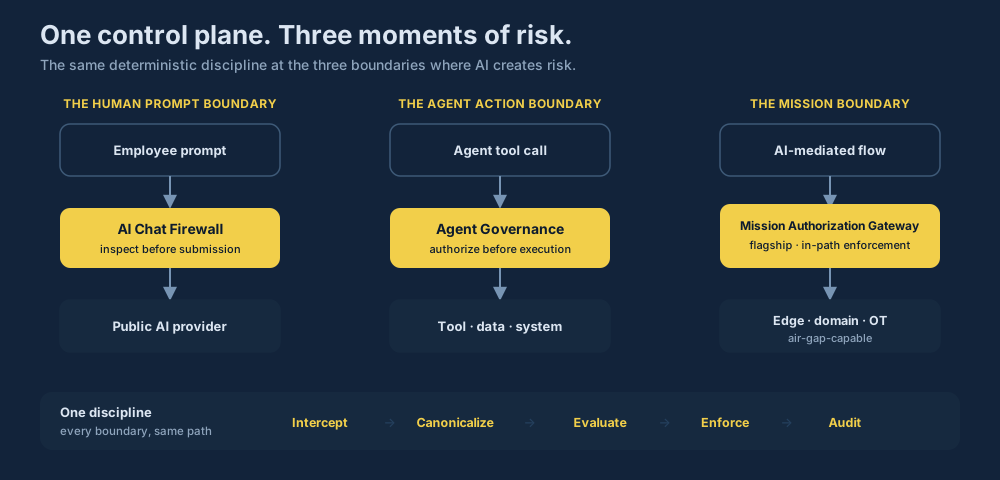
This is the layer Containment.AI is built for. We enforce AI-usage policy at the point of use — in the browser and at the LLM proxy — monitoring sessions in real time, blocking sensitive data before it crosses the boundary, and generating the tamper-evident audit trail that turns "we have an acceptable-use policy" into "here is the evidence." That maps directly onto NIST's own suggested action to use "digital content transparency solutions" that "provide a tamper-proof history of the content ... and enable traceability."
Our forward direction — a deterministic, non-bypassable, signed-receipt Mission Authorization Gateway for edge and disconnected environments — extends the same principle to the places a cloud authorization can't reach at all: the tactical, air-gapped, and OT contexts where defense AI increasingly runs.
FedRAMP moving frontier AI inside the authorization boundary is genuinely good news. It just moves the hard question one step closer: now that your people can use these models, what governs the data they put into them? Answer that before an assessor — or an incident — answers it for you.
Containment.AI governs the data crossing the LLM boundary — real-time policy enforcement in the browser and at the proxy, with the audit evidence defense programs need. See how it works for defense →