The EU AI Omnibus Regulation entered into force in July 2026. On July 7, the European Commission published its Action Plan on Cybersecurity and Artificial Intelligence, developed jointly with ENISA. Together, these two events mark the moment EU AI governance moved from political agreement to operational obligation.
For defense AI deployers — prime contractors, aerospace OEMs, and dual-use platform vendors — the question is no longer whether to build governance infrastructure. The question is whether what you already built will survive an audit.
What the AI Omnibus Actually Changed
The original EU AI Act created a risk tiering system. The AI Omnibus sharpened the enforcement architecture on top of it. High-risk AI systems operating in critical infrastructure — a category that includes AI deployed in energy grids, transport, water systems, and defense-adjacent logistics — now have a concrete implementation timeline: rules apply from 2 December 2027 for Annex III high-risk domains.
That sounds like 17 months. For a defense prime running AI in a production supply chain or autonomous logistics system, 17 months is one procurement cycle. The development, validation, and integration work starts now.
The Omnibus also reinforced the EU AI Office's powers over general-purpose AI models and centralized oversight — reducing the governance fragmentation that had made multi-jurisdiction compliance a patchwork problem.
The July 7 Cybersecurity Action Plan: What It Adds
The July 7 Action Plan from the European Commission, developed with ENISA, sets out a coordinated approach to help Member States, businesses, and public authorities address cybersecurity and resilience challenges from advanced AI models. It is not a compliance checklist — it is a procurement signal.
The Action Plan's structure tells you what EU regulators consider the unresolved risk: the interaction between AI capability and cybersecurity posture at the deployment layer. Specifically: what happens when an AI model operates in an environment where its outputs can affect physical systems, critical services, or sensitive data — and the boundary between the model and those systems is not deterministically enforced?
For defense deployers, that is not a theoretical question. It is the daily operational reality of AI-assisted targeting support, logistics optimization, maintenance prediction, and intelligence processing.
The Gap the Compliance Layer Cannot Close
Most defense-adjacent organizations have, or are building, a GRC compliance layer. Vanta, Drata, and their peers can document your AI governance posture, map controls to framework requirements, and generate audit evidence. That capability is real and increasingly FedRAMP-ready.
But the compliance layer and the enforcement layer are different problems, solved at different architectural layers.
The compliance layer answers: can you prove you have a governance policy?
The enforcement layer answers: can you prove that policy was applied, deterministically, at the moment the AI output was generated — and that proof is tamper-evident?
The EU AI Omnibus and the July cybersecurity action plan are both pointed at the second question. Regulators in 2026 are no longer satisfied with documented intent. They are asking for operational evidence: cryptographically signed decision receipts, verifiable policy evaluation logs, and the ability to demonstrate that a given AI output was gated against a defined policy boundary before it influenced a system or action.
For systems deployed at the edge — in disconnected, degraded, intermittent, or low-latency environments — that operational evidence requirement is hardest to meet. The model is running where the compliance dashboard cannot reach.
What "Enforcement at the Edge" Actually Requires
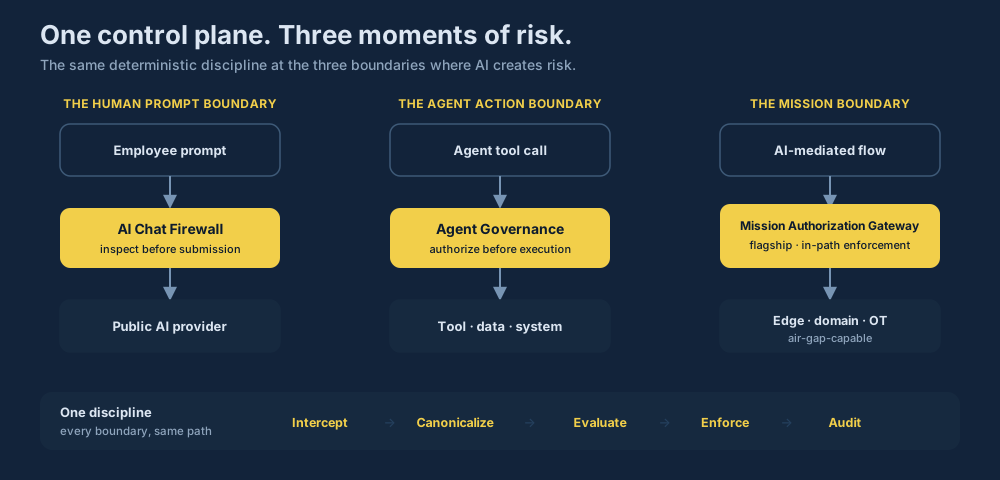
A Mission Authorization Gateway for forward-deployed AI governance provides the missing enforcement layer:
- Deterministic, non-bypassable policy evaluation at the point of AI inference, not retroactively in a log aggregator
- Signed decision receipts — a cryptographically verifiable record that a specific output was evaluated against a specific policy and permitted or denied before acting
- Edge-native operation — runs in DDIL (disconnected, degraded, intermittent, low-bandwidth) environments where cloud-dependent compliance tools cannot operate
- Tamper-evident audit trail that satisfies both EU AI Act operational evidence requirements and DoD audit transparency expectations
This is the architectural answer to what the EU AI Omnibus, the July cybersecurity action plan, and the high-risk AI provisions are actually requiring: not better documentation of intent, but verifiable proof of enforcement.
The Implementation Timeline Is Now
The 2 December 2027 date for critical infrastructure AI rules is the deadline for operational compliance. The procurement, integration, and validation work to achieve it has a natural lead time of 12–18 months.
Defense primes, aerospace OEMs, and dual-use platform vendors with EU market exposure — or operating AI systems in NATO-partner environments governed by EU-aligned frameworks — need to evaluate their enforcement architecture now, not in 2027.
The EU AI Omnibus just made the enforcement layer mandatory. The question is whether it is already in your design.
Containment.AI's Mission Authorization Gateway provides the deterministic, non-bypassable enforcement layer for forward-deployed AI in defense and safety-critical environments. Designed for DDIL operation, cryptographically signed decision receipts, and edge-native policy enforcement.