On July 20, 2026, the European Commission published official guidelines to help providers and deployers of artificial intelligence systems meet the EU AI Act's transparency obligations — obligations that start to apply on 2 August 2026.
If you're a defense prime, an aerospace OEM, or a dual-use platform operator with any EU-market exposure, this isn't a distant regulatory event. It's a 13-day countdown.
What the Guidelines Actually Require
The July 20 publication clarifies three concrete obligations under Article 50 of the AI Act:
For AI providers: Systems must be designed to inform users when they are directly interacting with an AI. This isn't a banner or a checkbox. It's an architectural requirement — the disclosure must be built into the system, not bolted on.
For content: Providers must add machine-readable marks to AI-generated or manipulated content to enable detection. For defense applications that involve AI-assisted analysis, reporting, or decision support, this means every output artifact needs a provenance trail.
For deployers: Organizations must inform people when they are exposed to deep fakes, to AI-generated content on matters of public interest without human review or editorial control, and to emotion recognition or biometric categorization systems.
That last category is significant. Defense environments increasingly use AI-assisted biometric and behavioral analysis. If that AI is deployed in any context touching EU persons or EU-market operations, the deployer obligation applies.
Why Defense Deployers Face Disproportionate Complexity
Commercial SaaS vendors have a relatively clean mapping problem: identify which of their AI features are interactive or generative, add disclosure UI, mark outputs. Inconvenient, but tractable.
Defense deployers face a more complex landscape:
Multi-system AI chains. A targeting-support pipeline may pass data through three AI components before producing output. Which node is the "provider"? Which disclosure obligation attaches at which layer? The guidelines cover single-system disclosure but the multi-layer edge case is less settled.
Operational security tension. Disclosing that an interface is AI-powered in a tactical environment may itself be sensitive information. The Article 50 framework doesn't have a carve-out for classified operational contexts — it's written for civilian AI systems. Defense primes operating dual-use systems need a compliance posture that satisfies EU requirements without compromising OPSEC.
Audit trail requirements. The machine-readable marking obligation implies you can prove which outputs were AI-generated, when, and under what policy. If you can't produce a signed, tamper-evident log of AI-generated content at audit time, you cannot demonstrate compliance. This is a records-management problem as much as a technology problem.
The Deterministic Audit Trail Problem
This is where the defense sector diverges sharply from enterprise SaaS.
Audit trails for transparency compliance aren't just logs. They need to be:
- Tamper-evident: The record of what the AI generated cannot be altered after the fact
- Attributable: Each output traces to a specific model version, input, and policy context at time of generation
- Machine-readable: The marks must be detectable by downstream systems, not just human-visible
For a defense prime running AI inference at the edge — disconnected from cloud logging infrastructure — this means the audit capability must be embedded in the inference layer itself, not in a downstream cloud collector.
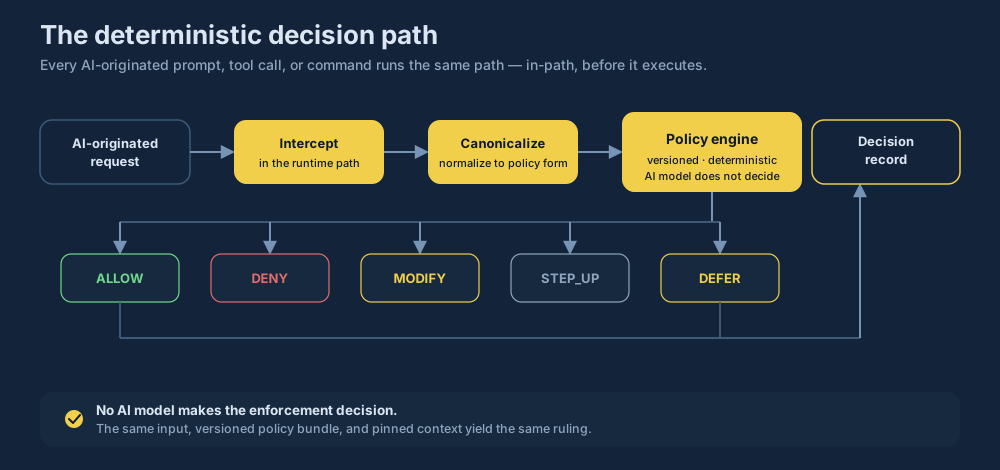
A gateway that intercepts every AI call, evaluates it against policy, and produces a cryptographically signed receipt at inference time provides exactly this: a per-decision audit record that doesn't depend on connectivity and can't be retroactively altered.
What To Do in the Next 13 Days
Map your AI-touching systems with EU exposure. Which of your deployed AI systems interact with EU persons, process EU-origin data, or are sold to EU-market customers? The extraterritorial reach of the AI Act is broad — if your aerospace OEM sells platforms to European defense ministries, the deployer obligations likely reach you.
Identify Article 50 gaps. For each in-scope system: Does it disclose AI interaction to users? Do its outputs carry machine-readable marks? Can your deployer team produce an audit record of AI-generated content on demand?
Separate the EU-market and dual-use compliance tracks. The commercial compliance track (SOC 2, ISO 27001) is not sufficient here. Article 50 is a product design requirement, not a security certification. Your governance vendor may be able to help you document the framework mapping, but the disclosure and marking obligations require changes at the AI system layer.
Look upstream in your supply chain. If you're a deployer of a third-party AI system (an LLM API, an analytics model, a decision-support tool), the provider's disclosure architecture becomes your compliance dependency. You need to understand whether your upstream provider has implemented the machine-readable marking requirement before August 2.
The Mission Authorization Gateway Pattern
For defense and aerospace organizations thinking about this systematically rather than as a one-time compliance sprint, the transparency obligations point toward an architectural pattern:
A non-bypassable governance layer that sits between your operators and every AI system they interact with. Every inference request passes through it. Every response is evaluated against policy, tagged with provenance, and logged in a tamper-evident receipt. The receipt serves triple duty: operational audit, regulatory compliance evidence, and anomaly detection.
This is the same pattern that satisfies DoD AI Ethical Principles requirements for human oversight — the EU transparency obligations and the US DoD framework are converging on the same architectural answer from different directions.
August 2 is the compliance deadline. It's also the moment when the regulatory pressure and the operational reality align.
The EU AI Act transparency guidelines were published by the European Commission on 20 July 2026. Source: Commission publishes guidelines on transparency obligations for providers and deployers of certain AI systems