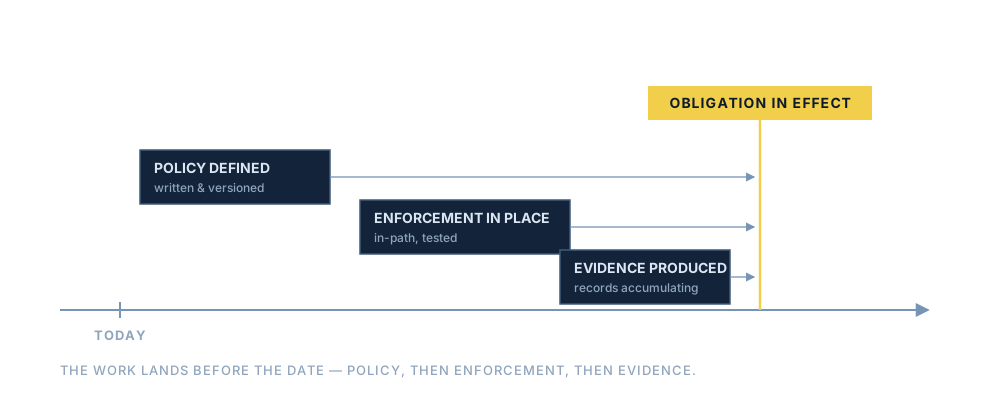
On August 2, 2026, the EU AI Act's transparency rules take effect.
The European Commission's AI Act framework is explicit on the timeline: the regulation entered into force on 1 August 2024 and becomes fully applicable two years later, on 2 August 2026. The obligations for general-purpose AI models became applicable on 2 August 2025; the transparency rules follow in August 2026.
For most enterprise compliance teams, this is a known calendar item. For defense deployers — primes, aerospace OEMs, and Defense-Tech companies that field AI across NATO-allied or EU-partnered environments — it is a harder problem than it looks.
What the transparency rules actually require
The AI Act's transparency tier introduces disclosure obligations designed to ensure people know when AI is involved. Per the Commission's framework, they include:
- Disclosure at the point of interaction. When people use AI systems such as chatbots, they should be made aware they are interacting with a machine.
- Identifiable AI-generated content. Providers of generative AI must ensure AI-generated output is identifiable as artificially generated.
- Marking of synthetic media and certain text. Certain AI-generated content must be clearly and visibly labelled — namely deep fakes and text published to inform the public on matters of public interest.
To support these rules, the Commission published a Code of Practice on marking and labelling AI-generated content on 10 June 2026, with additional transparency guidance in preparation.
Why defense deployers face a different problem
Commercial enterprises deploying AI mostly face documentation obligations addressable with policy updates and standard GRC tooling. Defense deployers face a compounding challenge:
1. Dual-use exposure. A system built for a domestic defense program may also power a subsidiary, partner, or reseller operating inside EU jurisdictions. Deployers should not assume a broad national-security carve-out covers dual-use or commercial defense AI, or the enterprise software stack that surrounds classified systems — map your own exposure rather than presuming exemption.
2. Agentic AI expands the disclosure surface. Defense AI operating at the edge, in DDIL environments, or across autonomous decision chains generates a disclosure surface that compliance tooling built for cloud SaaS wasn't designed to handle.
3. Evidence must be runtime, not retrospective. A policy document asserting "we comply" is not the same as a tamper-evident record proving the system behaved as declared. For platforms operating in disconnected or forward-deployed environments, that evidence has to be captured at the system boundary, not reconstructed after the fact.
The evidence gap at the edge
Modern defense AI operates in exactly the environments where cloud-based logging and audit trails break down:
- Disconnected and DDIL environments where continuous cloud logging isn't available
- Forward-deployed edge nodes where AI decisions happen inside connectivity gaps
- Multi-vendor autonomous stacks where attribution between components is unclear
A policy attestation does not satisfy an auditor. A tamper-evident, timestamped record showing that each AI output was handled according to declared policy — captured at the enforcement boundary, available even offline — is a different class of evidence.
This is the gap the Containment.AI Mission Authorization Gateway is designed to close. The gateway is designed to sit as a deterministic, non-bypassable enforcement boundary at the point where AI outputs cross into operational environments — with the goal that every output is evaluated against declared policy, every decision is recorded in a signed receipt, and the audit trail remains available offline in disconnected, forward-deployed configurations.
Three actions before August 2
1. Map your EU exposure. Identify every AI system whose output reaches users or partners in EU jurisdictions — including platforms that touch NATO-partner environments, EU-based subcontractors, or international program offices, not just systems built for EU markets.
2. Audit your synthetic-content pipeline. If your systems generate text, imagery, or audio — briefing summaries, situational-awareness reports, translated communications — assess whether those outputs require marking. The obligation falls on the deployer, not only the model provider.
3. Close the runtime-evidence gap. Treat policy documentation as necessary but not sufficient. Build the enforcement layer that captures compliance evidence at the system boundary, in a form designed to withstand scrutiny.
The August 2 date doesn't pause for procurement cycles. Defense deployers operating internationally face the same transparency obligations as every other enterprise — with less margin for ambiguity and higher stakes for getting it wrong.
About Containment.AI: The Mission Authorization Gateway is designed to enforce AI governance policies at the system boundary in safety- and security-critical environments — generating tamper-evident signed receipts intended to satisfy audit requirements in disconnected, forward-deployed contexts. Request an AI Boundary Review