On August 2, 2026, the European Commission began enforcing the EU AI Act. After two years of runway since the regulation entered into force, the majority of its provisions are now applicable. For most enterprise teams, that means a compliance clock that has been abstract is now concrete.
For defense primes, aerospace OEMs, and defense-tech companies with operations or customers in the EU, the picture is more nuanced — and the window for preparation is shorter than the headline date suggests.
What actually went live on August 2
The Act's broad provisions became applicable on August 2, 2026. The European Commission published a press release on July 31 announcing the start of enforcement. This is not a soft launch: the Commission's AI Office now has authority to investigate and sanction non-compliant providers.
The enforcement scope on day one includes:
- General-Purpose AI (GPAI) model obligations — these have been live since August 2025. Providers of foundation models used in downstream applications must have documentation, incident-reporting, and security practices in place.
- Transparency obligations under Article 50 — AI systems that generate or manipulate synthetic content must mark outputs as machine-detectable starting August 2, 2026 (with a grandfathering window to December 2, 2026 for systems already on the market before the enforcement date).
- The nine prohibited practices — bans on social scoring, certain biometric surveillance, and manipulation of vulnerable groups were already in force since February 2025.
The high-risk deferral — and why it does not mean wait
The headline news for defense-adjacent AI buyers is the Annex III deferral. Under the AI Omnibus agreed in May 2026, obligations for high-risk AI systems in Annex III — the category covering critical infrastructure safety components, employment screening, law enforcement, and border management — are deferred from the original August 2, 2026 date to December 2, 2027. That is a 16-month extension.
A second tier, Annex I systems embedded in regulated products (medical devices, machinery, radio equipment), is deferred to August 2, 2028.
The temptation is to read this as "16 more months." It is not. Here is why:
First, the deferral covers the formal conformity assessment and registration obligations — not the underlying design and documentation work. A defense system that needs to demonstrate adequate risk management, human oversight, and audit trails under Annex III requirements cannot build that evidence in a quarter. The 16-month window is barely enough for a program that starts now.
Second, defense primes operating across EU member states will face national market surveillance authority scrutiny that may begin before the December 2027 EU-level deadline. The Act requires member states to designate competent authorities, and early enforcement actions in high-visibility sectors are common as regulators establish precedent.
Third, government procurement — both EU member state defense ministries and NATO-aligned procurement vehicles — is beginning to require AI Act compliance representations as a contract condition, ahead of the statutory deadline. Primes that cannot demonstrate governance-layer evidence will lose bids.
What "high-risk" means for defense AI systems
The Act defines high-risk AI systems in Annex III across eight areas. The ones most directly relevant to defense-adjacent and dual-use AI include:
- Critical infrastructure safety components — AI systems whose failure could put lives and health of citizens at risk. This directly covers AI safety layers in autonomous platforms, logistics, energy, and transport systems used by or contracted to defense.
- Biometric identification and emotion recognition — relevant to security vetting, access control, and situational awareness systems.
- Law enforcement AI — relevant to any AI system used by government customers for threat assessment, intelligence fusion, or evidence evaluation.
For defense-tech companies (the Anduril / Shield AI tier), the critical-infrastructure and safety-component provisions are the most likely to apply to autonomous systems that operate in or adjacent to civilian infrastructure.
The enforcement layer gap
Most compliance approaches for the EU AI Act focus on documentation: risk assessments, technical files, conformity declarations. These satisfy the audit-readiness requirement at a point in time.
What the Act actually requires for high-risk systems is ongoing: human oversight mechanisms that are technically enforced, not just documented. Article 14 requires that high-risk AI systems "allow the natural persons to whom human oversight is assigned to effectively oversee the functioning of the AI system."
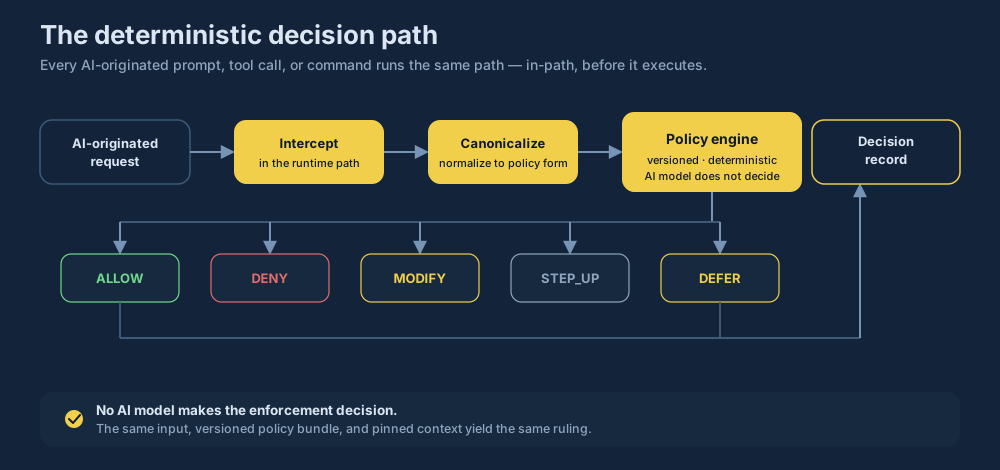
Documentation says oversight is possible. A deterministic enforcement layer — a gateway that intercepts AI actions, evaluates them against configured policy, and produces a signed receipt — proves it happened, on every request, in real time.
The distinction matters to auditors. It will matter more to market surveillance authorities with enforcement power.
What this means in practice for defense primes
If your organization deploys, procures, or integrates AI systems that fall under Annex III, the December 2027 obligations require you to have:
- A completed conformity assessment and technical documentation
- Human oversight mechanisms that are technically enforced, not just described in a policy document
- An audit trail that can demonstrate, per decision, that oversight operated as designed
- Registration in the EU database for high-risk AI systems
The enforcement layer — the mechanism that intercepts AI actions and generates auditor-ready evidence — is the hardest part to bolt on after the fact. It is also the part most likely to be the focus of a market surveillance authority's first questions.
The window is 16 months. For defense programs with long acquisition and integration cycles, that is not a comfortable margin.
Containment.AI's Mission Authorization Gateway enforces AI governance policy at the boundary — deterministically, without bypass, with a signed receipt on every decision. Purpose-built for safety- and security-critical environments where documentation is necessary but not sufficient.