The high-risk enforcement deadline for stand-alone agentic AI systems under the EU AI Act is now 2 December 2027, not 2 August 2026. The Digital Omnibus on AI — in force since 27 July 2026 — extended that deadline. High-risk AI embedded in regulated products under Annex I has an even longer runway: 2 August 2028.
If you run agentic AI in sectors covered by Annex III — hiring, lending, healthcare triage, law enforcement, critical infrastructure — you have 16 more months than you thought.
That extra time doesn't change what compliance requires. It clarifies the question you were already going to have to answer.
What the Extension Actually Changed
The Digital Omnibus deferred the enforcement date. It did not amend Articles 9, 11, 12, or 14 — the four provisions that govern high-risk agentic systems. Those articles still require:
- Article 9 — a risk management system, documented and maintained throughout the system's lifecycle
- Article 11 — technical documentation sufficient to demonstrate the system operates as intended
- Article 12 — logging capabilities that enable identification of risk situations and post-market monitoring
- Article 14 — human oversight measures that are effective during operation, not available as a policy option
The penalties for non-compliance remain: up to €15M or 3% of global annual turnover for breaches of the high-risk obligations; up to €35M or 7% for the prohibited practices listed in Article 5.
What the extension did is give organizations building agentic AI systems more time to get the evidence infrastructure right before regulators check.
The Evidence Question Three Frameworks Share
The EU AI Act is binding law. NIST AI RMF 1.0 is voluntary U.S. guidance. ISO/IEC 42001 is a certifiable international management system standard. They were written by different bodies for different purposes.
They converge on the same underlying question for agentic systems: can you prove that oversight was operational during deployment — not just documented as policy, but functioning when the agent acted?
That's not a logging question. Logs written by the AI system about itself are weak evidence for exactly this purpose — they're produced by the thing being governed. The EU AI Act's Article 12 doesn't specify a content format for good reason: a log that the system could have altered or omitted doesn't satisfy the monitoring purpose the article describes.
What all three frameworks presuppose — but none of them build — is an independent, tamper-evident record produced by an enforcement layer that sits outside the model itself.
Why Agentic Systems Are the Hard Case
A traditional high-risk AI system makes a decision. A human reviews it. The log records what was decided.
An agentic system takes a sequence of actions. Each action may be individually low-stakes. The aggregate — a sequence that acquires access, moves data, executes code, and communicates externally — may be high-stakes in ways that no single step reveals. The compliance challenge isn't logging the steps. It's proving that oversight was structurally present at each step, not just available in principle.
Article 14 says oversight must allow natural persons to intervene or halt the system. That's easy to implement as a kill switch and nearly impossible to evidence post-hoc. Did the oversight actually run before each action executed, or is the kill switch a feature nobody reached for?
The December 2027 deadline gives you time to build an answer to that question. It doesn't give you a way to skip it.
What the NIST Critical Infrastructure Profile Adds
In April 2026, NIST published a concept note for an AI RMF Profile on Trustworthy AI in Critical Infrastructure, extending the core framework to energy, finance, healthcare, and transport operators. The profile is in concept phase, with a draft for public comment expected later in 2026.
The direction is consistent with the EU AI Act's risk-tiered approach: sector-specific, operationally grounded guidance rather than general principles. For defense-adjacent and critical infrastructure operators, this suggests the U.S. voluntary baseline is moving toward the same evidence specificity the EU Act already requires.
The Containment.AI Position
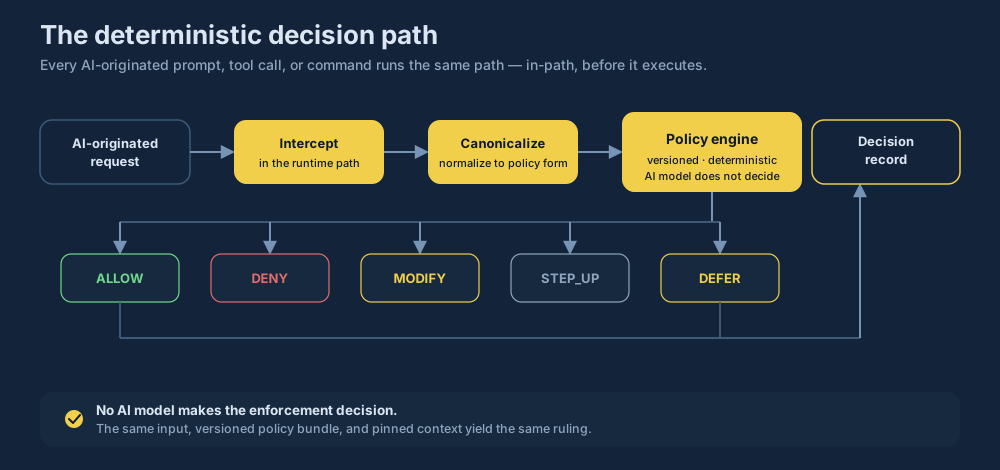
The Mission Authorization Gateway is purpose-built for the evidence layer these frameworks describe: a deterministic, non-bypassable enforcement point that evaluates each agent action against policy before execution and issues a signed receipt on every decision — permitted, denied, or halted.
The receipt chain that satisfies EU AI Act Article 12 is the same chain that maps to ISO/IEC 42001 Annex A.6.2.8 and NIST AI RMF Measure 2.4. Build the evidence once; cite it under any framework the auditor brings.
The December 2027 deadline is the window to get that infrastructure in place before enforcement begins. The frameworks' other obligations — risk management, technical documentation, organizational oversight measures — remain your work. The evidence that the oversight actually ran is what the gateway produces.
The Digital Omnibus on AI deadline shift is set out in Regulation (EU) 2026/1744 (CELEX 32026R1744; OJ 24 July 2026; in force 27 July 2026), recital 40 — eur-lex.europa.eu/eli/reg/2026/1744/oj/eng. It amends Regulation (EU) 2024/1689. The NIST Critical Infrastructure Profile concept note reference is to nist.gov/artificial-intelligence. Containment.AI does not claim formal EU AI Act certification, FedRAMP authorization, or IL5 readiness. The gateway is designed to produce the class of evidence these frameworks require; whether it satisfies a specific conformity assessment is a legal determination.