Correction (2026-08-30): This post stated that high-risk enforcement began on 2 August 2026 and that the compliance window was closed. That was wrong when published — the Digital Omnibus had been in force since 27 July 2026 — and it is wrong now.
Regulation (EU) 2026/1744 (the Digital Omnibus on AI, in force 27 July 2026) moved stand-alone high-risk systems under Annex III to 2 December 2027 and high-risk AI embedded in regulated products under Annex I to 2 August 2028. Only the Article 50 transparency obligations took effect on 2 August 2026. The analysis of what runtime enforcement requires is unchanged; the deadline framing was wrong.
As of August 2, 2026, the European Union's AI Act is fully applicable to high-risk AI systems. This is not a draft. It is not a transitional period. The enforcement deadline for AI systems in critical infrastructure, defense supply chains, employment systems, law enforcement, and essential services has arrived.
For U.S. defense primes with EU-operating subsidiaries, aerospace OEMs with European production lines, and systems integrators supplying AI-enabled capability to NATO partners, this is a live compliance obligation — not a future planning item.
The question is whether your AI governance stack is actually enforcing policy, or just documenting what happened after the fact.
What the Act Actually Requires (Not the Summary Version)
The EU AI Act is specific about what high-risk AI systems must demonstrate. The requirements include:
- Activity logging to enable traceability — not retrospective audit exports, but continuous, tamper-evident records of what the system decided and why
- Human oversight measures — mechanisms that allow a qualified person to intervene, override, or halt the system's operation
- Adequate risk assessment — documented, updated evaluation of what the system can and cannot do in its operational context
- High resilience — systems must function correctly even under adversarial conditions or attempts to manipulate outputs
These are runtime requirements. They describe what the system must be doing while it operates — not what a compliance team must document in a spreadsheet afterward.
That distinction matters enormously when the AI system in question is an autonomous agent making decisions inside a defense supply chain, a critical infrastructure control loop, or a mission-critical workflow.
The GRC-Checkbox Gap
Most enterprise AI governance tools on the market were built to satisfy audit questionnaires. They track which models are approved, whether a vendor completed a security review, and whether someone signed an acceptable-use policy.
That's compliance-layer inventory. It's valuable for procurement reviews and SOC 2 evidence packets.
It is not activity logging to enable traceability. It is not a human oversight mechanism. It does not satisfy the runtime enforcement requirements of the EU AI Act for high-risk systems.
The gap is architectural. Audit tools sit outside the inference path. They cannot intercept a decision before it executes. They cannot enforce a policy in real time. They cannot produce a signed, per-decision receipt that documents what policy was applied, what the system decided, and what data crossed which boundary.
For systems that the EU AI Act classifies as high-risk — which explicitly includes AI in critical infrastructure, employment, and law enforcement — the documentation gap is a compliance gap.
What Enforcement-Layer Governance Looks Like
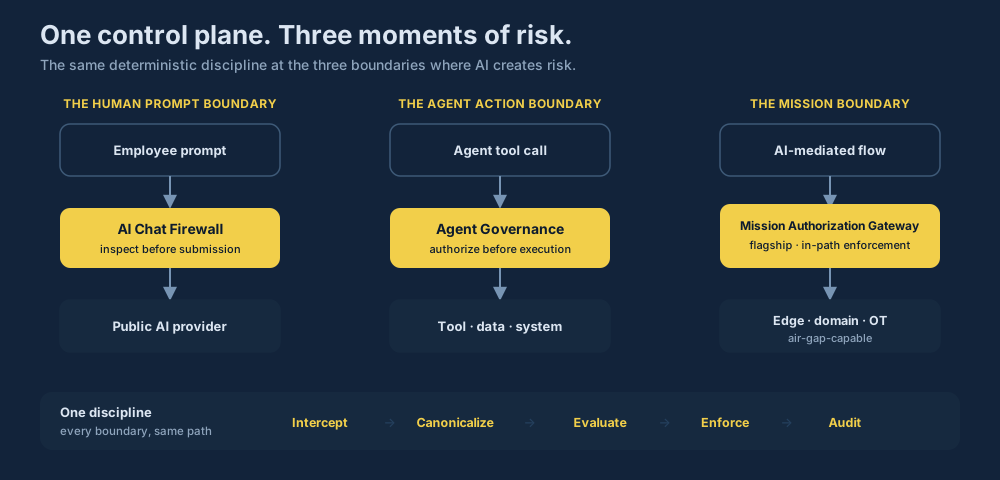
The architecture that satisfies the EU AI Act's runtime requirements is an enforcement layer in the inference path, not a monitoring dashboard above it.
That means:
- Every request from an AI system is intercepted before it executes
- The applicable policy is evaluated against the request, the context, and the data involved
- A deterministic decision — permit, deny, or clamp — is made and recorded with a signed receipt
- The receipt is tamper-evident and auditable, not reconstructed from logs after the fact
- Human override points are built into the enforcement path, not bolted on as a UI feature
This is the architecture of the Mission Authorization Gateway: an enforcement layer that operates in-path at the boundary between the AI system and the environment it acts in. It is deterministic because high-risk AI governance cannot be probabilistic — a model that "usually" enforces policy is not compliant with an act that requires human oversight measures and activity logging.
The Defense Dimension
For aerospace OEMs and defense primes with EU operations, the EU AI Act's timing intersects with several active pressures:
- NATO AI governance guidelines pushing member-state contractors toward auditable, human-overseen AI systems
- CMMC requirements for U.S. defense contractors that increasingly overlap with EU audit evidence expectations for allied-nation procurement
- DoD AI adoption mandates that create parallel obligations for systems with transatlantic deployment profiles
A defense prime that satisfies CMMC on the U.S. side but cannot demonstrate runtime enforcement and traceability on the EU side is carrying a compliance asymmetry that will surface in procurement reviews for EU-facing contracts.
The enforcement-layer approach addresses both simultaneously: the same signed receipt that satisfies DoD audit requirements also documents the activity logging and human oversight measures the EU AI Act mandates. One enforcement path, two regulatory compliance proofs.
The Window Is Open — and That Is the Point
August 2, 2026 is not a future date. For organizations that were watching the EU AI Act deadline and planning to address it "before enforcement begins" — enforcement has begun.
The practical question is now sequencing: which systems need to demonstrate runtime compliance first, which carry the highest penalty exposure, and what the fastest path to an auditable enforcement architecture looks like.
For defense and aerospace operators with EU exposure, that conversation starts with understanding the boundary between what your GRC platform covers and what it cannot — and what has to sit in the inference path itself.
The Mission Authorization Gateway was built for exactly this boundary. If you are working through EU AI Act compliance for high-risk AI systems in a defense or critical-infrastructure context, we are available for a scoped assessment.
Learn how the Mission Authorization Gateway enforces policy at the runtime layer →