On 2 August 2026 — 29 days from today — the European Union's AI Act becomes fully applicable. Not proposed, not phased, not deferred. The transparency rules kick in on that date for any AI system that interacts with people. And for high-risk AI operating in critical infrastructure, the obligations around logging, documentation, and human oversight are now active requirements, not draft guidance.
If your organization supports DoD programs, operates aerospace AI in NATO-allied markets, or provides AI capabilities to European defense ministries, that date is relevant to your compliance posture right now.
What "Fully Applicable" Actually Means
The EU AI Act entered into force on 1 August 2024, with a phased application timeline. Prohibited AI practices came into effect in February 2025. Rules for General Purpose AI models became applicable in August 2025. And on 2 August 2026, the majority of the Act's provisions — including deployer transparency obligations — become enforceable.
After the AI Omnibus political agreement reached on 7 May 2026, the timeline for certain high-risk systems was adjusted: standalone high-risk AI in Annex III areas (biometrics, critical infrastructure, employment, migration) now applies from 2 December 2027; high-risk AI embedded in regulated products from 2 August 2028. But what doesn't move: deployer transparency under Article 50 lands on 2 August 2026.
For defense and aerospace primes with EU market exposure, that means: any AI system your personnel interact with must disclose that it's AI. That's not a future state. That's 29 days from today.
The Gap That Matters for Defense Primes
The EU AI Act governs what you build and deploy. It classifies risk, assigns oversight obligations, and creates audit trail requirements for documented AI interactions.
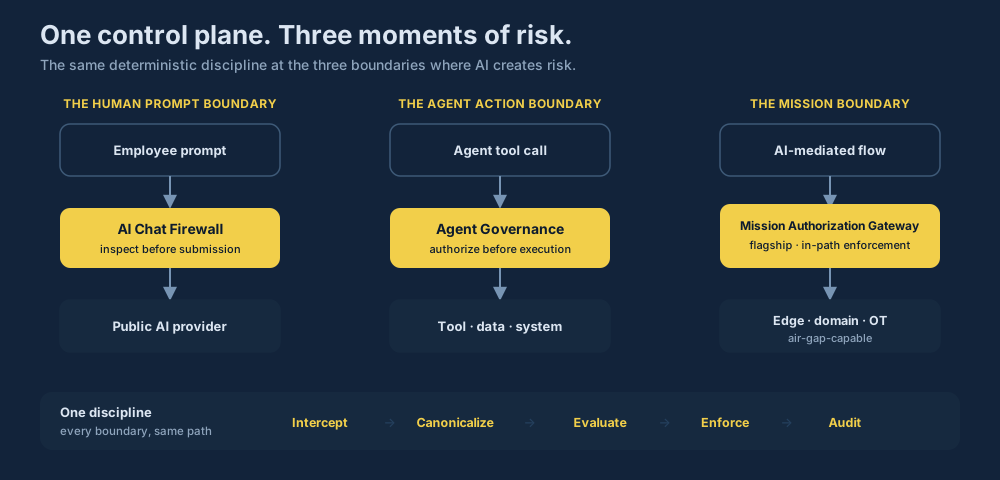
What compliance teams most often miss is the undocumented interaction: the cleared engineer, the defense program manager, the system integration team member who pastes controlled technical information into a commercial LLM and never enters that interaction into any compliance log.
Agent inventory governance tools can tell you which AI agents are registered and what they're authorized to access. They can't tell you about the browser tab that just sent a CUI summary to ChatGPT. The EU AI Act's deployer transparency obligations require that users know when they're interacting with AI — and meeting that obligation means knowing where AI interactions happen, including the unmanaged ones.
The Runtime Governance Requirement
High-risk AI under the EU AI Act must maintain "logging of activity to ensure traceability of results." That's a runtime requirement — not a policy document or periodic audit. The governance layer must be present at inference time, generating audit-grade records at the moment of interaction.
For defense primes managing mixed EU-US program environments, this means the governance architecture for NATO-adjacent operations needs to produce signed, verifiable records at the point an AI system is used — not batched nightly, not reconstructed from logs after the fact.
The Procurement Signal
With the AI Omnibus maintaining the August 2, 2026 transparency deadline, compliance and procurement teams inside defense primes and aerospace OEMs with EU operations have a concrete near-term milestone. That date is the conversation opener: where is your AI interaction audit trail, and does it cover unmanaged browser-tab interactions or only registered agent workflows?
If the answer is "registered workflows only," the gap is measurable and the exposure is real — both for EU Act deployer obligations and for DoD CUI boundary controls that operate in parallel.
The governance layer that satisfies both requirements is the same layer: policy enforcement at inference time, signed receipts for every AI interaction, and audit records that survive disconnected and edge deployments. The EU AI Act and DoD's data-boundary requirements converge on the same architecture. August 2 is the date that makes that convergence urgent for any prime operating across both environments.
Source: European Commission — AI Act policy page (digital-strategy.ec.europa.eu). Application timeline verified against the official EU regulatory framework page, last updated 11 May 2026.