The EU AI Act entered into force on 1 August 2024, and will be fully applicable two years later — on 2 August 2026. That is 13 days from today.
For defense prime contractors and aerospace OEMs operating AI systems in European markets, or supplying European defense customers, August 2 is not a distant regulatory abstraction. It is a hard enforcement date.
What Article 50 Requires
The transparency rules of the AI Act will come into effect in August 2026. Article 50 covers disclosure obligations: deployers of AI systems that interact with humans must notify those humans they are interacting with an AI. Providers of AI that generates synthetic content — text, images, audio, video — must mark that content as AI-generated.
This is not a "prepare a policy" obligation. It is a runtime obligation: the system must produce the disclosure or the marking at the moment of interaction or output. No after-the-fact attestation satisfies it.
Why Defense Primes Are in Scope
The EU AI Act has extraterritorial reach. If your AI system is placed on the EU market, or if its output is used in the EU, the Act applies regardless of where your company is headquartered.
For a Tier-1 aerospace OEM with European defense contracts, this means:
- AI-assisted analysis tools that surface recommendations to European program offices
- Autonomous inspection or quality systems deployed at European manufacturing sites
- Any agentic AI workflow that produces outputs consumed by EU-based personnel
...are all in scope for transparency disclosure requirements from August 2.
The Enforcement-Layer Gap
Most compliance programs address Article 50 at the documentation layer: policy statements, records of processing, risk registers. That satisfies the audit readiness question. It does not satisfy the runtime enforcement question.
The difference is where governance lives:
Documentation layer: a human reads a policy before using the AI tool, or a compliance officer maintains records after the fact. The AI system itself enforces nothing.
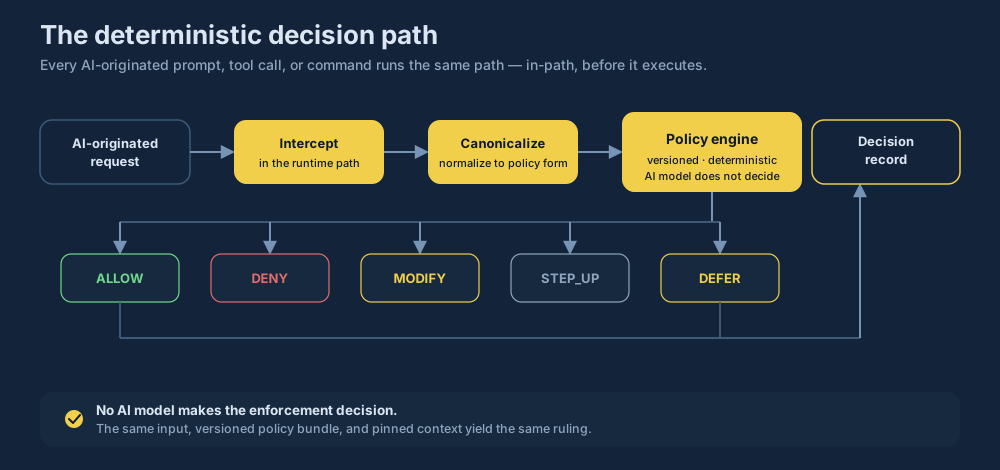
Enforcement layer: the AI system intercepts every output, evaluates it against the transparency policy, and either applies the required disclosure automatically or blocks the output until the condition is met. The policy runs at decision time, not at audit time.
For high-risk and safety-critical AI in defense and aerospace — where edge deployments, disconnected environments, and agentic workflows are becoming operational reality — enforcement-layer governance is not optional. It is the difference between a system that is compliant in documentation and one that is compliant in operation.
What a Defense Prime Should Verify Before August 2
Five questions to ask your program security leads and CISOs today:
- Inventory: Which of our AI systems produce outputs consumed by EU-based users or customers?
- Classification: Do any of those systems generate synthetic content (text summaries, translated documents, AI-drafted communications)?
- Runtime check: Does our current governance tooling insert the Article 50 disclosure at the moment of output, or only record the event after the fact?
- Edge coverage: For AI systems deployed at forward or disconnected sites, does governance enforcement work without a cloud connection?
- Audit trail: Can we produce a tamper-evident, per-decision log of disclosures made — at the enforcement layer, not reconstructed from application logs?
If the answer to question 3 is "after the fact" and question 4 is "no" — you have a runtime compliance gap that documentation alone does not close.
The Gateway Pattern for Compliance-at-Enforcement
A Mission Authorization Gateway — sitting between the AI model and the consuming application or user — provides the architectural home for runtime policy enforcement. Every output passes through the gateway, which evaluates it against the configured policy (including Article 50 disclosure requirements), appends or injects the required marking, logs the decision with a signed receipt, and surfaces any violation for immediate action.
This pattern works in connected enterprise environments. It also works at the edge: a gateway that enforces policy deterministically, without requiring a round-trip to a cloud trust service, extends compliance coverage to precisely the environments where defense and aerospace primes operate AI.
The signed receipt matters. An auditor asking "prove you applied the disclosure on this output, on this date, in this context" needs a log artifact that cannot be backdated or altered. That is what the enforcement layer produces; the documentation layer cannot.
Thirteen Days
August 2 is a forcing function, not a finish line. The compliance programs that survive regulatory scrutiny will be the ones that moved governance from the policy document into the runtime enforcement layer — where the AI system actually operates.
If your program has EU-market AI exposure and you are still answering Article 50 with documentation rather than enforcement, now is the moment to close that gap.
Containment.AI builds high-assurance governance gateways for defense and aerospace AI deployments. The gateway enforces policy at the enforcement layer — producing signed, tamper-evident decision receipts for every AI output, in connected and disconnected environments.