In May 2026, the Digital Omnibus on AI quietly moved the most consequential deadline in the EU AI Act. Annex III high-risk AI obligations — the ones covering critical infrastructure, law enforcement-adjacent systems, and essential services — were postponed from August 2, 2026 to December 2, 2027. Sixteen months of additional runway.
For defense primes and aerospace OEMs operating in EU-adjacent markets, the instinctive reaction is relief. The hard deadline just got softer. Procurement timelines can breathe. Compliance programs can wait for standards bodies to catch up.
That instinct is wrong — and it's wrong for a specific architectural reason.
What the Extension Actually Changes
The Digital Omnibus extended the enforcement deadline. It did not change what EU AI Act Article 14 requires of high-risk AI systems when they are finally assessed: a human oversight mechanism capable of intervening in or overriding AI outputs. It did not change Article 9's requirement for a risk management system running throughout the system lifecycle. It did not change Article 12's logging requirements — the ones that demand traceability sufficient for a market surveillance authority to reconstruct what the system decided and why.
The extension bought time to implement those controls. It did not reduce the technical bar for what implementation means.
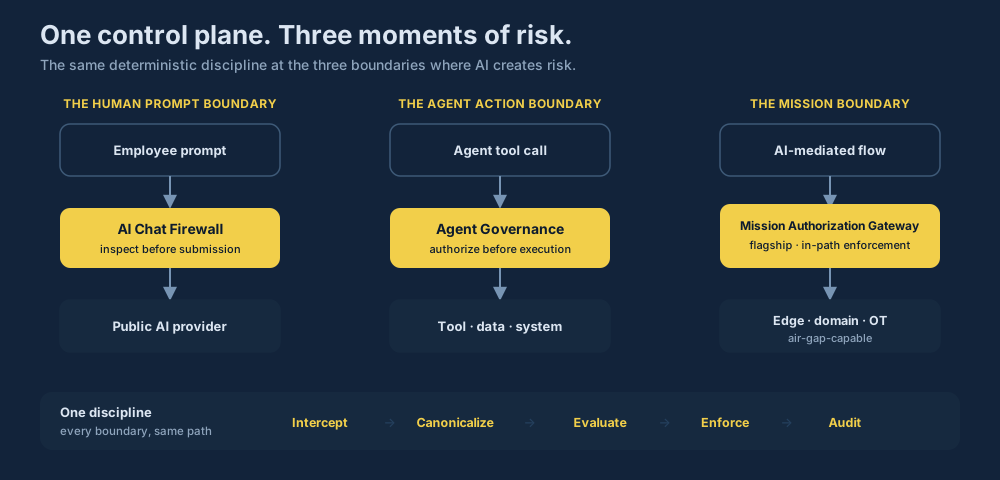
For a defense prime operating agentic AI systems — logistics optimization, targeting-adjacent decision support, autonomous ISR processing — the governance requirement was never really about the EU AI Act deadline. It was about the underlying question the deadline was forcing: can you prove, at the moment of action, that a deterministic policy evaluated the agent's decision and produced a signed, auditable receipt before the action executed?
That question doesn't get 16 more months. It's already the question your program office is asking.
The Architecture Problem That Monitoring Doesn't Solve
The compliance market's response to EU AI Act pressure has been largely monitoring and traceability tooling. Platforms that discover which agents are running in your environment, map their permissions, and log their decisions to an audit record. That tooling is genuinely useful — and genuinely insufficient for Annex III environments.
Monitoring records what happened. High-risk AI governance under Articles 9, 12, and 14 requires something architecturally different: a control layer that intercepts the action before it executes, evaluates it against a deterministic policy, and produces the evidence of that evaluation as a signed receipt. The receipt is the audit trail. The intercept is the oversight mechanism.
These are different problems, solved at different layers. A traceability layer tells you what your agent did. An enforcement layer ensures the agent couldn't have done anything else.
For Annex III sectors — and particularly for defense programs where the consequence of an unauthorized agent action isn't a regulatory fine but a mission failure or an incident — the enforcement layer is the non-negotiable one.
What 16 Months Is For
The December 2027 deadline creates a window. The productive use of that window is not to defer the governance conversation — it's to architect the enforcement layer correctly, without the pressure of an imminent enforcement date forcing shortcuts.
That means three things for defense and aerospace programs evaluating high-risk AI deployments:
First, separate the monitoring stack from the enforcement stack. Your GRC platform handles compliance evidence collection and framework alignment. Your enforcement layer handles the pre-execution intercept — the deterministic policy gate that sits between the agent and the action. These are different products doing different jobs. Conflating them in a procurement decision is the most common architecture mistake we see.
Second, require non-bypassability. An enforcement layer the agent can route around — a soft guardrail, a wrapper, a post-hoc filter — doesn't satisfy Article 14's human oversight requirement because it doesn't actually constrain the agent's action space. The architecture needs to be non-bypassable by design: the agent cannot take the action if the policy evaluation hasn't run and issued a PERMIT receipt.
Third, demand the receipt. The signed decision receipt — policy clause cited, PERMIT or DENY verdict, timestamp, hash — is both the audit artifact and the human oversight mechanism. It is what a market surveillance authority is looking for. It is what your program office needs when they ask how you can prove the system behaved within its authorization envelope.
The December 2027 deadline is real. The enforcement architecture it requires is already deterministic: intercept, evaluate, receipt, enforce. Building that architecture takes time. Sixteen months is enough — if you start now.
Containment.AI's Mission Authorization Gateway provides the deterministic enforcement layer for high-risk AI systems in defense and critical infrastructure environments: non-bypassable pre-execution intercept, policy evaluation against configurable rule sets, and cryptographically signed decision receipts. Learn more at containment.ai/products/mission-authorization-gateway.