On August 4, 2026 — the same week EU AI Act Article 50 transparency obligations took effect — Drata announced the Limited Availability of its AI Agent Governance product. The press release framed it directly against the regulatory moment: "With EU AI Act enforcement beginning earlier this week, the gap between AI adoption and AI governance has become the single largest unmet expectation in the enterprise."
Drata is right about the gap. But the product they shipped to close it is a monitoring and traceability tool, not an enforcement layer. That distinction matters enormously — and it matters most in the environments where AI agents are being deployed to do consequential work.
What Drata's Product Actually Does
According to the announcement, AI Agent Governance is designed to help enterprises "discover, monitor, govern, and prove traceability of the AI agents running inside the organization." It launched first with Anthropic support, with early access customers already running it in production.
The operative words are discover, monitor, and prove traceability. These are audit functions. They answer the question: what did the agent do?
They do not answer: can we stop the agent before it does something it shouldn't?
The Enforcement Gap
In most enterprise environments, post-hoc traceability is useful. Compliance teams need audit trails. Security teams need logs. When an agent takes a wrong action, knowing what happened is valuable for investigation and remediation.
But there's a class of environment where that model breaks down: anywhere the cost of the wrong action is non-recoverable.
Consider a defense-AI workflow where an agent is authorized to retrieve mission-relevant data from a classified store. The agent's next step — passing that data to an unapproved model endpoint, exfiltrating it to an external tool, or combining it with open-source context in ways the mission owner never sanctioned — doesn't have a "remediate after the fact" path. The data has moved. The boundary has been crossed.
A governance product that discovers and traces what happened is useful for the post-incident report. It is not a substitute for a system that evaluated the action before it executed and blocked it when it fell outside the authorized policy envelope.
Monitoring and Enforcement Are Different Products
This isn't a criticism of Drata's product. Monitoring and traceability are genuinely valuable, and for the majority of enterprise AI deployments — internal productivity tools, code assistants, customer-facing chatbots — knowing what your agents did is the right starting point.
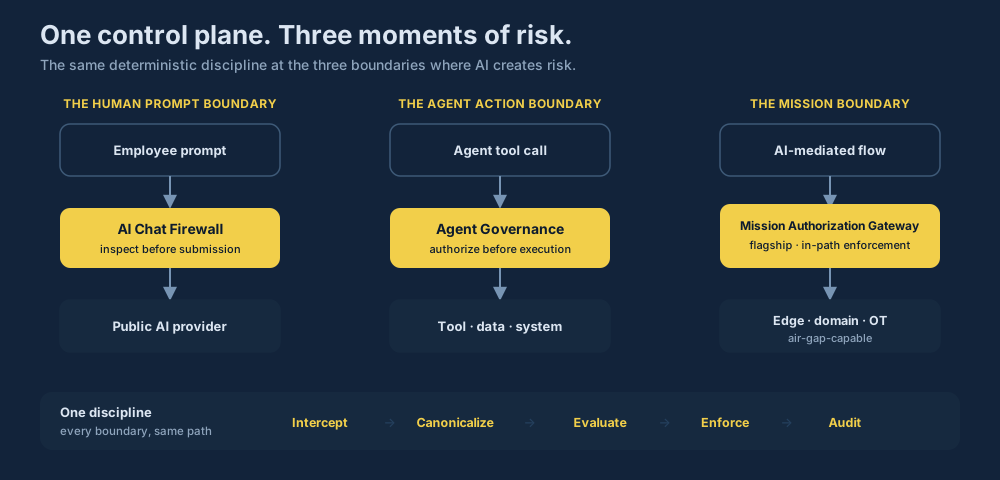
But as AI agents take on higher-stakes roles — in defense, in operational technology, in autonomous systems — the governance requirement shifts. You need a layer that:
- Intercepts every agent action at the boundary — before execution, not after.
- Evaluates it against a deterministic policy — no probabilistic self-assessment by the model, no soft guardrails that the agent can reason its way past.
- Issues a signed, auditable decision receipt — PERMIT or DENY, with the policy clause cited, before the action proceeds.
- Is architecturally non-bypassable — not a wrapper the agent can route around, but a chokepoint in the call path.
That's the Mission Authorization Gateway pattern. It's not a monitoring product bolted onto an agent framework. It's an enforcement layer built into the data flow.
Why the Timing of This Launch Is Significant
Drata is a well-resourced company with strong enterprise distribution. Their entry into AI agent governance — timed explicitly to EU AI Act enforcement — signals that the category is real and that procurement conversations are happening now.
It also signals that the first wave of AI agent governance products will look like compliance automation: discover, inventory, trace. That's the tool the compliance team buys.
The tool the security team buys — and the one a defense program manager must buy for any AI agent operating near sensitive data — is the enforcement layer. These are complementary products, not substitutes. But enterprises evaluating governance tooling should understand the difference before assuming one covers the other.
The Defense Buyer's Checklist
If you're evaluating AI agent governance for a defense or critical-infrastructure environment, the right questions to ask any vendor are:
- Does this product intercept and evaluate agent actions before execution, or does it log them after?
- Is the policy enforcement deterministic — rules-based, auditor-verifiable — or does it rely on a model to assess its own behavior?
- Does the enforcement point produce a signed decision receipt that an auditor or mission commander can verify?
- Is the enforcement layer architecturally non-bypassable — or can an agent be configured to skip it?
A traceability product answers none of these questions. An enforcement gateway does.
Drata's launch is a useful signal that the AI agent governance category is maturing. It's also a useful reminder of what the category's first products don't yet cover.
Containment.AI's Mission Authorization Gateway is an enforcement layer for AI agents in defense and critical-infrastructure environments. It intercepts, evaluates, and issues signed decision receipts on every agent action — before execution. Learn more at containment.ai/platform.