The order: AI-first, at the edge, on a 30-day clock
On January 9, 2026, the Secretary of War issued the "Artificial Intelligence Strategy for the Department of War," directing the Pentagon to become an "AI-first" warfighting force "across all components, from front to back" (Department of War, January 9, 2026). It is not a research agenda. It is an execution order with dates.
Three of those dates matter for anyone building or securing defense AI:
- The edge is now in scope for compute. The memo directs the Department to "invest substantial resources in the expansion of our access to AI compute infrastructure, from datacenters to the edge."
- Agents are the deliverable. Two of the seven "Pace-Setting Projects" are explicitly agentic: Agent Network, for "AI-enabled battle management and decision support, from campaign planning to kill chain execution," and Enterprise Agents, a "playbook for rapid and secure AI agent development and deployment."
- Models refresh every 30 days. Under "AI Model Parity," the memo directs the CDAO to "establish a delivery and integration cadence with AI vendors that enables the latest models to be deployed within 30 days of public release," and makes that cadence "a primary procurement criterion for future model acquisition."
And the clock is already running. The Pace-Setting Projects were ordered to show "initial demonstration by transition-partner user(s) ... within six months from the date of this memorandum" — that window closes this month, July 2026. Every military department, combatant command, and defense agency was told to name "at least three projects" to fast-follow within 30 days.
The line most people will skip
Buried in the "Speed Wins" section is the sentence that should reorganize every defense-AI vendor's security roadmap: "We must accept that the risks of not moving fast enough outweigh the risks of imperfect alignment."
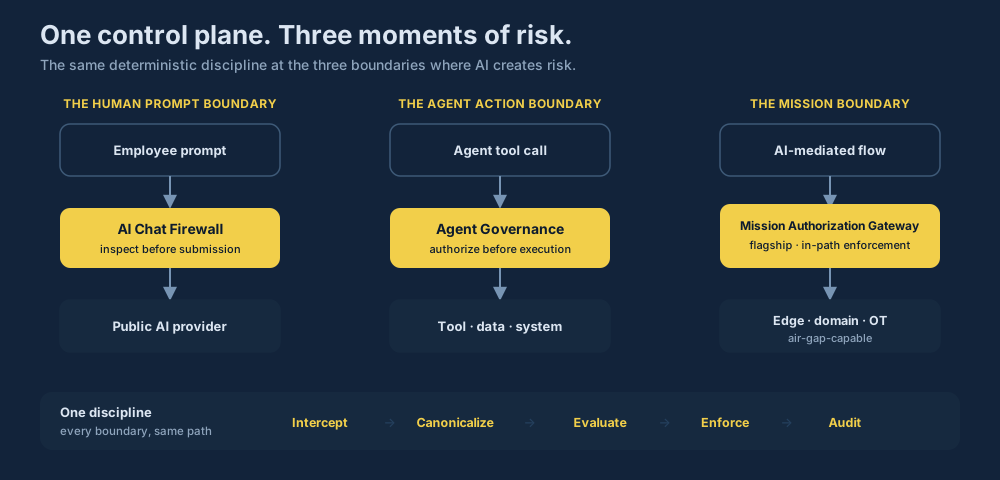
Read plainly, that is a decision to accept model-level uncertainty in exchange for speed. It is a defensible wartime posture — but it has a direct consequence. If you are not going to slow the model down, you are going to swap it every 30 days, and you are going to run it at the edge where a cloud policy service cannot reach it, then the one thing you cannot also make probabilistic is the enforcement boundary. The faster and less predictable the model, the more the governance layer has to be the deterministic part of the system.
Why cloud-era governance breaks against this memo
Most AI governance in production today assumes three things this strategy removes:
- Connectivity. SaaS policy engines phone home. The memo pushes compute "to the edge" — into disconnected, degraded "DDIL" environments where the home never answers.
- A stable model. Governance tuned to one model's quirks becomes technical debt the moment the CDAO's 30-day cadence swaps it. The boundary has to be model-agnostic by construction.
- Audit-after-the-fact. The memo's data-access provisions — federated catalogs "exposing their system interfaces, data assets, and access mechanisms across all classification levels," plus CDAO authority to "direct release of any DoW data to cleared users" — widen the blast radius of a wrong data-crossing. A log that records an exfiltration is evidence of a breach, not prevention of one.
Meanwhile, the civilian frameworks are still catching up. NIST notes that "the AI RMF 1.0 is being revised," and on April 7, 2026 released only a concept note for an "AI RMF Profile on Trustworthy AI in Critical Infrastructure" (NIST). Voluntary guidance moving at concept-note speed is not the thing that will govern a model deployed 30 days after its public release, at the edge, inside a decision-support workflow.
What the boundary has to be instead
If the model is fast, swappable, and forward-deployed, the enforcement layer has to hold five properties the memo's own tempo demands:
- Deterministic — no AI model makes the enforcement decision; the same input, policy, and context produce the same ruling.
- Fail-closed — lost connectivity or ambiguous input resolves to deny, not allow.
- Local / air-gap-capable — the decision path runs where the mission runs, with no dependency on a reachable cloud.
- Model-agnostic — it governs the data and actions crossing the boundary, not the internals of whichever model is loaded this month.
- Verifiable — every ruling emits a signed, tamper-evident record a contracting officer or assessor can replay.
This is the design center of Containment.AI's Mission Authorization Gateway. To be precise about status — because a defense buyer should demand precision — the Gateway is a staging build today. Its deterministic edge action authorization, output conformance, and Ed25519-signed, hash-chained decision receipts are implemented on staging; formal verification of the parsing path is in progress; the physical data-diode driver is pending a vendor SDK; and FedRAMP/ATO pathways are on the roadmap, not shipped. It is designed against NSA cross-domain standards and built for DDIL — designed, not certified, and we publish the milestone status so your diligence team can hold us to it.
For the connected enterprise around that boundary — the thousands of engineers on program networks — the browser and proxy tier enforces AI-use policy at the point of use, and scoped, paid design-partner pilots are available now.
The takeaway for primes and defense-tech vendors
The Department of War has told the entire defense base that AI is coming to the edge — fast, and agentic — and that the acceptable trade is speed over perfect model alignment. If you are a prime fast-following the Pace-Setting Projects, or a defense-tech company whose autonomy stack is the model being deployed, the question your program office will ask is not "which model did you use." It will be: "show me the boundary that governed what it touched — and prove it held when the link went down."
That boundary cannot be another model. It has to be deterministic, local, and verifiable. Build it before this month's demonstration turns into next quarter's deployment.
Primary source: the Artificial Intelligence Strategy for the Department of War, dated January 9, 2026. If your program is standing up edge or agentic AI and needs a deterministic governance boundary — not just an audit trail — see the Mission Authorization Gateway or request a 30-minute boundary review.