On July 7, 2026, Anthropic launched Claude Code and Claude Cowork in public beta inside Claude for Government Desktop — "delivered through a FedRAMP High authorized environment," per the announcement. Security teams also get tamper-evident audit logs and documentation supporting the agency ATO process.
This is a real capability. It's not the capability your ISSO thinks it is.
What FedRAMP High Actually Authorizes
FedRAMP High authorizes the infrastructure — the cloud environment where the service runs. For AI tools, that means: the compute, storage, network, identity, and logging substrate is assessed against NIST SP 800-53 High baseline controls. The authorization boundary covers what Anthropic operates.
It does not cover what happens inside a session.
When a DoD prime employee opens Claude for Government Desktop and types a prompt — whether that prompt contains CUI, PII, controlled technical data, or export-controlled information — FedRAMP's authorization boundary doesn't catch it. FedRAMP doesn't know what your users typed. It doesn't know if the response exfiltrated sensitive context. It doesn't generate the audit evidence your CMMC assessor will demand when they ask for proof that CUI didn't exit your approved boundary through an AI session.
The Gap Between Authorization and Governance
This confusion between infrastructure authorization and data governance is exactly the gap NDAA FY2026 Section 1513 was designed to close. That provision directs DoD to build an AI security framework into CMMC and DFARS specifically because FedRAMP authorization of AI cloud services doesn't address what defense contractors need: session-level policy enforcement, CUI boundary control, and audit-ready evidence.
FedRAMP says: this cloud service meets federal security standards for infrastructure.
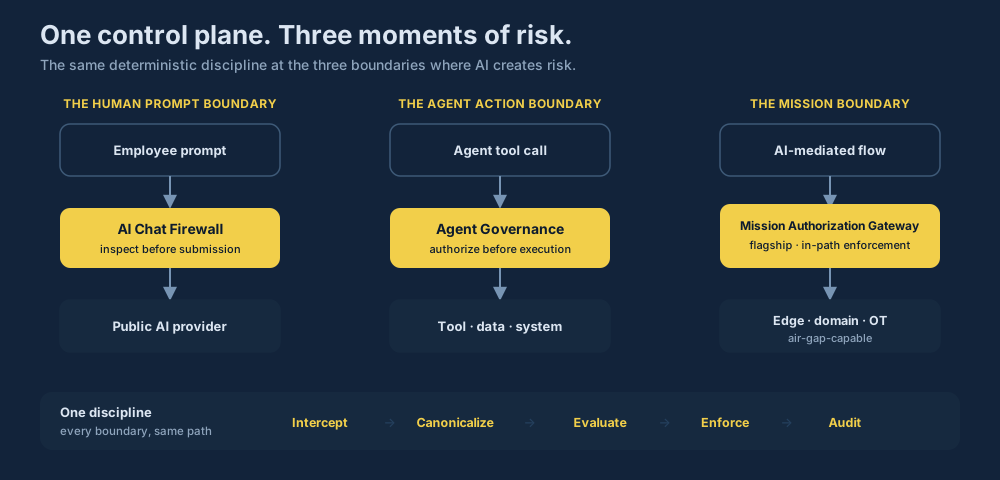
CMMC will ask: show me your policy enforcement layer — the thing that sat between your employee and the model and stopped CUI from crossing the boundary, and generated a signed, tamper-evident log when it did.
Those are two different questions. FedRAMP answers the first. No authorization answers the second — you have to build it.
What DoD Primes Actually Need
For defense contractors operating under CMMC Level 2 or heading toward Level 3, the Anthropic announcement creates urgency, not relief. FedRAMP High is now table stakes — it means the infrastructure passed the bar. The governance layer on top is what determines whether your CMMC boundary holds when an employee asks Claude to help them draft a proposal that references controlled program data.
The governance controls that close this gap look like:
- Real-time session monitoring — not logging after the fact, but enforcing policy at the moment the request is made
- CUI-sensitive policy rules — classifying prompt content and blocking or alerting before it leaves the boundary
- Tamper-evident audit trail — session records your CMMC C3PAO can examine that prove policy was enforced, not just configured
- Boundary enforcement across all AI surfaces — not just the approved FedRAMP-authorized platform, but every AI tool a defense employee can reach from a work device or browser
FedRAMP High tells your AO the environment is authorized. It doesn't tell your CMMC assessor your CUI boundary held.
The Timing Is Not Coincidental
The Section 1513 congressional status update was due June 16. Claude for Government Desktop launched July 7. The pattern is clear: FedRAMP-authorized AI tools are entering defense environments faster than the governance frameworks that define what "properly governed" means.
Defense contractors who treat FedRAMP High authorization as a governance checkbox are building on a false foundation. The contractors who will be ready when DoD formalizes AI governance requirements in DFARS are the ones building the session-level enforcement layer now — before the assessment clock starts.
Containment.AI enforces AI governance policies at the browser and proxy layer in real time — monitoring AI sessions, enforcing CUI-sensitive policy rules, and generating the audit evidence defense contractors need as CMMC AI requirements take shape. See the Mission Authorization Gateway