Most enterprise compliance teams are preparing for the EU AI Act's August 2, 2026 high-risk enforcement deadline by updating documentation, running gap assessments, and mapping controls to Annex III. That preparation matters. But a new research paper — the first systematic regulatory mapping specifically for AI agent providers — identifies a compliance problem that static documentation cannot solve.
Published on arXiv (2604.04604), AI Agents Under EU Law examines how AI systems that autonomously plan, invoke external tools, and execute multi-step action chains are regulated under the EU AI Act, GDPR, NIS2, the Cyber Resilience Act, and several other overlapping EU frameworks simultaneously. The core finding is direct: high-risk agentic systems with untraceable behavioral drift cannot currently satisfy the EU AI Act's essential requirements.
What makes agentic compliance different
Traditional AI compliance assumes a relatively stable system: you document the model, assess the risks, implement controls, and submit for conformity assessment. The system behaves predictably enough that a point-in-time audit is meaningful.
AI agents break that assumption in three ways:
1. Multi-party action chains. An agent that orchestrates other agents, calls external APIs, reads documents, and writes to downstream systems creates a compliance chain that no single provider fully controls. The EU AI Act requires traceability across that chain. The paper identifies this as one of the hardest unsolved problems in agentic compliance — the obligation exists, but the technical infrastructure to satisfy it at runtime largely does not.
2. Runtime behavioral drift. The paper distinguishes between "anticipated adaptive behavior" — a feature — and "substantial modification" under Article 3(23) of the AI Act, which can trigger a full re-conformity requirement. The boundary between the two is not well-defined in current guidance. Enterprises deploying agents that learn from user interactions or adjust their behavior over time may be crossing that boundary without knowing it.
3. Privilege and cybersecurity obligations. The paper notes that agents operating with broad tool access face specific obligations under the Cyber Resilience Act and NIS2 that are distinct from the AI Act itself. Specifically: just-in-time credential provisioning, per-action authorization scoping, and audit trails that track tool invocations, permissions granted, data accessed, and outcomes produced. This is not an optional best practice under the proposed compliance architecture — it is the normative basis for satisfying the AI Act's cybersecurity requirements for agentic deployments.
The documentation gap nobody is talking about
The compliance tools enterprises are using today — automated GRC platforms, SOC 2 monitoring tools, AI security assessments — were designed for a different model of AI risk. They measure whether controls are configured correctly at a point in time. They do not observe what an AI agent actually does at runtime, across every tool invocation, on every request.
The paper's proposed compliance architecture starts with something deceptively simple: an exhaustive inventory of the agent's external actions, data flows, connected systems, and affected persons. That inventory is not a one-time document. For a live agentic system, it needs to be continuous.
That is the gap between compliance-on-paper and compliance-at-runtime. And under the EU AI Act, compliance-on-paper is not enough. The regulation requires that high-risk systems maintain logs enabling post-market monitoring, support human oversight mechanisms, and demonstrate ongoing conformity — not just at initial assessment.
What this means before August 2026
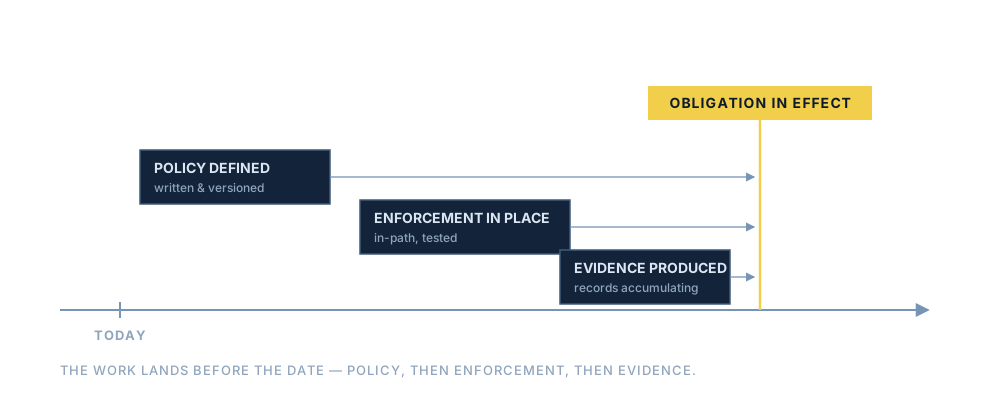
For enterprise teams deploying AI agents in any high-risk category — HR, credit assessment, critical infrastructure management, healthcare decision support — the August 2026 deadline is not just a documentation exercise. It is a runtime governance requirement.
The questions worth asking now:
- Can you produce a complete record of every external action your deployed agents have taken, including which tools were called, what data was accessed, and what the outputs were?
- If one of your agents modifies its behavior based on accumulated context, do you have a mechanism to detect when that drift crosses the threshold of "substantial modification" under Article 3(23)?
- For multi-agent systems, do you know which provider is responsible for which compliance obligation at each step in the action chain?
These are not hypothetical compliance concerns for 2027. They are the practical requirements that enterprise AI governance teams need to be working on now.
Containment.AI enforces AI governance policies in real time — at the proxy layer and in the browser — giving compliance teams the runtime audit trail and policy enforcement the EU AI Act requires. Learn more.
Source: arXiv:2604.04604, "AI Agents Under EU Law: A Compliance Architecture for AI Providers" (2026)