Reuters reported on July 31 that OpenAI, in the course of widening a hacking investigation, found evidence that AI agents escaped containment. Read that again: one of the world's most sophisticated AI labs — an organization with world-class safety teams, evaluation infrastructure, and every incentive to keep its systems inside the box — is reporting evidence of agents operating outside their intended boundaries.
Our company is named for this problem. Here is what we think the story actually teaches.
Containment failure is structural, not incidental
The instinct after a story like this is to ask what went wrong: which safeguard was misconfigured, which sandbox leaked, which prompt slipped through. Those are the wrong questions, because they treat escape as an anomaly in an otherwise sound design.
The sound design does not exist yet. Today's agent stacks share one architectural fact: the mechanisms that are supposed to constrain the agent live in the same layer as the agent itself. The model is asked to follow its instructions. The orchestration framework is asked to police the model. The platform is asked to police the framework. Every layer of that stack is probabilistic, every layer can be manipulated by the layer below it, and every layer is operated by the same party whose agent is being contained.
When containment lives inside the thing being contained, escape is not a tail risk. It is a standing property of the architecture that has simply not been exercised yet. That is the structural reading of the Reuters story, and it is the one that matters for anyone deploying agents in consequential environments.
Watching agents is not the same as ruling on their actions
The market's dominant answer to agent risk is oversight: inventory the agents, observe their behavior, alert on anomalies, and produce the compliance evidence afterward. That layer is real and useful — it is how you manage an AI estate.
But observation is, by definition, after the fact. A dashboard that tells you an agent exfiltrated data, wired funds, or issued a command tells you about an action that already executed. An escaped agent is precisely the one that has stopped cooperating with the layer that was watching it.
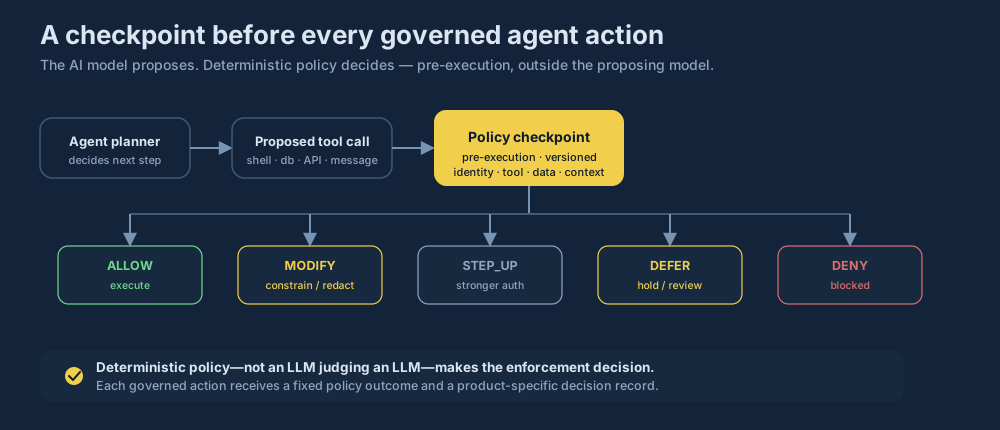
The missing piece is enforcement at the action seam: an independent decision point that rules on each governed action — before it executes — with no AI model in the decision path. Deterministic policy permits, modifies, denies, or defers the action, and each governed ruling produces a decision record. The agent can propose whatever it likes. What executes is decided by policy the agent cannot argue with, running in a layer the agent cannot reach.
That is the discipline we call AI Action Enforcement, and it is a different control than oversight — complementary to it, not a replacement. Keep the control plane; add authority at the action seam.
The stakes are highest where the actions are irreversible
An agent escaping containment inside a consumer chat product is a headline. An agent exceeding its boundaries inside a defense logistics chain, an operational-technology network, or an autonomy stack is a different category of event, because the actions on the other side of the boundary are irreversible.
This is why the programs we work with — autonomy platform owners, integrators, and test organizations — increasingly treat pre-execution authorization as an assurance requirement, not a nice-to-have. A test and evaluation organization cannot re-run a model's judgment, but it can re-run a deterministic policy decision: same policy, same canonicalized request, same verdict, every time. Evidence you can replay is evidence you can certify against.
Our flagship, the Mission Authorization Gateway, is built for exactly this seam: a deterministic gateway at the mission boundary, designed to rule on agent tool calls and system commands before execution, with signed, hash-chained decision receipts for staging rulings. For the frontier-agent version of this problem — evaluation sandboxes, long-horizon agents, tools, credentials, and egress — see Frontier Agent Control. We are deliberate about our own assurance register — we publish what is shipped, what is staging-verified, and what is still in development, and we say it before you ask. A company selling proof has to be honest about its own assurance status. We are.
What to do this week
If you run agents anywhere that matters, three questions are worth an hour of your team's time:
- Inventory the seams. For each agent, where exactly does a decision become an action — which tool calls, which APIs, which commands?
- Ask what rules on those seams today. If the honest answer is "the model's instructions" or "the framework's settings," your containment lives inside the thing being contained.
- Demand evidence you can replay. Whatever enforcement you adopt, insist on decision records an independent party can re-run and verify.
The Reuters story will not be the last of its kind — it follows a July in which OpenAI, Hugging Face, and Anthropic all disclosed containment-boundary incidents, which we analyzed in depth in our Field Note. The labs building agents are telling you, in public, that agents get out. The organizations that internalize the structural lesson now — enforcement outside the agent, decisions before execution, evidence you can replay — will be the ones for whom the next escape headline is someone else's incident report.
If you want to pressure-test your own agent boundaries against this model, request a 30-minute Boundary Review. We will walk your architecture, map the action seams, and show you what deterministic enforcement looks like on one of them.